The Navy's Robot Tanker: What the MQ-25A Stingray Does, and When It Goes to Sea
It flies itself, carries no pilot and drops no bombs. Its job is to hand fuel to fighter jets far out over the ocean. What the Stingray is for, what it has already done, and why it will not be on a carrier until 2029.
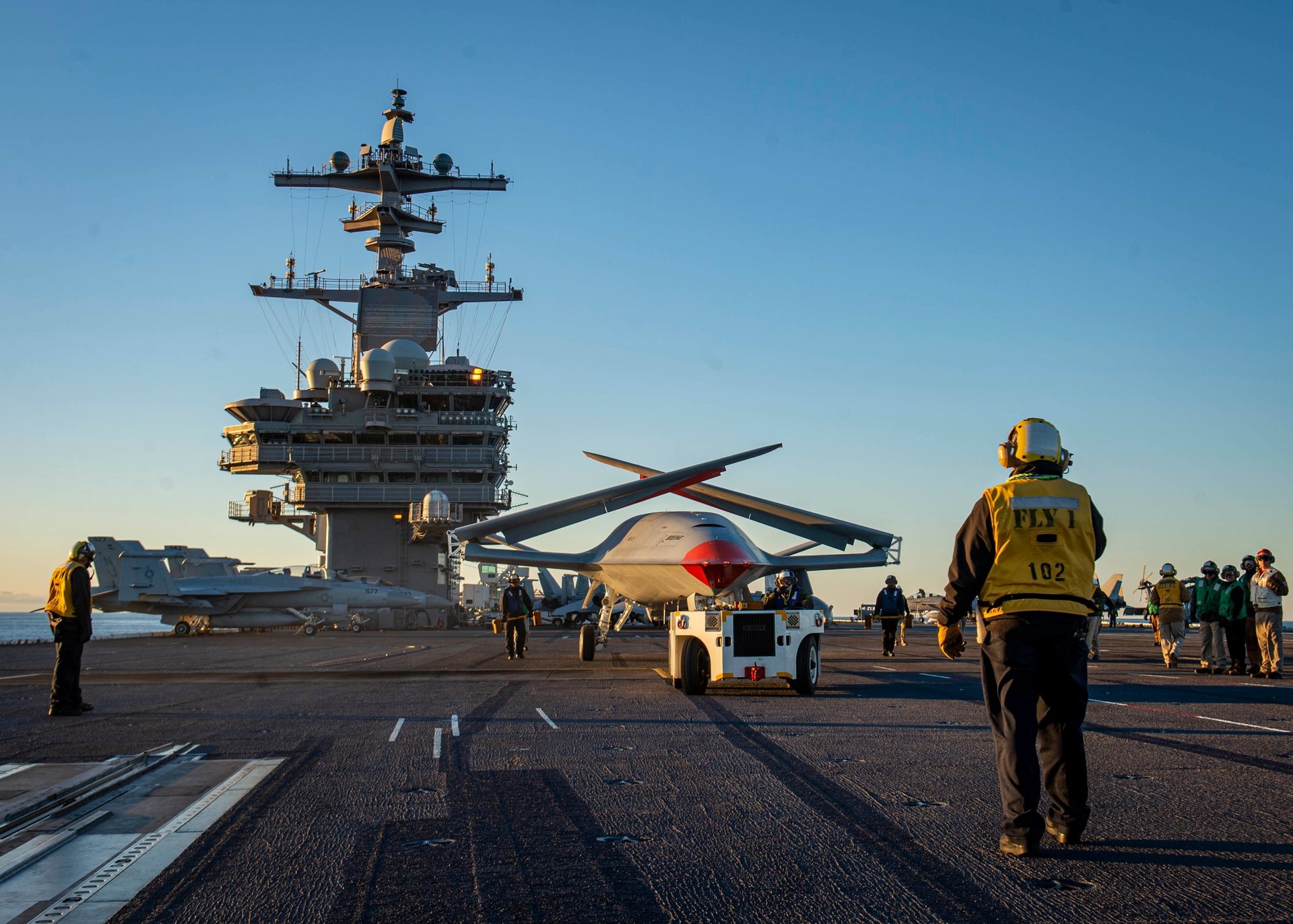
By SpaceDew · Photo: U.S. Navy photo by Mass Communication Specialist 3rd Class Brandon Roberson (December 13, 2021)
Published October 30, 2026. Facts as of October 28, 2026. Some details may have changed since.
On Saturday, April 25, 2026, an aircraft with no cockpit rolled down the runway at MidAmerica Airport in Mascoutah, Illinois, took off, flew for about two hours, and landed. Nobody was on board, and nobody was steering it with a stick. It taxied, took off, flew and landed by itself, answering commands from the ground.
It was the first flight of the first MQ-25A Stingray built for the U.S. Navy, which calls it its first operational carrier-based unmanned aircraft. It is a drone, but not the kind most people picture. The Stingray is not built to drop bombs. It is built to carry fuel.
Why an aircraft carrier needs a flying gas station
A fighter jet launched from a carrier can only fly so far before it has to come back for fuel. Refuel it in the air and it can fly farther and stay up longer. The Navy has done that for years, but with its own fighters. A Super Hornet carries extra fuel tanks and a hose, flies up beside another jet, and passes fuel across. It is called buddy tanking.
The cost is that those Super Hornets are not doing the job they were built for. Reporting on the Navy since 2016 has put tanking at roughly 20 to 30 percent of Super Hornet flying, counted in some accounts as sorties and in others as flight hours. Army Recognition repeated the figure this week: "about 20 to 30 percent of Super Hornet sorties."
The Stingray is meant to take that work off their hands. In Boeing's words, it "allows manned fighters currently performing the aerial refueling role to focus on their primary role of strike fighting." The Navy's design goal, as its officials have described it since 2017, is about 15,000 pounds of fuel handed out to other aircraft 500 nautical miles from the carrier. U.S. Naval Institute News summed it up in a 2017 headline: the tanker "Could Almost Double Strike Range of U.S. Carrier Air Wing."
A longer reach means the carrier can launch its jets from farther out at sea. The acting Secretary of the Navy, Hung Cao, put it simply this month: the Stingray's refueling capabilities "enable F/A-18 Super Hornets to fly farther and longer."
Flown with a button, not a stick
The Stingray is "designed to taxi, take off, fly and land autonomously at the push of a button," according to Boeing. People still run it. Its operators are called Air Vehicle Pilots, and on a carrier they work from a room built for the job, the Unmanned Air Warfare Center, using a ground control station called the MD-5C. Boeing says the aircraft can also be directed by the pilots of manned aircraft to do tasks such as refueling.
Two carriers have that room now. The first went into USS Theodore Roosevelt, and in August the Navy finished the second, on USS Ronald Reagan, its unmanned carrier aviation program office announced on September 30.
Then, on October 19, the Reagan tried it out. Sailing in the Pacific, the ship's Unmanned Air Warfare Center connected to an MQ-25A test aircraft parked at Boeing's plant in Illinois, more than 2,100 miles away, and controlled it over a network of low Earth orbit satellites. It was a test of the link, not a flight. Capt. Daniel Fucito, who runs the program, called it "the first-ever underway connection" between a carrier's control center and an MQ-25A.
What it has already done
The Stingray has been coming for a while. A test aircraft Boeing built and owns, called T1, first flew on September 19, 2019. On June 7, 2021, it became the first unmanned aircraft ever to refuel another aircraft, passing fuel to a Super Hornet. That August it refueled an E-2D Hawkeye, and in September an F-35C. In December 2021 it went to sea for the first time, aboard USS George H.W. Bush in the Atlantic, where sailors directed it around the flight deck in the program's first demonstration on a carrier. That is the picture at the top of this story.
The Navy's own aircraft came later. Boeing won the contract for the first four in August 2018, for $805 million. The first was moved to Boeing's new 300,000-square-foot plant at MidAmerica St. Louis Airport in March 2025 for final assembly. It completed a taxi test on January 29, 2026, and flew on April 25. On May 19 the Navy said the program had been approved to start low-rate initial production.
Still not at sea
For all of that, the Stingray will not be working from a carrier for a few more years. It was first due to be ready in 2024. That slipped to 2026, then 2027. Navy budget documents now give February 2029, Defense One reported in April: "The latest projection for MQ-25 IOC is February 2029." IOC means initial operational capability, the point at which the Navy says it is ready for real use. Defense One found no reason given for the latest slip, and the Navy did not immediately comment. Earlier Pentagon reports had pointed to COVID-19's effect on Boeing's suppliers, design problems and quality issues.
The Navy plans to buy 76 Stingrays in all, nine of them for testing. For the 2027 budget year it asked for $771 million to buy three.
More than a tanker
Fuel is the job, but not the only one. Boeing says the Stingray is also equipped for intelligence, surveillance and reconnaissance, watching the sea for the carrier. In April 2024, images of a model showed it carrying anti-ship missiles under its wings. For now, the job the Navy is buying it for is fuel.
By the numbers, from Boeing: 51 feet long, wings 75 feet across that fold to 31.3 feet for a crowded deck, and one Rolls-Royce AE 3007N engine.
The next steps are more flying in Illinois to widen what the aircraft is cleared to do, and then carrier qualification, the tests that prove it can launch from and land on a ship, at Naval Air Station Patuxent River in Maryland.
Sources
- Boeing, MQ-25 Stingray (mission, autonomy, specifications, and the program timeline from 2018 to January 2026), read October 28, 2026
- Defense One (Thomas Novelly), Navy's drone refueler notches first flight, but it won't be on aircraft carriers until 2029, April 28, 2026
- U.S. Navy, MQ-25A Stingray achieves successful first flight, advancing future of naval aviation, April 27, 2026
- Unmanned Carrier Aviation program office (PMA-268), via DVIDS, Second U.S. carrier ready to fly MQ-25A, September 30, 2026
- Naval News, US Navy carrier remote-controls MQ-25A Stingray over 2,100 miles away, October 20, 2026, from a U.S. Navy release
- Army Recognition (Alain Servaes), Two U.S. Navy aircraft carriers now ready to operate new MQ-25A tanker drones, October 28, 2026
- U.S. Naval Institute News (Sam LaGrone), MQ-25 Stingray Unmanned Aerial Tanker Could Almost Double Strike Range of U.S. Carrier Air Wing, August 31, 2017 (the 15,000 pounds at 500 nautical miles goal, as cited by Wikipedia)
- U.S. Naval Institute News, CNO: Navy Should Quickly Field CBARS To Ease Tanking Burden on Super Hornets, February 12, 2016 (the 20 to 30 percent)
- Wikipedia, Boeing MQ-25 Stingray (the fuel goal, the tanking share, and the April 2024 model with anti-ship missiles, each with its own sources)
- Photo: U.S. Navy, Mass Communication Specialist 3rd Class Brandon Roberson, GHWB Operates the MQ-25 Aircraft, December 13, 2021, public domain. The photographs of the April 2026 flight are Boeing's and are not used here.
Get the Morning Dew
The daily brief, live quotes and the newest stories, every morning. Plus a Friday recap of the week. Nothing else, ever.