Starship Flight 14, the Day the Biggest Rocket Ever Built Reached Orbit
Thirteen flights went up and came back down. On September 28, 2026, the fourteenth went around. What happened, why reaching orbit is different from going high, and what still has to come next.
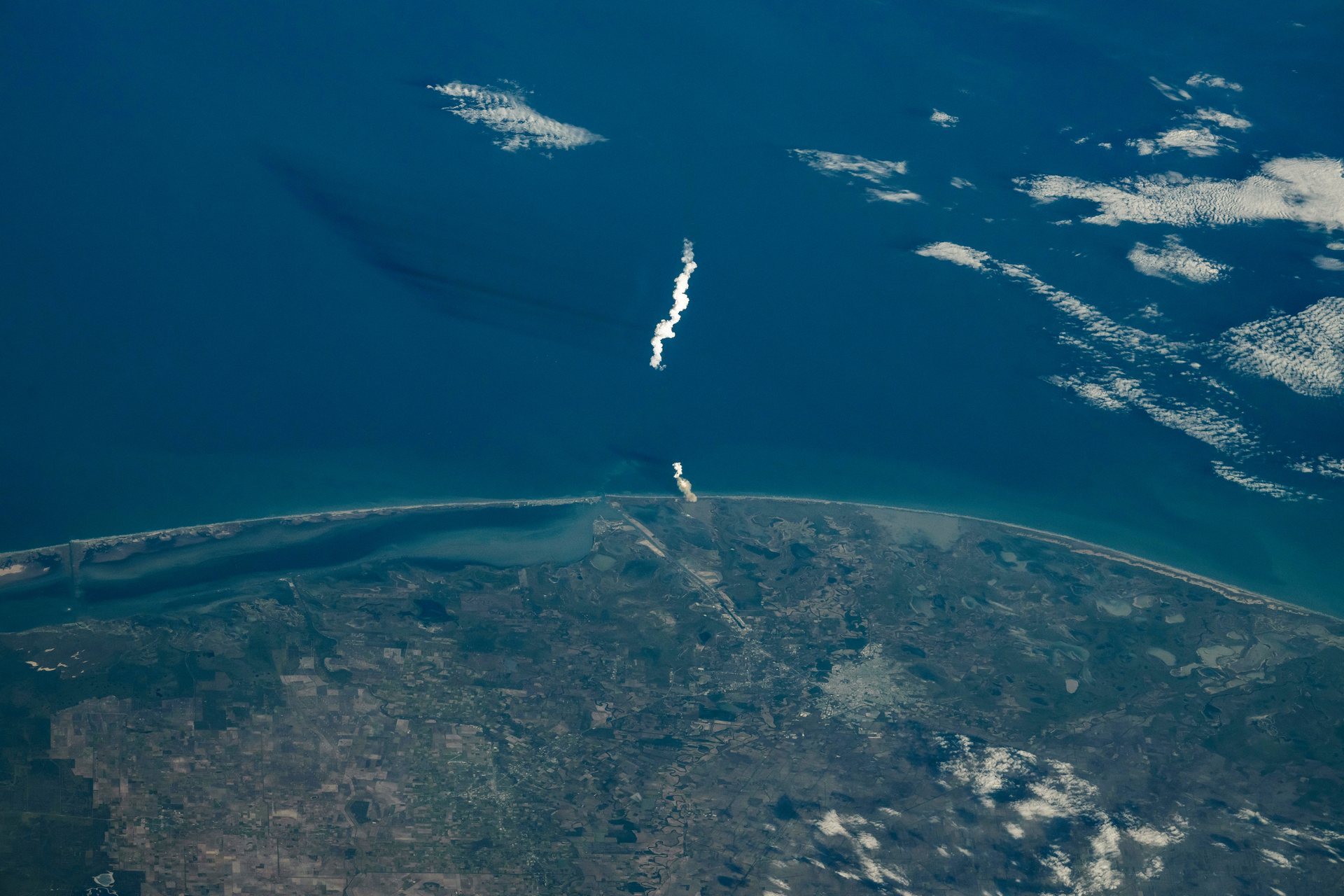
By SpaceDew · Photo: NASA, Don Pettit (Flight 6, November 19, 2024)
Published October 9, 2026. Facts as of October 5, 2026. Some details may have changed since.
At 8:49 a.m. Eastern on Monday, September 28, 2026, SpaceX launched its fourteenth Starship from Starbase, Texas. The Associated Press calls it the biggest and most powerful rocket ever built. About 25 minutes later, a single engine on the ship fired for less than 20 seconds, and mission control made the call: "Starship is orbital."
It was the first time. Every one of the thirteen Starship flights before it had been suborbital: up into space and back down, without ever going all the way around the Earth. Flight 14 went around. And it carried something with it: 26 working Starlink satellites, which as of October 5 were still circling the planet.
Going high is not the same as going around
This is the part that makes Flight 14 special, so it is worth a minute.
Getting into space is hard, but it is not the same as orbit. Orbit is about speed, not height. Anything you throw falls back to the ground. Throw it fast enough sideways, and the ground curves away beneath it as fast as it falls. It is still falling, but it never lands. At Starship's height, that takes about 17,500 miles per hour, according to the Associated Press.
The earlier Starships went to space on purpose without quite reaching that speed. Their paths were shaped to come back down over the ocean on their own. On Flight 13, in July, the ship flew "intentionally falling short of orbit."
Flight 14 was built to do the last step. The ship's main burn put it on a path like the earlier flights, and then, as Spaceflight Now's William Harwood described it, "a second engine firing using a single Raptor engine completed the climb to orbit."
The tracking data agrees. The space object catalog kept by CelesTrak lists the ship as STARSHIP-14, in an orbit from 267 to 276 kilometers up, going around the Earth once every 90 minutes, inclined about 30.5 degrees to the equator. By the timeline published for the flight, it completed a little more than one full lap in orbit before firing again to come home.
The morning of the flight
The rocket was the newest version of Starship, called Block 3 or V3: Super Heavy Booster 21 under Ship 41, launching from Starbase's Pad 2. It was the third flight of that version.
The plan was ambitious: an orbit about 275 kilometers up, about six trips around the Earth over roughly ten hours, 26 Starlink satellites released along the way, and a splashdown in the Pacific off Chile.
It did not go exactly to plan, and the way it went says a lot about how SpaceX tests.
During the climb, one of the ship's six Raptor engines shut down early. Reports describe it as one of the three vacuum engines, the ones built to work in space. For a while it looked like there would be no orbit at all. SpaceX's Dan Huot told viewers the team had "made the call not to commit to orbit." Then the call reversed: "We are go for orbit." The single-engine burn put Starship into orbit.
26 satellites
About half an hour into the flight, Starship began releasing Starlink V3 satellites, the next generation of SpaceX's internet satellites, using a dispenser the company calls the "Pez." Over about 30 minutes, all 26 went out. Harwood reported each has 10 times the capacity of the previous generation.
Three of them carried cameras pointed back at Ship 41, to photograph its heat shield from outside before it faced reentry.
Elon Musk posted afterward: "First orbital flight of Starship successful!" and "All 26 Starlink V3 operational satellites deployed and operating nominally."
Starships had released satellites before, most recently 20 Starlink V3s on Flight 13, but on suborbital paths. Flight 14 was the first time Starship put working satellites into orbit.
Cutting it short
With an engine out, SpaceX ended the mission early, after about three hours instead of ten. The Associated Press reported the company did so "out of an abundance of caution." Musk explained why caution matters for a vehicle this size: if debris rained down on people, "our popularity would diminish very rapidly."
About two hours and twelve minutes after launch, Ship 41 fired its engines to drop out of orbit. It fell back into the atmosphere belly first, steering with its fins and flaps. Near the ocean, three Raptors relit, the ship flipped upright, and it settled tail first into the Pacific north of Hawaii at 11:57 a.m. Eastern, about three hours and eight minutes after liftoff. Then it tipped onto its side and exploded as leftover propellant ignited.
The booster had its own trouble. Booster 21 lost one engine during the climb and appeared to lose a second during its turn back toward Texas. It made what Spaceflight Now called a "seemingly normal vertical splashdown" a few miles off the coast in the Gulf, about seven minutes after liftoff. No catch by the launch tower was planned this time. Payload called the booster's engines failing to relight for the return "a recurring issue."
How Flight 14 fits the story so far
Starship's test flights have built on each other, one first at a time:
- Flight 1, April 2023: the first time the whole stack flew.
- Flight 2, November 2023: the first time the booster and ship separated in flight.
- Flight 4, June 2024: the first controlled splashdown of the ship.
- Flight 5, October 2024: the launch tower caught the returning booster in its arms.
- Flight 9, May 2025: the first flight of a reused booster.
- Flight 10, August 2025: the first satellites released (test dummies) and an engine relit in space.
- Flight 12, May 2026: the first Block 3 rocket and the first launch from the second pad.
- Flight 13, July 2026: 20 real Starlink satellites released on a suborbital path.
- Flight 14, September 2026: orbit, and 26 satellites left in it.
Along the way, Wikipedia's record of the flights counts Flights 1, 2 and 7 through 9 as failures, the boosters of Flights 12 and 13 were lost, and the Federal Aviation Administration required a mishap investigation after Flight 12. Testing in the open means failing in the open.
Why it matters
The Moon. NASA is counting on Starship to land astronauts on the Moon. Its plans have shifted: Artemis III is now planned as a crewed test in Earth orbit, with Orion docking with lander test vehicles from SpaceX and Blue Origin, and the first crewed landing moved to Artemis IV, which the AP reported is planned for no sooner than 2028. NASA's Administrator, Jared Isaacman, congratulated SpaceX on "getting Ship to orbit and managing every step in a safe, responsible, and especially inspirational way."
Refueling. A Starship that goes to the Moon has to be filled up in orbit first, by other Starships carrying propellant up to it. Harwood reported a lunar landing could take "15 or so" tanker flights. Moving propellant between two ships in orbit has not been done yet. You cannot refuel in orbit until you can get to orbit, which is why Flight 14 matters for everything after it.
The road to Mars. On SpaceDew's Dew Point ladder, the milestone for this stage is a fully reusable super-heavy rocket that completes an orbital mission and recovers both stages. Flight 14 did the first half. Neither stage came home in one piece this time, so the rung stays in progress. The next one on the ladder is the same one NASA is waiting for: propellant transferred between two vehicles in orbit.
What comes next
As of September 30, Fox Weather reported Flight 15 was targeted for no earlier than October 19, and that it may try something never done before: catching the returning ship, not just the booster, with the launch tower. Musk put the odds of a catch at "at least 50% to 60%." Musk has also claimed Starship is two to three years from flying every hour.
Claims like that are worth holding loosely. What is not a claim is that on September 28, 2026, the biggest rocket ever built went all the way around the Earth for the first time.
Flight 14 at a glance
- Launched: September 28, 2026, 8:49 a.m. Eastern (7:48 a.m. Central), Starbase, Texas, Pad 2
- Vehicles: Super Heavy Booster 21 and Ship 41, Block 3
- Orbit: 267 by 276 kilometers, inclined 30.5 degrees, about 90 minutes a lap (CelesTrak)
- Payload: 26 Starlink V3 satellites, all deployed
- Duration: about 3 hours 8 minutes, cut short from a planned 10 after an engine shut down early
- Ship: controlled splashdown north of Hawaii, then exploded after tipping over
- Booster: vertical splashdown in the Gulf; no catch was planned
- First: Starship's first orbital flight, after 13 suborbital ones
Sources
- Spaceflight Now (William Harwood), Starship returns to Earth; rocket splashes down north of Hawaii after three-hour flight, September 28, 2026
- CBS News (William Harwood), SpaceX launches Starship on giant rocket's first flight to orbit, September 28, 2026
- Associated Press (Marcia Dunn), via NBC News and WSB-TV, September 28, 2026
- Reuters (Joey Roulette and Steve Nesius), via ThePrint, September 28, 2026
- Astronomy (Brooks Mendenhall), Starship reaches orbit on 14th test flight, September 30, 2026
- Payload, Starship reaches orbit on 14th test flight, September 28, 2026
- 24/7 Wall St., Musk: "First orbital flight successful", September 29, 2026 (Musk's posts as quoted there)
- Aviation Week (Irene Klotz), FAA clears SpaceX for Starship 14 flight, September 27, 2026
- Fox Weather, After milestone flight, SpaceX targets next Starship launch, September 30, 2026
- CelesTrak, satellite catalog for launch 2026-225 (Starship 14 and the 26 Starlinks), read October 5, 2026
- Wikipedia, Starship flight 14 (flight timeline) and SpaceX Starship flight tests (Flights 1 to 13)
- Wikipedia, Starship flight test 13
- Spaceflight Now, FAA requires SpaceX-led mishap investigation, May 27, 2026
- NASA, NASA outlines preliminary Artemis III mission plans, May 13, 2026
- Photo: NASA, Don Pettit, iss072e220043, Starship's sixth flight test seen from the International Space Station, November 19, 2024. No freely licensed photograph of Flight 14 itself was available.
Follow SpaceX on SpaceDew
Get the Morning Dew
The daily brief, live quotes and the newest stories, every morning. Plus a Friday recap of the week. Nothing else, ever.