Harry Reid asked the Pentagon to lock this program away. Its own files say why it didn't.
Today's release of government UFO records includes the Defense Intelligence Agency's own paperwork on AAWSAP, the advanced aerospace study Reid funded. In 2009 the agency praised the work, then found nothing in it secret enough to hide.
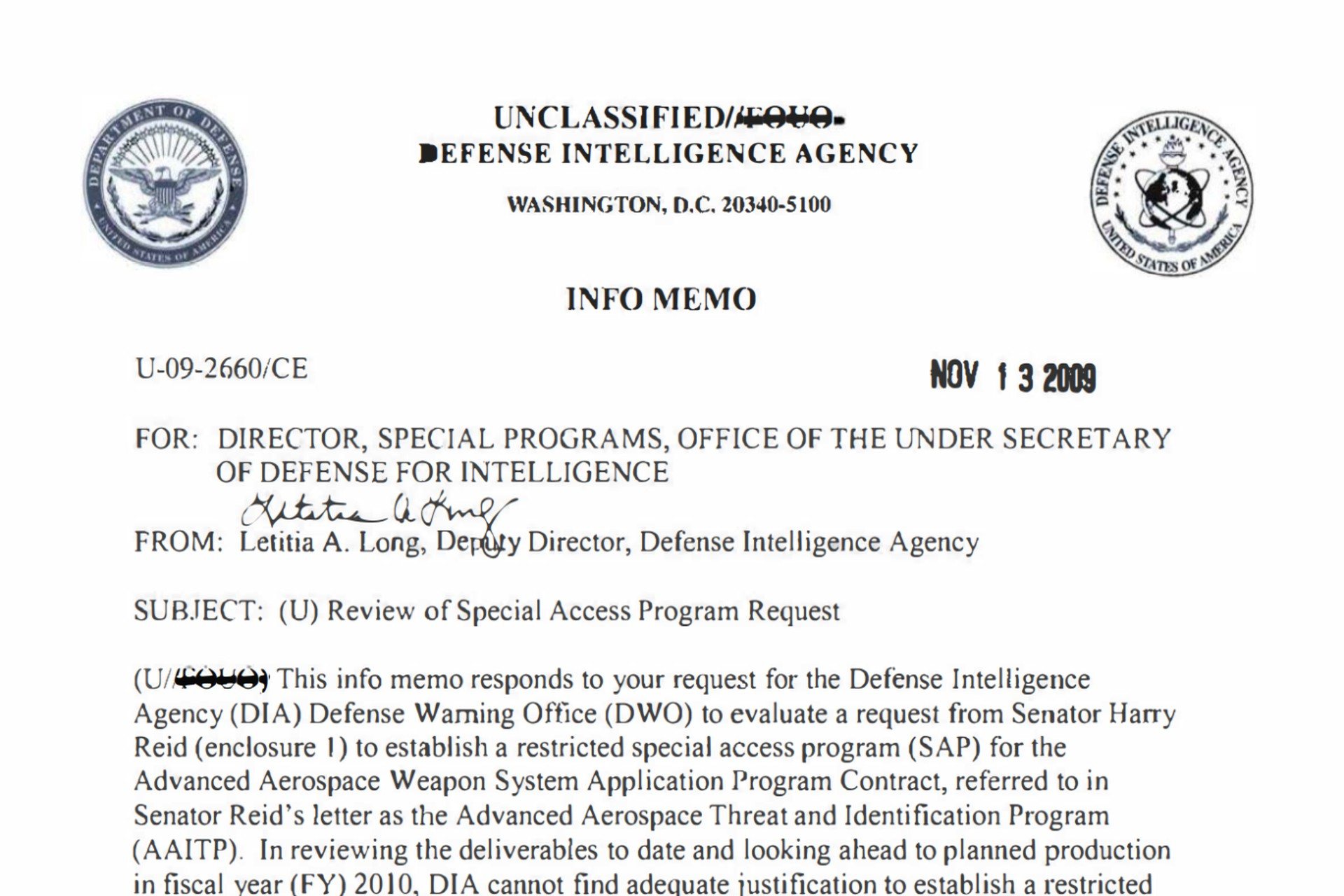
By Boggle Riley · Photo: Defense Intelligence Agency memo, released by the Department of War on November 20, 2026 (DOW-UAP-D185), public domain
Published November 20, 2026. Facts as of that day. Some details may have changed since.
On June 24, 2009, the Senate Majority Leader, Harry Reid of Nevada, wrote to the second-ranking official at the Pentagon, Deputy Secretary of Defense William Lynn. He asked for something rare: a restricted special access program (SAP), a level of secrecy above ordinary classified work, with a short list of named people allowed to know about it.
The program he wanted locked away was a contract the Defense Intelligence Agency (DIA) ran to study far-future aerospace threats. Its official name was the Advanced Aerospace Weapon System Applications Program, or AAWSAP. Reid's letter called it the Advanced Aerospace Threat and Identification Program.
Five months later, the agency said no.
That exchange, and the paperwork on either side of it, is in the eighth release of government UFO records, posted today, November 20, 2026, on PURSUE, the Department of War's site for declassified UFO records. It is the agency's own account of the program, in memos written at the time. Here is what they say, in order.
What the program was
According to a DIA memo that the release dates to December 2010, the money came from Congress. Reid and Senator Daniel Inouye of Hawaii added $10 million for it to the 2008 defense supplemental appropriation. The goal was to investigate foreign advanced aerospace weapon threats from the present out to 40 years ahead, with a specific interest in "unconventional or 'leap' aerospace vehicles."
DIA asked for proposals on August 18, 2008, in twelve technical areas: lift, propulsion, control, armament, spatial and temporal translation, signature reduction, materials, configuration, power generation, human effects, human interface and technology integration. It received one bid, from Bigelow Aerospace Advanced Space Studies (BAASS) of North Las Vegas, Nevada. The contract was signed on September 22, 2008.
2009: "BAASS performance has been excellent"
Reid met DIA's director, Lieutenant General Michael Maples, about the program on November 13, 2008. Two briefing papers prepared for his later visits show how the agency's working level saw it.
The first, dated January 2, 2009, says DIA rated the contractor's plans for all twelve areas "very good to excellent" and that the contract was on schedule and within cost. The second, dated May 4, 2009, for the new director, Lieutenant General Ronald Burgess, goes further: "BAASS performance has been excellent." It calls the contract "a unique opportunity" for DIA and says Reid's and Inouye's continued support was "crucial to the success of this endeavor."
June 2009: Reid asks for secrecy
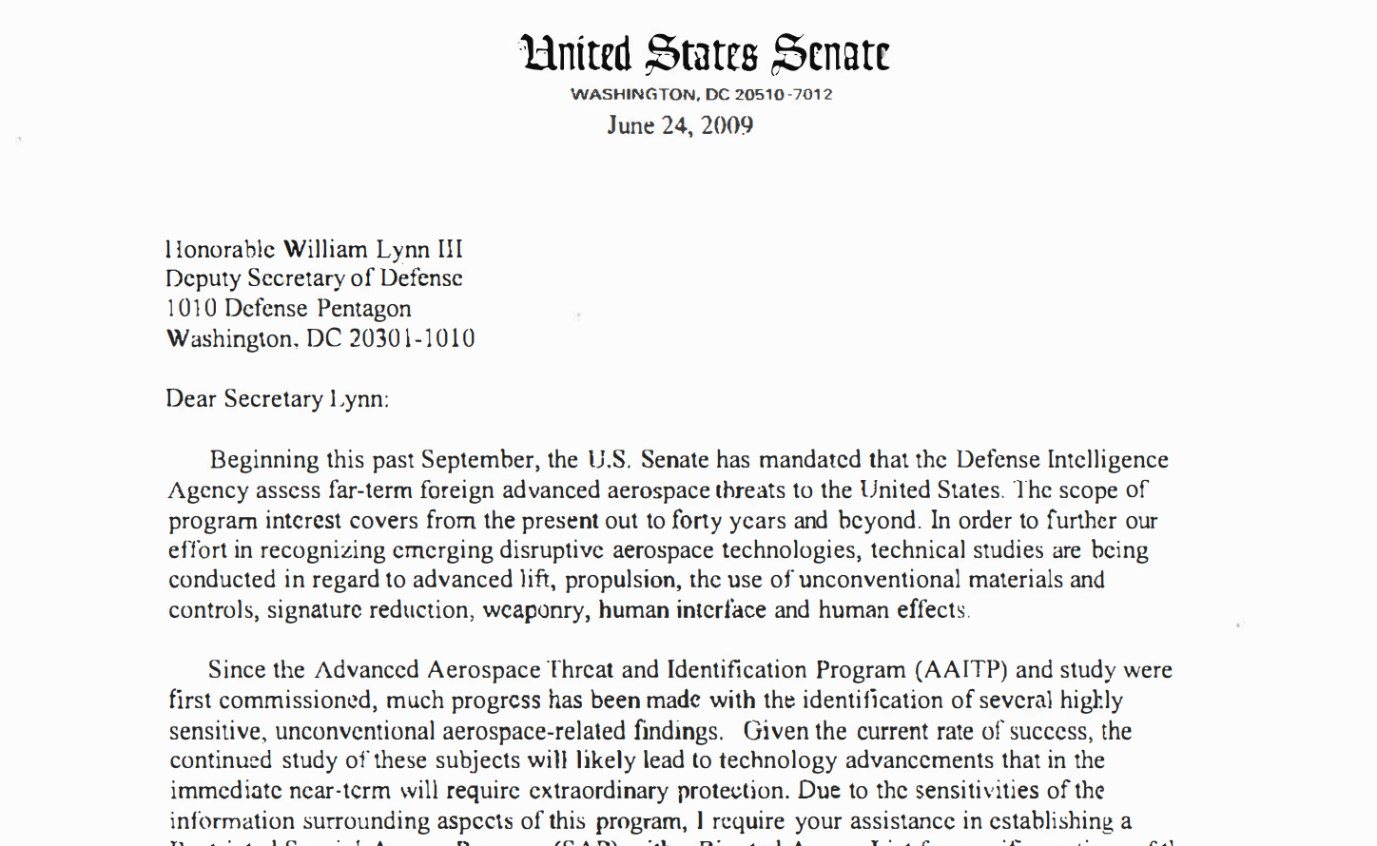
Then came Reid's letter. He wrote that the program had already made "much progress" in "the identification of several highly sensitive, unconventional aerospace-related findings," and that the work would soon "require extraordinary protection."
He asked that the methods used to "identify, acquire, study, and engineer" the program's technologies be protected, along with the identities of the people working on it and the industry partners taking part. Ordinary classification rules, he wrote, were not enough. He described the technologies as likely involving quantum mechanics, nuclear science, electromagnetic theory, gravitics and thermodynamics.
October 2009: the reviews come back
DIA's director asked for an assessment of the first year's reports at a May 15, 2009 meeting, after he had met Reid. The answer, dated October 30, 2009, lists 26 technical reports delivered in the 2009 fiscal year.
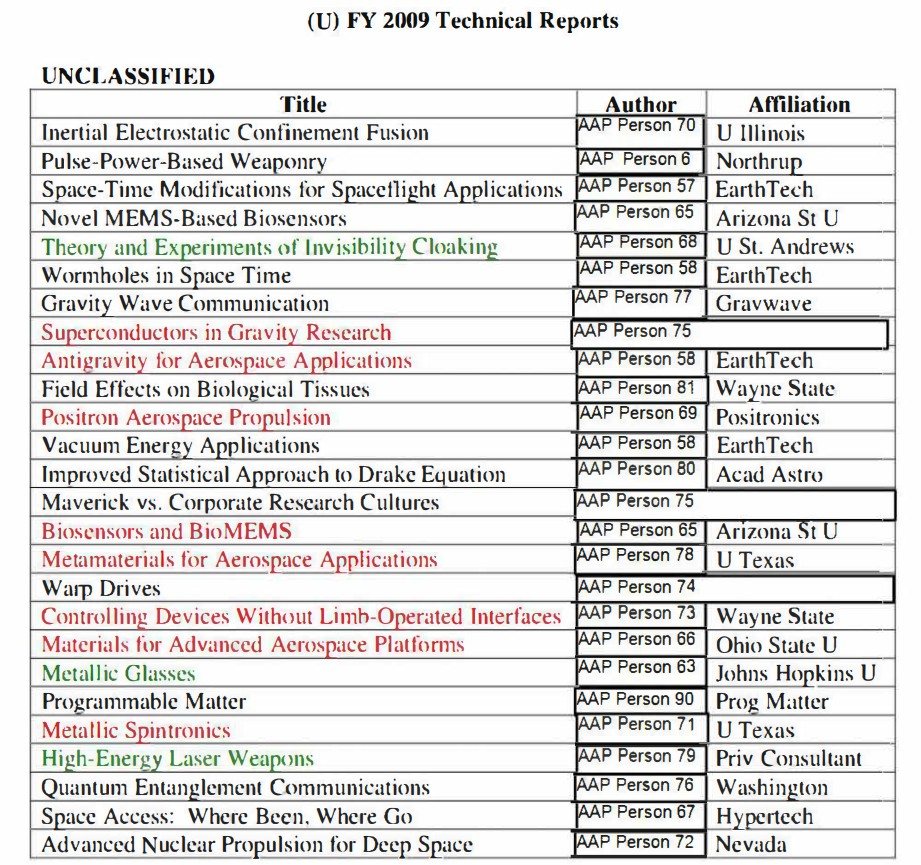
The titles range from the ordinary to the exotic. Next to "Metallic Glasses," "Programmable Matter" and "High-Energy Laser Weapons" sit "Antigravity for Aerospace Applications," "Wormholes in Space Time" and "Warp Drives."
The memo says eight reviews were done by other authors on the program and five by outside reviewers, three of them research staff at Sandia National Laboratories. "All of the reviews were positive, some exceptionally so," it says of the excerpts it quotes. "Even within the limitation of being able to conduct only unclassified research in the first contract year, the quality hoped for in the reports was achieved." DIA planned to publish them as Defense Intelligence Studies.
November 2009: nothing to lock away
Two weeks later, on November 13, 2009, DIA's deputy director, Letitia Long, gave her answer on Reid's request. DIA, she wrote, "cannot find adequate justification to establish a restricted SAP."
Her reasons were plain. Every program document delivered in the first year was unclassified, because the contractor had not yet set up a secure facility. No report had drawn on previously classified material. The information in the reports was not owned or produced by the government, and DIA could not identify any damage from releasing information that was already public. And DIA is not allowed to classify basic scientific research unless it clearly relates to national security.
On Reid's "highly sensitive" findings, the memo says DIA is "unaware of any report containing information sufficiently sensitive and vulnerable to require extra protection." It assumes Reid meant future phases of the program.
The verdict: "of limited value"
The December 2010 memo, from DIA's director, Lieutenant General Burgess, closes the story. In November 2009, he wrote, he and Deputy Secretary Lynn met Reid to discuss the program. "At that time, we determined the reports were of limited value to DIA." He suggested they might be of merit to other organizations, and that the project could move to another agency when DIA's contract ended.
By then the program had grown. Congress added $12 million more in the 2010 appropriations act, and twelve more reports were produced, 38 in all.
So the agency's own record holds both views. The people running the contract praised the work and its reviewers found it good. The people deciding on secrecy found nothing in it that needed hiding, and the director found little use for it at DIA.
What else is in the file
The release also includes BAASS's own report to DIA, dated July 2009 and 538 pages long. Among other things, it says BAASS paid the Mutual UFO Network (MUFON), a civilian group that collects sighting reports, monthly stipends for read-only access to its case system, including contact details for witnesses who agreed. It says MUFON received about 400 reports a month, about 12 of which were judged worth sending its investigators to. BAASS also kept its own team of sixteen investigators in Las Vegas, and was building a database that held 179 cases from Brazil's 1977 and 1978 sightings on Colares Island and in the state of Pará. The Department of War's summary of the report says it also covers research at a Utah site with a reported history of anomalous activity.
The names of the people who wrote, reviewed and ran the work are withheld throughout, replaced with labels such as "AAP Person 1." Only senior officials are named. That matters for one claim in particular: Jay Stratton, who led the Pentagon's later UFO task force, says in the publisher's description of his memoir that he co-founded AAWSAP. Our story on his book sets out what he claims. These files neither confirm nor rule it out.
One more note on the record itself. The Department of War's online summary of the January 2009 briefing paper says it called the reports of "limited value." The paper itself does not; it says the contract was on track. That judgment appears in the December 2010 memo.
Sources
All from the eighth PURSUE release, war.gov/UFO, November 20, 2026:
- DOW-UAP-D187, DIA talking paper for the director, January 2, 2009
- DOW-UAP-D184, DIA talking paper for the director, May 4, 2009
- DOW-UAP-D183, Senator Harry Reid's letter to Deputy Secretary of Defense William Lynn, June 24, 2009
- DOW-UAP-D188, DIA review of the contract's first-year reports, October 30, 2009
- DOW-UAP-D185, DIA memo on Reid's request, November 13, 2009
- DOW-UAP-D186, DIA memo on the program, dated by the release to December 2010
- DOW-UAP-D172, BAASS ten-month report, July 2009
Get SpaceDew by email
Free. Tick what you want, and nothing else is sent.