Kelly Johnson saw a flying saucer. The Air Force called it a cloud.
In December 1953, Lockheed's chief engineer watched a black ellipse hang over the California coast while a Lockheed test crew saw the same thing from the air. Today the government released the whole file, his own drawing included.
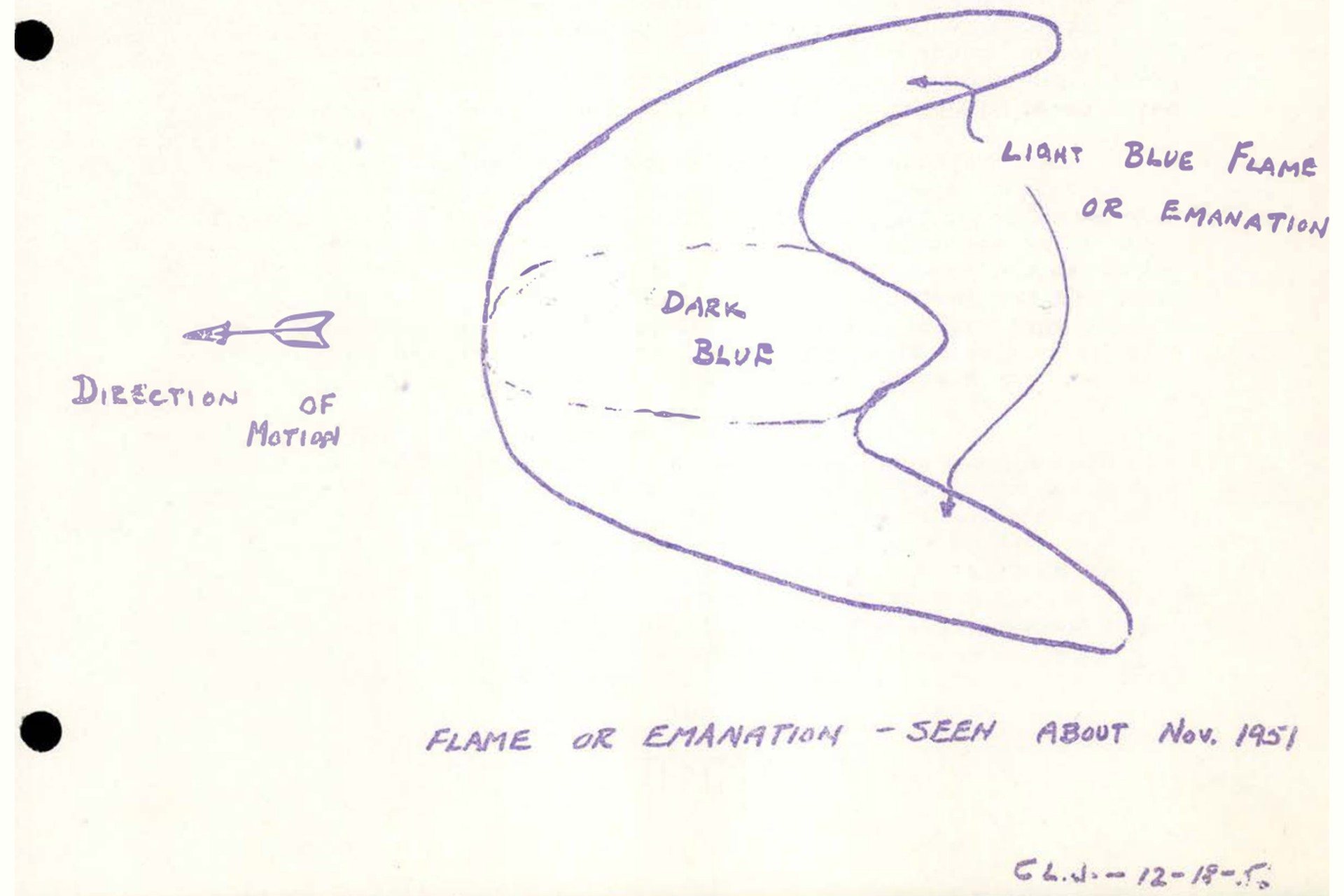
By Boggle Riley · Photo: Drawing by Clarence L. Johnson, December 18, 1953, of what he saw about November 1951, from the Air Force file released by the Department of War on November 20, 2026 (DOW-UAP-D206), public domain
Published November 20, 2026. Facts as of that day. Some details may have changed since.
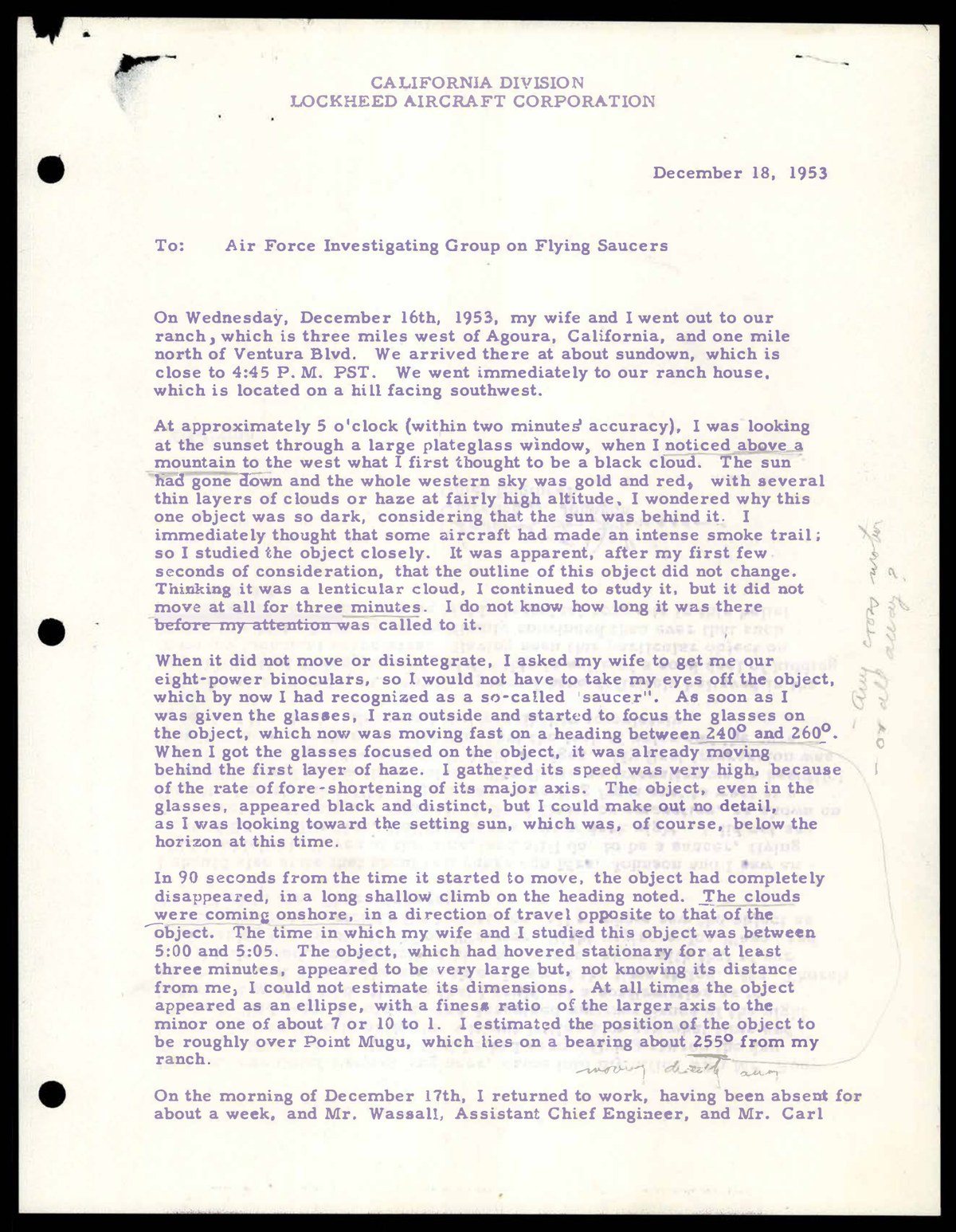
At about 5 o'clock on the evening of Wednesday, December 16, 1953, Clarence "Kelly" Johnson was looking out a big plate-glass window at his ranch near Agoura, California, west of Los Angeles. The sun had just gone down. Above a mountain to the west he saw what he first took for a black cloud.
Johnson was Lockheed's chief engineer, the man who would go on to lead the design of the U-2 and SR-71 spy planes. He looked closely. In his own account, written two days later, he wondered why one object was so dark with the sun behind it, thought it might be an aircraft's smoke trail, and then thought it might be a lenticular cloud, the smooth lens-shaped kind that forms over mountains. But its outline did not change, and it did not move at all for three minutes.
He asked his wife for their eight-power binoculars and ran outside. By the time he had them focused, the object was moving fast, on a heading between 240 and 260 degrees. "In 90 seconds from the time it started to move, the object had completely disappeared, in a long shallow climb," he wrote. The clouds that evening were coming onshore, he noted, the opposite direction.
What makes the case unusual is what happened the next morning.
The file is in the eighth release of government UFO records, posted today, November 20, 2026, on PURSUE, the Department of War's site for declassified UFO records. It runs 15 pages: the Air Force's record card, a general's cover letter, Lockheed's transmittal and five signed accounts.
"Kelly snapped this up immediately"
On December 17, Johnson was back at work after a week away. His chief flight test engineer, Rudy Thoren, came to his office with two of Lockheed's senior engineers. Over a technical discussion, Thoren mentioned, he later wrote, "for fear of being ridiculed," that he had been chasing a flying saucer the evening before.
Johnson stopped him before he could say when or where. He described his own sighting first, he wrote, "so that I could get a confirmation as to whether or not he saw the same thing." Thoren's memo describes the moment: Johnson "said that it was at 5:05 and the object was sighted off of Point Mugu. This literally bowled me over."
Thoren had been co-pilot on a test flight of a Navy WV-2 Super Constellation, which took off at 4:29 that afternoon. The crew was Roy Wimmer, the engineering test pilot; Thoren; Charlie Grugan, the flight engineer; and Joe Ware, the flight test engineer. Philip Colman, Lockheed's chief aerodynamics engineer, was in the cockpit too.
What the crew saw
Somewhere between 15,000 and 20,000 feet, climbing over the ocean, Wimmer said, "Look out, there's a flying saucer." Thoren, flying at that moment, turned toward it. Wimmer's first thought was a small cloud. After several minutes, Thoren wrote, he decided it was not, "because it had too definite sharp edges and its appearance stayed constant." To him it looked like "a very large flying wing airplane," silhouetted against the red sky after sunset.
They flew toward it for about five minutes at some 225 miles per hour without seeming to close on it. Then it began to shrink, and within about a minute it was a speck, and then gone, heading almost due west. The flight record, Thoren wrote, shows the plane leveling off at 20,000 feet at 5:10.
Each man wrote his own account in December 1953 and January 1954, and they differ in the ways honest accounts do:
- Wimmer saw a shape "like a crescent" and estimated it was at least fifty or sixty miles away, possibly much farther. He watched it the whole time, he wrote, and "it maintained its sharp outline and definite shape so I know it was not a cloud that dissolved."
- Colman saw "a thin black line," his first impression a B-36 bomber heading toward them, hovering for about ten minutes before it "suddenly accelerated due west" and disappeared in about ten seconds.
- Ware first took it for a large transport plane, a C-124, then for "a large object without wings." He put the time at about 6:00 p.m.; the others put it at about 5:00.
- Thoren first guessed it was about seven miles away, then decided it must have been much larger and farther than he thought.
Colman made the point that matters most. Johnson had seen it from the ground at Agoura; the crew saw it from the air, miles away, over the ocean. "The difference in the positions, both horizontally and vertically, between us indicate that the object had sufficient depth to eliminate the possibility that it was a cloud phenomenon," he wrote.
Thoren added: "I have been very skeptical of flying saucer stories, and have never even imagined seeing an object in the sky that I was not able to identify."
"Most reluctant to write the report"
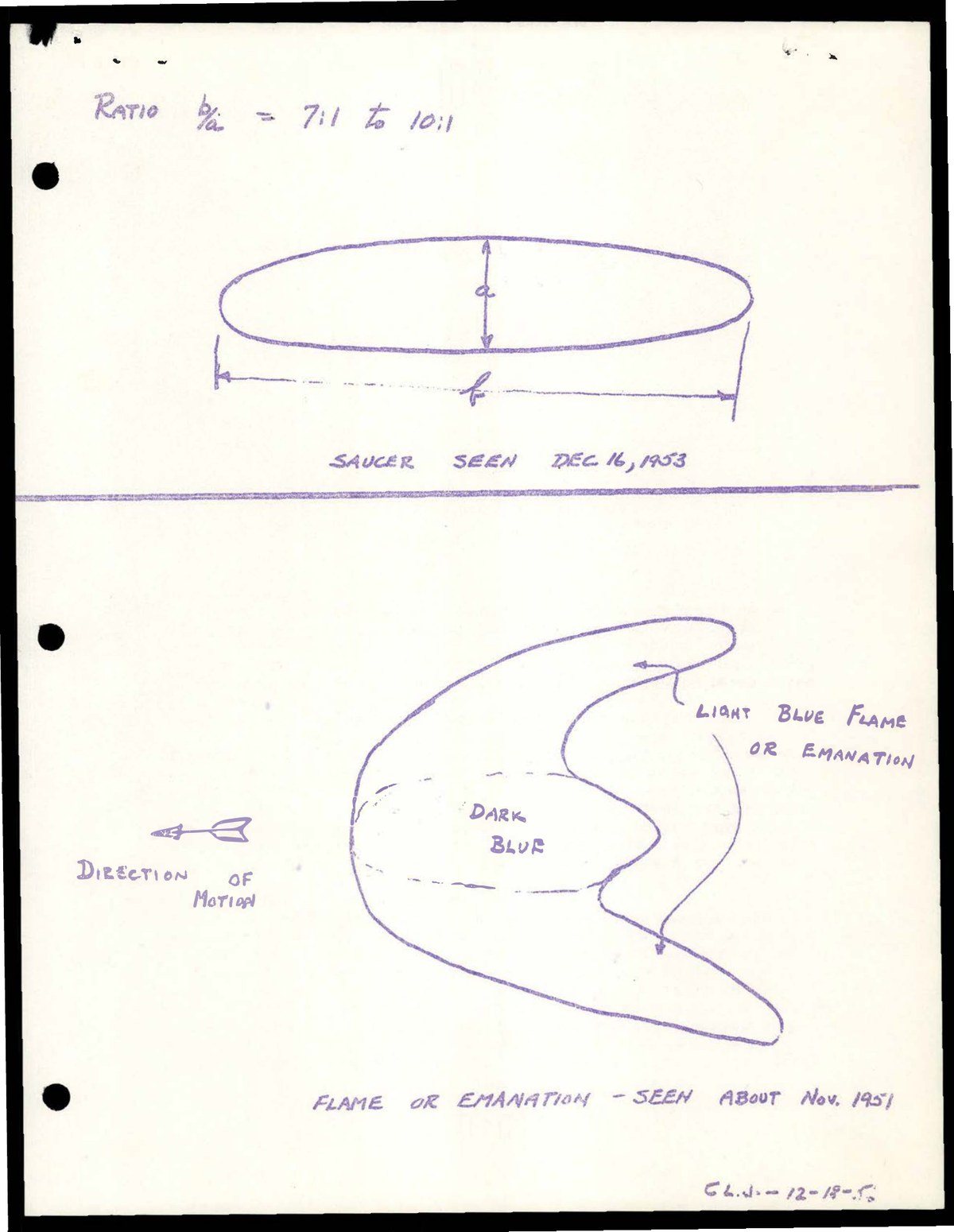
Johnson wrote that this was not his first sighting. About two years earlier, on a very dark night near Brents Junction, he and his wife had watched a "clearly defined flame or emanation," light blue, travel east to west at very high speed with no noise. He drew both.
He was candid about where he stood. "I should state that for at least five years I have definitely believed in the possibility that flying saucers exist," he wrote, "this in spite of a good deal of kidding from my technical associates." After December 16, "I am now more firmly convinced than ever that such devices exist, and I have some highly technical converts in this belief as of that date."
On January 20, 1954, Lockheed sent the accounts, under Johnson's signature, to the Air Technical Intelligence Center at Wright-Patterson Air Force Base in Ohio, the office that studied UFO reports. "This information has not been released to the press," the letter says, "but is submitted for such scientific purposes as your group may be concerned with." It asked for the Air Force's comments.
The file's own cover letter, from Lieutenant General D. L. Putt to the center's commander on February 15, 1954, tells a slightly different story: that Johnson "was most reluctant to write the report in the first place and then refused to forward it" to the Air Force, "because of his belief that those who profess to have seen flying saucers are not usually considered to be logical and practical hard-headed engineers." Lockheed people handed it to Putt instead.
The verdict on the card
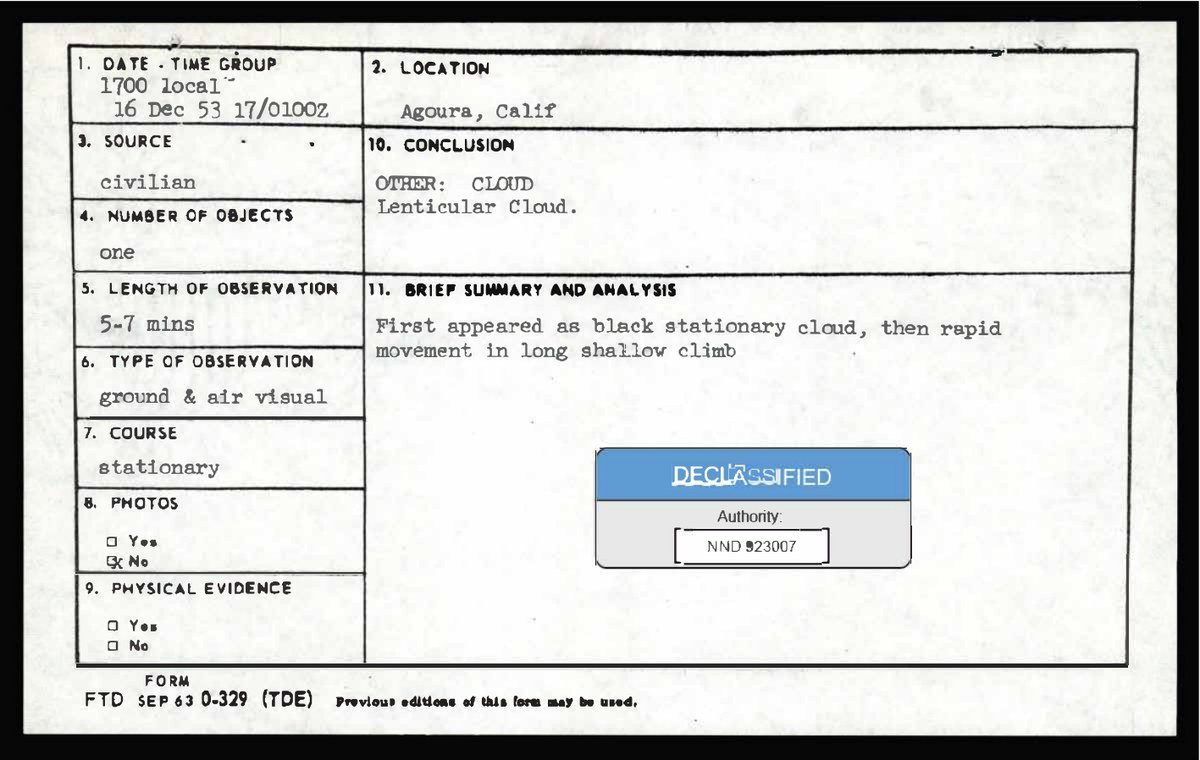
The Air Force's answer is the first page of the file. Its record card lists one object, seen for five to seven minutes, from the ground and the air, and gives its conclusion in four words: "Other: Cloud. Lenticular Cloud."
Two details on that card are worth noticing. The card is printed on a form edition dated September 1963, so this copy was filled in at least nine years after the sighting; the file does not say when the evaluation itself was made. And the explanation it gives is the one Johnson wrote that he had considered and set aside, because the object held its outline, then left fast in a climb, against the direction the clouds were moving.
Today's release lists the file as an unresolved case. The PURSUE site describes everything in its archive as cases where the government "is unable to make a definitive determination." The card in the file did make one, in 1954 or later. Whether that determination was right is another question, and the record leaves the reader with both: the Air Force's cloud, and five Lockheed engineers and pilots who wrote that it was not one.
Is this new?
Not entirely. Researchers have known about the Lockheed sighting for decades, and Project 1947 published a long study of it. What is new is the complete file, with Johnson's drawings and the cover letters, released by the government itself.
Sources
- DOW-UAP-D206, Unresolved UAP Report, California, 1953, from the eighth PURSUE release, war.gov/UFO, November 20, 2026: the Air Force record card; Lieutenant General D. L. Putt's letter of February 15, 1954; Lockheed's letter of January 20, 1954; the accounts of C. L. Johnson (December 18, 1953), R. L. Thoren (December 17, 1953), Roy Wimmer (January 12, 1954), P. A. Colman (January 11, 1954) and J. F. Ware Jr. (January 11, 1954)
- Project 1947, the Lockheed case of December 16, 1953
Get SpaceDew by email
Free. Tick what you want, and nothing else is sent.