What Was That in the Sky? The Lights People Mistake for UFOs, and How to Tell Them Apart
A line of lights sliding in single file, a star that will not move, a streak that is gone before you can point. Almost everything people see at night has a name. Here is how to tell which one you saw.
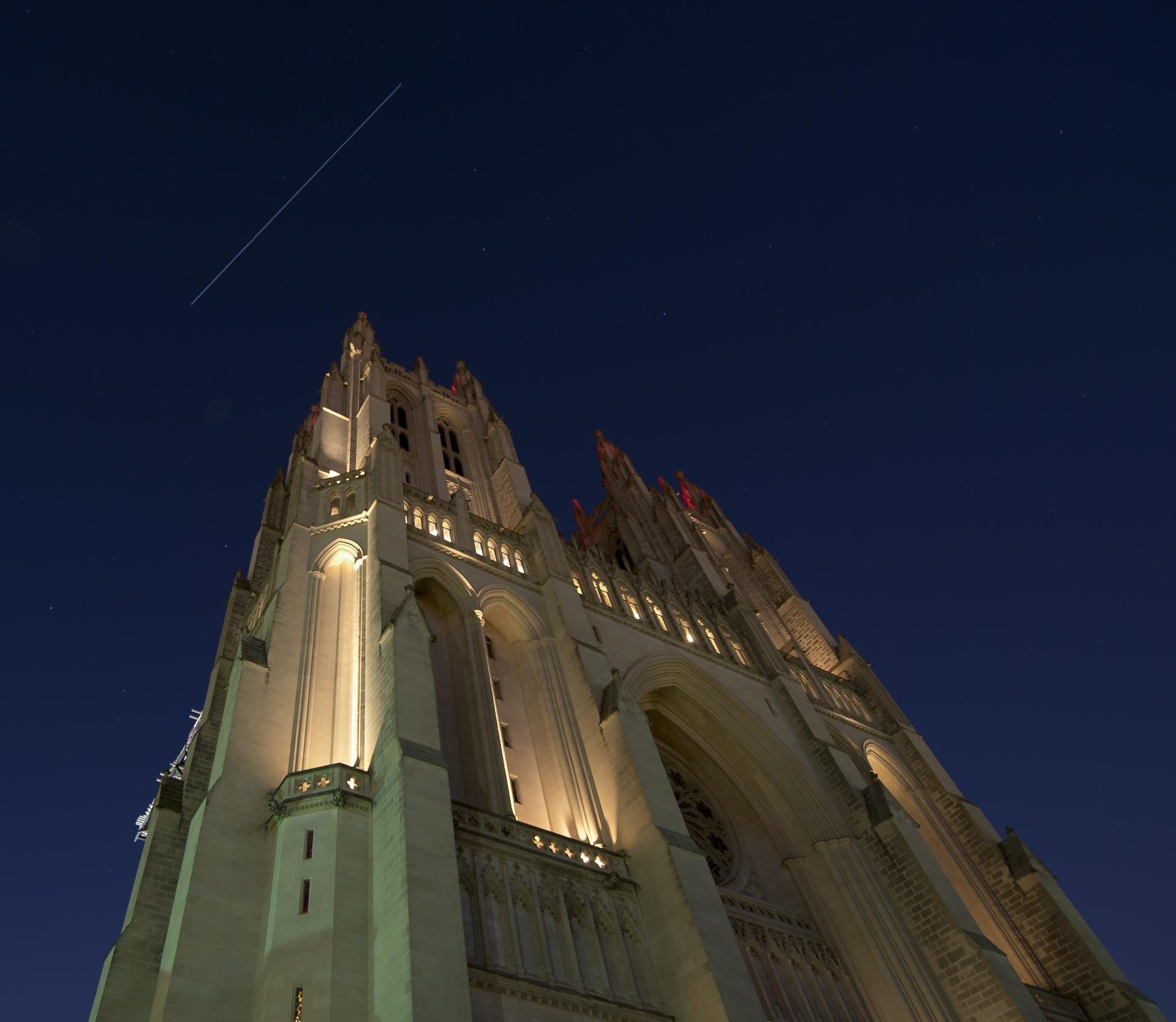
By SpaceDew · Photo: NASA, Bill Ingalls
Published October 26, 2026. Facts as of that day. Some details may have changed since.
Somebody you know has seen one. A light that moved wrong, or did not move at all, or came in a line like beads on a string. They looked it up and found nothing, and the question stuck: what was that?
The Pentagon has an office whose job is that question. The All-domain Anomaly Resolution Office, AARO, collects reports of unidentified anomalous phenomena, the government's term for what most people still call UFOs. In its latest annual report, released in July 2026, it counted 319 new reports between June 2024 and May 2025. It resolved 114 of them, and 256 older cases as well, and it said every case it resolved came down to ordinary things: balloons, satellites, birds, aircraft and drones. One was a commercial rocket launch. One was a man in a jet pack.
That does not close the book, and the office does not claim it does. It sent nine of the year's reports on for further analysis, and put 191 in an archive because there was not enough information to judge them. But the ones it could check had answers, and most of those answers are things you can learn to spot yourself from a backyard.
Start with four questions. Did it move? Did it blink? How long did you see it? And what time was it, close to dusk or dawn, or deep in the night?
A line of lights moving together
It is almost certainly a Starlink train.
SpaceX launches its Starlink internet satellites in batches. Right after launch, the batch flies low and close together, and for a day or two each satellite catches the sunlight as a dot, the dots strung out in a line crossing the sky in silence. The first 60 went up on May 23, 2019, and the line they made has been startling people ever since. The satellites have no lights of their own. What you see is sunlight bouncing off them, which is why trains show up after sunset and before sunrise, when the ground is dark but the sky a few hundred miles up is still lit.
Within days the satellites climb toward their working orbit, about 550 kilometers (340 miles) up, spread apart, and fade from easy view. So if you saw a train, a launch probably happened in the last day or two. AARO gave an example in its 2024 report: a commercial pilot reported white flashing lights in the night sky, and the office matched them to a Starlink launch from Cape Canaveral about an hour before.
SpaceDew's What was that? page checks for this. Pick "a line or chain of lights" and it looks for a recent Starlink launch that could have put a train over you.
One steady light, crossing the sky in a few minutes
It is probably the International Space Station, or another satellite.
NASA describes the station as looking "similar to an airplane or a very bright star moving across the night sky," with two differences that settle it: it has no blinking lights, and it does not change direction. It is also much faster than a plane, at about 17,500 miles an hour, and a pass is over in a few minutes. You can only see it within a few hours of sunrise or sunset, for the same reason as the trains: it shines by sunlight. Sometimes it vanishes halfway across the sky. Nothing happened to it. It flew into Earth's shadow.
Fainter satellites do the same thing all night long, dim points sliding steadily between the stars. Now and then one flashes. AARO calls this satellite flaring: sunlight glinting off a satellite's surface at just the right angle, bright "many times brighter than surrounding stars," for anything from a fraction of a second to a few minutes. With new three-dimensional modeling, the office resolved 238 reports as satellite flares in a single year.
Tonight's sky lists the bright passes over your place for the night ahead.
A bright light that does not seem to move
It is probably a planet, most often Venus or Jupiter.
From Earth, Venus is the brightest thing in the night sky after the Moon, and NASA's Night Sky Network calls it "one of the most confused objects in the sky," especially low on the horizon. Jupiter and the star Sirius are reported too. A planet can hang in one spot for so long that it seems to hover, or to follow your car.
The test is patience. Line the light up with a chimney or a branch and look again in ten minutes. A planet will have moved a little, along with every star around it, because the whole sky is turning. It shines steadily, too, rather than twinkling. A star is so far away that its light arrives as a single point, while a planet shows a tiny disk, a broader bundle of light that NASA's Astronomy Picture of the Day describes as "less affected by small scale turbulence."
This fall, the bright steady light before dawn is Jupiter, high in the east and southeast. In the evening, Saturn sits in the southeast and south, a steady yellow point.
A star that flashes colors
It is a star, low in the sky, seen through a lot of air.
Stars twinkle because moving air bends their light on the way down. NASA's StarChild site puts it simply: the movement of air "causes the starlight to get slightly bent." Near the horizon, the light passes through much more air, so a star there can flicker hard. The air bends each color by a slightly different amount, so the flicker can flash red, green and blue, what NASA's Astronomy Picture of the Day calls a "rainbow like" trail in a long exposure. A bright star flashing colors near the horizon can look like a hovering light that is changing color.
This fall there are two good candidates. Early in the evening, Capella rises low in the northeast and flickers. Before dawn, Sirius, the brightest star in the night sky, sits fairly low in the south and flashes colors.
A streak, gone in a second or two
It is a meteor, and a very bright one is a fireball.
Meteors are bits of comet and asteroid dust burning up in the air. The American Meteor Society calls a meteor a fireball when it is brighter than magnitude minus 4, about as bright as Venus. Some fireballs break apart or end in a flash.
This is fireball season. Every year from September to November, Earth passes through the debris of Comet Encke, and the Taurid meteors it makes are known for bright ones. NASA's meteor office says the dust hits the atmosphere at 65,000 miles an hour, and in some years Earth runs into a group of pebble-sized pieces and fireballs come more often, most likely in the last week of October and the first two weeks of November. The Southern Taurids peak around November 5 and the Northern Taurids around November 12, at about five meteors an hour under a dark sky. The Moon is a thin crescent or down at both peaks this year, so the sky will be dark.
A glowing cloud or spiral after sunset
It is probably a rocket launch.
When a rocket launches shortly after sunset or before sunrise, the ground below is dark but the rocket climbs into sunlight within minutes. Its exhaust lights up across the sky in shapes that do not look like anything: a glowing jellyfish, a comet with a curled tail, an expanding spiral, seen across a wide region at once. On December 22, 2017, a Falcon 9 lifted off from Vandenberg in California at sunset, and NASA's Astronomy Picture of the Day ran the view from Orange County: a plume "backlit by the setting Sun," looking "at times like a giant space fish."
SpaceDew's launch pages flag these. When a launch is timed so its plume will light up after dark, the page says so, and tells you where it can be seen from.
Blinking lights, red and green
It is an airplane, or a drone.
Federal rules require airplanes flying at night to show position lights: red on the left wing, green on the right, white at the tail. A plane fitted with anticollision lights, the flashing beacons and strobes, which the rules say must be aviation red or aviation white, has to keep them on too, unless the pilot judges it safer to turn them off. So a light that blinks is almost always an aircraft. A plane flying straight toward you can seem to hang still for a long time, because almost none of its motion is across your view.
Drones carry lights too, and drones are on AARO's list of answers, along with balloons of every size, from foil party balloons to large research balloons carrying instruments. A balloon shines only by reflected light, so NASA's Night Sky Network points out that one seen long after sunset is less likely, because the sun is too far down to light it.
If none of these fits
Write down what you can while it is fresh: where you were, the time, which direction you faced, how high it was, how long it lasted, and whether it moved or blinked. Those are the details that decide it, and a lack of them is why AARO set 191 of last year's reports aside.
Then ask the sky. What was that? takes where you were, when, and what it looked like, and answers from what was actually over that spot at that minute: satellites and trains from their orbits, the planets and bright stars from their positions, the meteor showers, and any rocket that launched within sight. For the government's own released files, see SpaceDew's UFO Files.
Sources
- All-domain Anomaly Resolution Office, Fiscal Year 2025 Consolidated Annual Report on Unidentified Anomalous Phenomena, information cut off May 30, 2025 (copy hosted by The Black Vault); DefenseScoop, Pentagon investigating UAP event near Virginia coast, July 21, 2026
- All-domain Anomaly Resolution Office and Office of the Director of National Intelligence, Fiscal Year 2024 Consolidated Annual Report on UAP, November 2024
- NASA, Spot the Station and Spot the Station frequently asked questions
- EarthSky, SpaceX Starlink satellites explained, September 12, 2022
- NASA, Venus facts
- NASA Night Sky Network, Identifying UFOs and UAPs, December 1, 2013
- NASA StarChild, Why do stars twinkle?; NASA Astronomy Picture of the Day, Scintillating, April 28, 2011
- American Meteor Society, Fireballs
- NASA Watch the Skies, The Taurid swarm is upon us, October 26, 2015; shower peaks and rates from the International Meteor Organization's calendar, as used on SpaceDew's sky pages
- NASA Astronomy Picture of the Day, SpaceX rocket launch plume over California, December 24, 2017
- Code of Federal Regulations, 14 CFR 91.209, aircraft lights, and 14 CFR 25.1385, position light system installation and 14 CFR 25.1401, anticollision light system
- Where the planets and stars are this fall: SpaceDew's own sky calculations, the same ones behind Tonight's sky
- Photo: NASA, Bill Ingalls, NHQ201711290001
Get the Morning Dew
The daily brief, live quotes and the newest stories, every morning. Plus a Friday recap of the week. Nothing else, ever.