Meet Starcloud, the Company Trying to Put Data Centers in Orbit
One satellite the size of a small fridge, one Nvidia chip, and a plan for tens of thousands more. What Starcloud has done, what it says it will do, and the hard problems in the way.
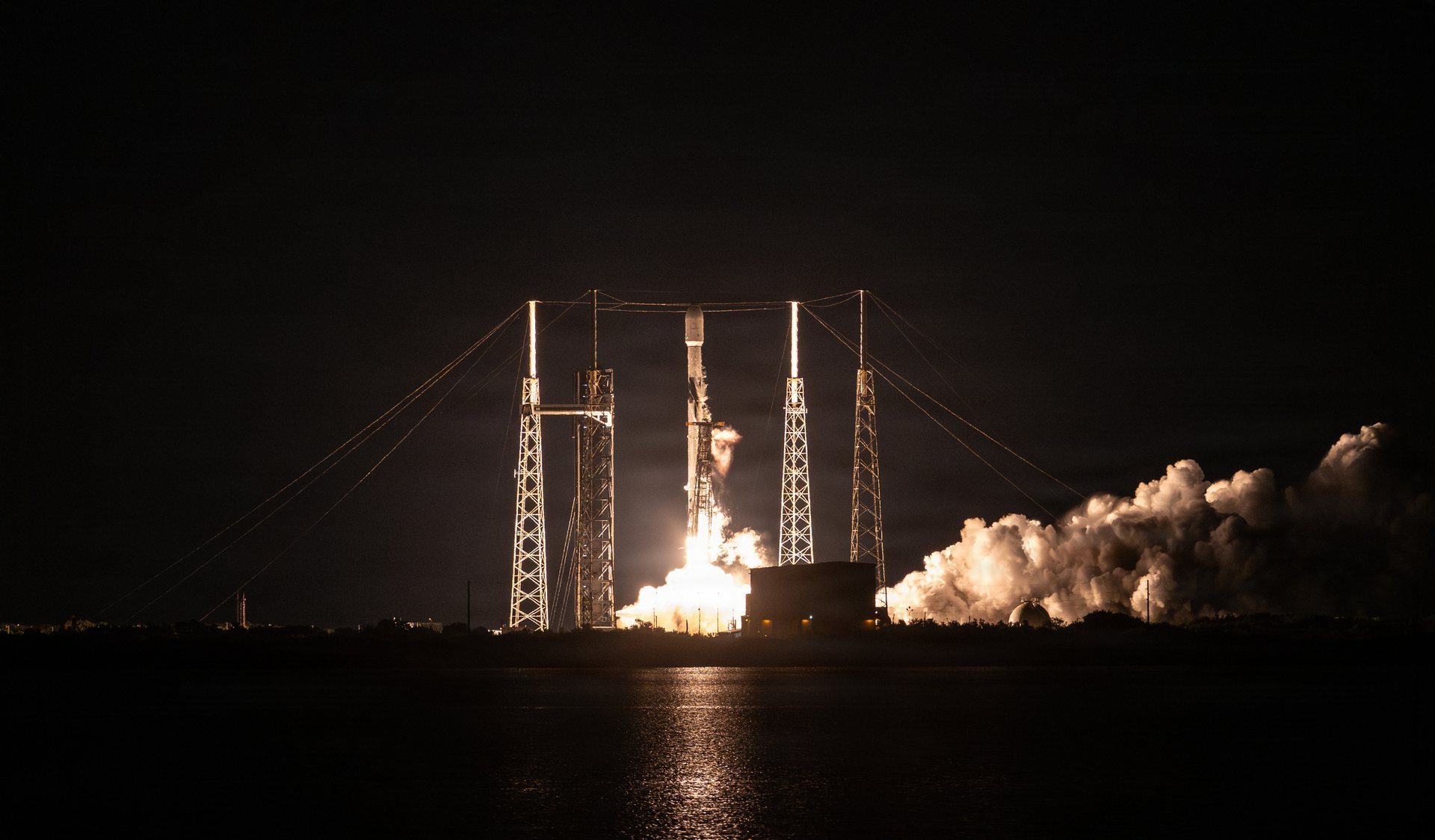
By SpaceDew · Photo: U.S. Space Force, Senior Airman Spencer Contreras
Published October 15, 2026. Facts as of October 5, 2026. Some details may have changed since.
In December 2025, a satellite about the size of a small fridge, circling the Earth, sent a message home. It came from an AI model running on a computer chip aboard the satellite, and it greeted "Earthlings," describing us as "a fascinating collection of blue and green."
The satellite was Starcloud-1. The chip was an Nvidia H100, the same kind of graphics processor that fills the data centers training today's AI models on the ground. Starcloud, the small company in Redmond, Washington, that built and flew it, said it had also trained a small AI model in orbit, which news reports called the first AI model trained in space.
Most people have never heard of Starcloud. Its idea is easy to say and very hard to do: move the data center, the warehouse of computers that runs the internet and AI, off the planet.
Who they are
Starcloud was founded in January 2024 under another name, Lumen Orbit, by three people:
- Philip Johnston, the chief executive, who worked on satellite projects at McKinsey.
- Ezra Feilden, the chief technology officer, who spent about ten years designing satellites, with a specialty in solar arrays and large structures that unfold in space.
- Adi Oltean, the chief engineer, who was a principal software engineer on SpaceX's Starlink team after about twenty years at Microsoft.
That summer the company went through Y Combinator, the startup program, in its Summer 2024 batch. In February 2025 it changed its name to Starcloud. Johnston told GeekWire the reason was simple: another company, Lumen Technologies, already had the right to "Lumen" for data centers.
It is still small. GeekWire counted 5 people in February 2025 and 12 in December 2025. TechCrunch reported 25 in August 2026, when the company also opened a 100,000 square foot factory in Woodinville, Washington.
The idea
A data center on Earth needs three things in large amounts: electricity, cooling and land. AI has made all three scarce. Starcloud's pitch is that orbit has the first two for free and does not need the third.
In September 2024 the founders published a white paper, "Why we should train AI in space." Its main claims, all theirs:
- Power. In the right orbit, a satellite is almost always in sunlight. The paper says a solar panel in space works more than 95 percent of the time, against a median of 24 percent for solar farms in the United States, and that the same panel produces over five times the energy.
- Cooling. There is no air in space to carry heat away, so heat has to leave as radiation, glowing invisibly into the cold of deep space. The paper says a one meter square black plate kept at 20°C radiates about 838 watts from its two sides, so the radiators would need to be less than half the size of the solar arrays. That is what the plate gives off when it sees nothing but the cold of deep space. In orbit a radiator also takes heat in, from sunlight, from sunlight reflected off the Earth and from the Earth's own infrared glow, as NASA's guide to spacecraft cooling sets out. Keeping radiators turned away from all of that, while the solar panels face the Sun, takes what IEEE Spectrum calls "complex, high-torque attitude control systems."
- Scale. A data center of 5 gigawatts would need a solar array about 4 kilometers on each side. The paper says it could go up in fewer than 100 launches, if a future reusable rocket carries 100 tonnes for about $5 million a launch.
That last "if" carries most of the weight, and the company says so. Johnston told TechCrunch in March 2026: "We're not going to be competitive on energy costs until Starship is flying frequently." Starship is SpaceX's giant reusable rocket, still in testing.
Starcloud-1
Starcloud-1 launched on November 2, 2025, at 1:09 a.m. Eastern, on a SpaceX Falcon 9 from Cape Canaveral, Florida. It rode along with other small satellites on a mission called Bandwagon-4. That is the launch in the photograph above.
The satellite weighs about 60 kilograms (132 pounds) and carries one Nvidia H100 with 80 gigabytes of memory. Starcloud says that is 100 times more GPU computing power than anything flown before it.
In December 2025, CNBC reported what it had done in orbit. It trained NanoGPT, a small teaching model written by the AI researcher Andrej Karpathy, on the complete works of Shakespeare. It also ran Gemma, an open model from Google, which wrote the greeting to Earthlings. The team connected the model to the satellite's own position data, so it could answer the question "Where are you now?"
Not everything worked. A second chip, an Nvidia A6000, failed during launch, TechCrunch reported. And Johnston has been frank about the hardware: "An H100 is probably not the best chip for space, to be honest." Chips built for a cool, air-conditioned building on Earth are not built for radiation and vacuum.
As of October 3, 2026, public tracking data from CelesTrak still showed Starcloud-1 in orbit, between 495 and 503 kilometers up.
What comes next
Starcloud-2 is the next step, and it has slipped. In late 2025 the company and reporters said it would fly in October 2026. In August 2026, TechCrunch reported two Starcloud-2 satellites of about 8 kilowatts each, flying on shared launches in 2027 and doing work for customers including U.S. government agencies. Reported plans for its hardware include several H100s, a newer Nvidia Blackwell chip, a server blade from Amazon Web Services, a bitcoin mining computer, and what the company calls "the largest deployable radiator flown on a private satellite."
Starcloud-3 is the big one: a satellite designed to be released from Starship, built on production lines at the new Woodinville factory. Its size depends on who is asking. Johnston told GeekWire in December 2025 it would be about 2 tons and 100 kilowatts; TechCrunch reported 3 tons and 200 kilowatts in March 2026.
The constellation. In February 2026, Starcloud asked the Federal Communications Commission for permission to fly up to 88,000 satellites as "a distributed datacenter in space," in orbits 600 to 850 kilometers high, talking to each other by laser. The FCC accepted the application for filing in March 2026. Accepting a filing is not approving it.
The Moon. On September 30, 2026, Firefly Aerospace announced it will carry a Starcloud payload around the Moon on its Elytra orbiter, on a mission planned for no earlier than 2028.
The company has raised money to match. In March 2026 it announced a $170 million round led by Benchmark and EQT Ventures, and in August 2026 another $250 million, led by Manhattan West, with Nvidia and Cisco Investments among the new investors.
The hard parts
Plenty of serious people doubt this can work soon, and some of their reasons come from physics, not opinion.
Heat. Nvidia's chief executive, Jensen Huang, put it simply at his company's conference in March 2026: "In space, there's no convection, there's just radiation." An analyst at ABI Research, Andrew Cavalier, worked the numbers for IEEE Spectrum: one H100, drawing 700 watts, needs about 1.4 square meters of radiator, and a single 40 kilowatt rack of computers needs about 80 square meters. Coatings wear in sunlight, which he estimates adds about 40 percent more radiator over five years.
Cost of getting there. Google is exploring the same idea under the name Project Suncatcher. Its researchers say the economics depend on launch prices near $200 a kilogram, which they think SpaceX could reach by about 2035. TechCrunch summed up Google's analysis as Starship needing to launch about 1,800 times before space data centers get off the ground.
Radiation and repair. Space radiation flips bits and wears out chips. Google put its own AI chip, the Trillium TPU, in a proton beam at the University of California, Davis, to see how it would hold up. Its most sensitive part, the memory, began to show errors only after about three times the dose a shielded chip would take in five years in orbit, and the radiation caused no hard failure even at about twenty times that dose. Google's team calls the error rate likely acceptable for running AI models; what it does to training, they write, needs more study. And when a computer breaks in orbit, nobody can walk over and swap a part. Repairs may mean another launch.
Getting the data down. A data center on the ground sits on fiber-optic cable. One in orbit has to send its results down by radio or laser. Google's paper says radio is enough for a pilot, but working at scale will need laser links to the ground that are still being developed. So the first paying work is the kind where little has to come down. A radar satellite that maps the Earth can produce about 10 gigabytes of data a second, Johnston told Nvidia, and IEEE Spectrum reports that the radio links bringing such data to the ground are already congested. Starcloud-1 analyzes data from Capella Space's radar satellites, TechCrunch reported, so an answer can be sent down instead of the raw images. Selling that kind of processing to other spacecraft is one of the company's two business models. The other, taking work from data centers on Earth, waits for cheaper launches.
Crowded orbit. Tens of thousands of satellites add to the debris problem and to the number of rocket launches, and astronomers and environmental researchers have raised both.
Even Starcloud's chief executive sets modest near-term expectations. Johnston told GeekWire he expects the economics to favor space in three to five years, but with less than 1 percent of new computing power in orbit even then.
Not alone
Starcloud is early, not alone:
- Google's first Project Suncatcher prototype, built with Planet, launched on October 1, 2026. "It is operating as expected," Travis Beals, who leads the project, wrote afterward.
- Axiom Space launched its first two orbital data center nodes in January 2026.
- SpaceX asked the FCC in January 2026 for permission to fly up to a million satellites for computing.
- Blue Origin filed for a constellation of 51,600 satellites. Jeff Bezos has called space data centers "very realistic," but a timeline of two to three years "a little ambitious."
Why it matters on the road to Mars
Whatever happens to orbital data centers, the problems Starcloud is working on are the problems of living and working off Earth: making a lot of power in space, getting rid of heat in a vacuum, and keeping delicate machines alive in radiation, far from anyone who can fix them. A Mars base will need every one of those answers.
Starcloud has one small satellite in orbit and a great deal still to prove. Its next real test is Starcloud-2, now planned for 2027. SpaceDew follows the company on its watch list, and we will report when it flies.
Starcloud at a glance
- Founded: January 2024, as Lumen Orbit; renamed Starcloud in February 2025
- Founders: Philip Johnston, Ezra Feilden, Adi Oltean
- Based in: Redmond, Washington, with a factory in Woodinville
- People: 25 (August 2026)
- In orbit: Starcloud-1, launched November 2, 2025, carrying one Nvidia H100
- Next: two Starcloud-2 satellites, planned for 2027
- Filed for: up to 88,000 satellites (FCC application, February 2026)
Sources
- Starcloud, company site, Starcloud-1, Starcloud-2 and Starcloud-3 pages
- Starcloud (as Lumen Orbit), Why we should train AI in space, white paper v1.03, September 2024
- Y Combinator, Starcloud company page
- GeekWire, Lumen Orbit raises $11M, December 11, 2024
- GeekWire, Lumen Orbit changes its name to Starcloud, February 26, 2025
- Nvidia, How Starcloud Is Bringing Data Centers to Outer Space, October 15, 2025
- IEEE Spectrum, Nvidia's H100 GPU Takes Data Centers to Space, November 3, 2025
- Via Satellite, Bandwagon mission launches 18 payloads, November 3, 2025
- CNBC, Nvidia-backed Starcloud trains first AI model in space, December 10, 2025
- GeekWire, Starcloud plans its next power plays, December 22, 2025
- CelesTrak, satellite catalog record for Starcloud-1 (NORAD 66303), orbit data of October 3, 2026
- FCC, Public Notice SAT-01982, March 13, 2026
- CNBC, Nvidia chips for orbital data centers, March 16, 2026
- TechCrunch, Starcloud raises $170 million Series A, March 30, 2026
- GeekWire, Starcloud hits $1.1B valuation, March 30, 2026
- IEEE Spectrum, Why Thermodynamics Rules Future Orbital Data Centers, June 11, 2026
- CNBC, Do space-based AI data centers make economic sense?, June 21, 2026
- TechCrunch, Starcloud raises $250 million as launch options dry up, August 21, 2026
- GeekWire, Starcloud raises $250M, August 21, 2026
- Firefly Aerospace, Firefly signs Starcloud as commercial customer, September 30, 2026
- CNBC, Google AI chips launched to orbit with Planet satellites, October 1, 2026
- TechCrunch, Google on the Starship launches space data centers need, October 1, 2026, and Google Research, Exploring a space-based, scalable AI infrastructure system design
- Google, Towards a future space-based, highly scalable AI infrastructure system design, the Project Suncatcher paper (radiation testing at the UC Davis Crocker Nuclear Laboratory, ground links)
- NASA, Small Spacecraft Technology State of the Art: Thermal Control
- Axiom Space, Orbital Data Centers
- Scientific American, Space-Based Data Centers Could Power AI with Solar Energy, At a Cost, December 9, 2025
- Photo: U.S. Space Force, Senior Airman Spencer Contreras, DVIDS 9424663, public domain
Follow Starcloud on SpaceDew
Get the Morning Dew
The daily brief, live quotes and the newest stories, every morning. Plus a Friday recap of the week. Nothing else, ever.