How a Launch Gets Scrubbed, and What the Countdown Is Really Checking
A rocket can be fueled, the crew strapped in and the whole world watching, and still not go. Here is what the countdown checks, who can stop it, and why a scrub can cost a day or a month.
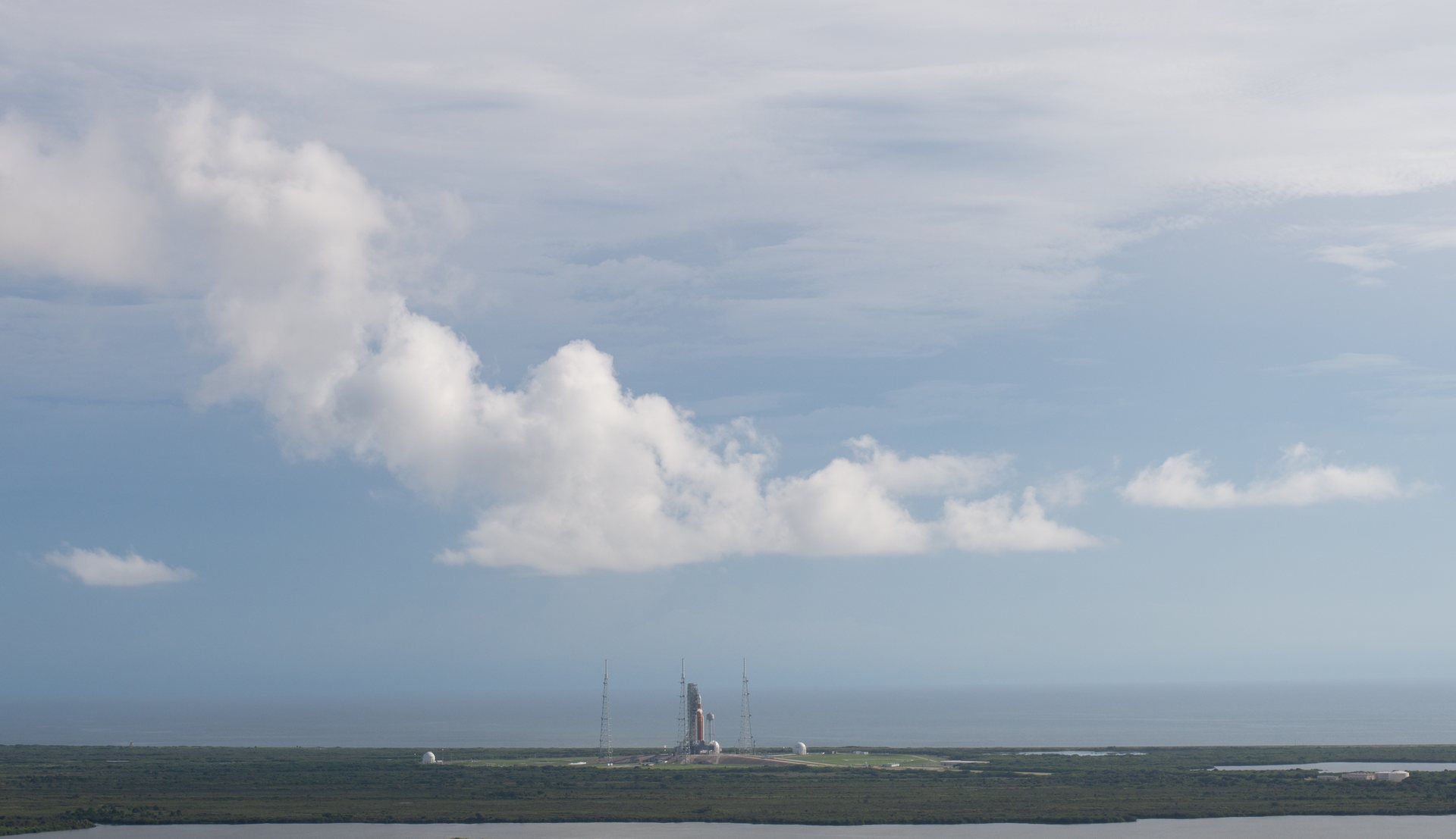
By SpaceDew · Photo: NASA, Joel Kowsky
Published October 6, 2026. Facts as of October 5, 2026. Some details may have changed since.
On May 27, 2020, two NASA astronauts sat strapped into a SpaceX Crew Dragon on top of a fueled Falcon 9 in Florida. About 17 minutes before liftoff, the launch was called off. The problem was not the rocket. It was the sky: lightning in the area, electric charge in the air, and the anvil cloud of a thunderstorm.
"It's just part of the deal," said Doug Hurley, one of the two astronauts. Three days later, they flew.
That is a scrub. If you follow launches, you will see a lot of them. This is a guide to what is happening when one happens.
The words
T-minus and L-minus. NASA keeps two clocks. "L-minus" is the real time left until liftoff. "T-minus" is the countdown of events. During a planned pause the T clock stops while the L clock keeps running, which is why a countdown can sit at "T-10 minutes" for half an hour.
Built-in holds. Those pauses are planned. NASA builds them into the count to give the team a cushion and to hit a precise launch window. Before the first flight of its Space Launch System (SLS) moon rocket in 2022, the countdown included a 3.5 hour hold for a weather and fueling briefing and a 30 minute hold at 40 minutes before liftoff.
Hold. An unplanned pause to look at something.
Recycle. Stop, back the count up to an earlier point, and try again the same day if there is time left in the window. NASA's rules for the Artemis I launch allowed a recycle back to T-10 minutes from late in the count, "provided there is adequate launch window remaining."
Scrub. Done for the day. NASA's own word for it is "waive off." On September 3, 2022, "the launch director waived off the Artemis I launch attempt at approximately 11:17 a.m. EDT."
Launch window. The span of time a rocket can leave and still reach where it is going. Some windows are two hours long. Some are instantaneous: one exact second. Crew Dragon's window that day in May 2020 was 4:33:35 p.m. Eastern, and nothing else. With an instantaneous window, there is no waiting out a passing cloud.
What the countdown is checking
A countdown is a long list of things that must happen in order, each one confirmed before the next.
Fueling. Big rockets burn propellants so cold they have to be loaded on launch day. The SLS took on more than 700,000 gallons of them for Artemis I. Liquid hydrogen goes in at about minus 423 degrees Fahrenheit.
Chilling the engines. Before ignition, the engines are chilled by bleeding cold propellant through them; NASA calls it thermal conditioning. A Falcon 9 starts its engine chill seven minutes before liftoff.
Pressure and power. In the last minutes, the tanks are pressurized for flight and the vehicle switches from ground power to its own batteries. On a Falcon 9, at one minute before liftoff the flight computer is commanded to begin its final checks, and at 45 seconds the launch director verifies the rocket is go for launch.
The computers take over. Near the end, people hand control to an automated sequencer, which stops the count by itself if a reading it watches goes out of limits. For the SLS, that handoff comes at 33 seconds. After it, NASA's Artemis I rules said, "any issue that would stop the countdown would lead to concluding the launch attempt for that day." The space shuttle worked the same way: after T-31 seconds there was no such thing as a hold, only a cutoff.
The sequencers do stop launches, and not always for the rocket's sake. On June 1, 2024, Boeing's Starliner was counting down with two astronauts aboard an Atlas V. Its ground launch sequencer runs on three computers that must stay in step. One of them was six seconds slow to respond, and the count stopped at 3 minutes 50 seconds. They tried again four days later and flew.
The go/no-go poll. Before the final minutes, the launch director polls the team to make sure every part of it is "go."
The weather rules
At Cape Canaveral and Kennedy Space Center, launch weather belongs to the Space Force's 45th Weather Squadron. Its rules are strict on purpose. For the lightning rules to read green, its launch weather team needs, in the words of two of its forecasters, "clear and convincing evidence, and unanimous agreement." If any one of them has any doubt, the answer is no.
The rules NASA published for its Artemis launches include these:
- No launch for 30 minutes after lightning within 10 nautical miles of the flight path.
- Stay 10 nautical miles from anvil clouds, the flat tops of thunderstorms, with some exceptions.
- Do not fly through a cloud layer more than 4,500 feet thick that reaches freezing temperatures.
- Stay away from cumulus clouds, the puffy towering kind, by distances that depend on their height.
- Do not launch while instruments on the ground called field mills show a strong electric field in the air.
- Do not launch through rain, or during severe solar storms.
Most of these rules are not about storms hitting the rocket. When the squadron's forecasters surveyed them, 11 of the 12 were about the rocket making its own lightning. A rocket and its long trail of exhaust act like a wire into a charged cloud, and can set off a bolt in an electric field about 100 times weaker than nature needs. Apollo 12 was struck twice on its way up in 1969. In 1987 an Atlas Centaur rocket triggered a strike that scrambled its guidance; it broke up and was destroyed. In their survey, the squadron's forecasters wrote that no rocket launched under the modern rules had been struck by triggered lightning since.
There are other weather rules too: ground winds, so a rocket does not topple or get blown back into the launch pad; and winds high up, which load a rocket's structure as it climbs. A crewed launch also watches the weather far away. For astronaut launches, mission managers have watched more than 50 places along the flight path, up the coasts of the United States and Canada and across the North Atlantic toward Ireland. If the rocket had to abort, the capsule would splash down somewhere along that line, and the seas there have to be safe. In October 2021, NASA and SpaceX's Crew-3 mission waited three days because of high winds and rough seas offshore.
Even the landing matters. A SpaceX Starlink launch in September 2020 waited because the ocean currents where its booster was to land, about 400 miles out, were too strong for the landing ship to hold its position.
The range
The Space Force also runs the range, the sea and sky the rocket flies over. Its job is to make sure the airspace and ocean under the flight path are clear, and to be able to destroy a rocket that strays off its safe path. That makes the destruct system part of the countdown too.
On January 30, 2022, a Falcon 9 count stopped about 30 seconds before liftoff with the call "Hold! Hold! Hold!" A cruise ship, Royal Caribbean's Harmony of the Seas, had sailed into the hazard area. The window was instantaneous, so that was the end of the day. It was the fourth scrub in a row for that rocket. It flew on the fifth try.
On November 16, 2022, the night Artemis I finally launched, a failed network switch at Cape Canaveral, part of the destruct system's command path, made the range "no go" until it was replaced. The same night, a three-person "red crew" went out to the fueled rocket to tighten bolts on a leaking hydrogen valve. The rocket left 43 minutes into its window.
Then there is traffic in orbit. Before launch, the path is checked against satellites and the space station. Federal Aviation Administration rules say a launch must keep either a set distance from an inhabited spacecraft, such as 200 kilometers along its orbit, or a chance of collision no higher than one in a million. Those checks cut moments out of a launch window, called cutouts.
Engines lit, then shut down
The most dramatic stops come after ignition.
On December 12, 1965, Gemini 6 lit its engine with astronauts Wally Schirra and Tom Stafford aboard, and 1.2 seconds later the engine shut down. An electrical plug had fallen out early and started the onboard clock. Schirra had a handle that would fire both men out of the capsule on ejection seats. He felt no motion, judged the rocket had not moved, and did not pull it. The crew had his calm to thank for flying three days later.
The space shuttle had five pad aborts, where its main engines started and the computers shut them down before the solid rocket boosters lit. The first was Discovery's on June 26, 1984, at four seconds before liftoff: one of its three engines never lit, so the computers stopped the other two. A hydrogen fire, invisible in daylight, broke out at the back of the orbiter, and the pad's water system drenched the crew as they got out. Discovery flew two months later.
On October 2, 2020, a Falcon 9 stopped itself two seconds before liftoff. Two engines were starting too early. SpaceX traced it to a small vent port in the engines, one sixteenth of an inch wide, blocked by masking lacquer a supplier had left behind. Catching that cost the next astronaut launch two weeks.
Why one scrub costs a day and another a month
What happens after a scrub depends on what the rocket used up while trying.
- Propellant and batteries. A scrub means draining or replenishing propellant, and spacecraft batteries charged for that one attempt may need charging again.
- Parts with a clock on them. For Starliner, after a set date some batteries and other life-limited items would have to be replaced, which meant rolling the rocket back about 10 days.
- Certifications. The batteries in a rocket's destruct system are certified for a set number of days. For Artemis I the range certified them for 20 days, then 25. Testing them again had to be done inside NASA's Vehicle Assembly Building, which meant rolling the rocket back from the pad.
Artemis I shows how it adds up. Its first attempt, on August 29, 2022, was scrubbed when one of its four main engines could not be chilled to the right temperature; NASA suspected the trouble was not with the engine itself. The second, on September 3, was scrubbed for a hydrogen leak at a fuel connection. Then Hurricane Ian sent the rocket back to its hangar. It finally flew on November 16, 79 days after the first try.
Few flights tested patience like shuttle mission STS-61-C. Its first launch date was December 18, 1985. It was delayed by a closeout of the shuttle's rear compartment, a false reading on a booster at 14 seconds to go, about 4,000 pounds of liquid oxygen drained by accident, weather at its emergency landing sites across the Atlantic, a sensor lodged in an engine valve, and heavy rain. It flew on January 12, 1986, on its seventh date.
How often does it happen?
Often. A study by the 45th Weather Squadron's forecasters found the lightning rules alone had scrubbed nearly 5 percent of launches from the Cape and Kennedy and delayed 35 percent. They put the cost of one scrub at between $150,000 and over $1,000,000, depending on the rocket. In 2019 the squadron told Spectrum News 13 that 48 percent of scrubs over the past 30 years were for weather; the station did not give the data behind that figure. And by one count in The Conversation, only about 40 percent of the 135 space shuttle missions launched on time.
Even the biggest launches are not exempt. When Artemis II sent four astronauts on a flight around the Moon on April 1, 2026, it did not scrub that day, but the count still worked through a problem in the range's destruct command link and a battery reading on the launch abort system that turned out to be a faulty sensor, and lifted off 11 minutes into its window. Its earlier delays came from a hydrogen leak and a helium problem found during testing on the ground.
The next time you see one
A scrub is not a failure. It is the system doing its job: every reading in limits, every weather rule green, every team go, and the range clear, so that the rocket only leaves when everything says it can. The crews know it. As Doug Hurley put it, sitting on a fueled rocket that was not going anywhere that day, it is just part of the deal.
Sources
- NASA, Artemis I Launch Countdown 101
- NASA, Artemis I weather criteria and Artemis II launch weather criteria
- NASA, Engineers assess data after scrub, August 29, 2022, and Artemis I launch attempt scrubbed, September 3, 2022
- NASA, Artemis I rocket rolls back to the VAB, September 26, 2022, and Artemis I liftoff
- Spaceflight Now, Artemis 1 launch dates and the flight termination system batteries, September 8, 2022
- Air & Space Forces Magazine, USSF was almost no go for the Artemis moon launch, November 17, 2022
- NASA, CRS-29 countdown and ascent milestones, November 9, 2023
- NASA, Space Shuttle Launch Commit Criteria, hold and cutoff guidelines (NSTS 16007)
- NASA, Space Shuttle weather launch commit criteria, March 2011
- W. Roeder and T. McNamara, 45th Weather Squadron, A Survey of the Lightning Launch Commit Criteria, American Meteorological Society
- SpacePolicyOnline, Demo-2 scrubs due to weather, May 27, 2020, and NASA, Demo-2 liftoff
- Spaceflight Now, crew launch abort weather, May 26, 2020; Crew-3 delayed by winds and waves, October 30, 2021; Starlink waits for ocean conditions, September 18, 2020
- The Maritime Executive, Errant cruise ship forces SpaceX to scrub launch, and Spaceflight Now, CSG-2 live coverage
- Code of Federal Regulations, 14 CFR 450.169, launch and reentry collision avoidance
- SpacePolicyOnline, Another scrub for Starliner Crew Flight Test, June 1, 2024; NASA, Crew Flight Test launch scrubs Saturday; SpaceQ, Starliner Crew Flight Test finally launches
- Smithsonian National Air and Space Museum, The heart-stopping shutdown of Gemini VI; NASA, Gemini 6 image S65-61916; Drew Ex Machina, the Gemini 6 launch abort
- NASA History, 40 years ago: STS-41D, the first space shuttle launch pad abort, June 26, 2024
- Spaceflight Now, GPS 3 SV04 static fire and the October 2 abort, October 31, 2020
- NASA, STS-61C mission page
- Spectrum News 13, 45th Weather Squadron explains criteria behind scrubbing launches, May 22, 2019
- The Conversation, republished by Government Executive, Artemis launch delay is the latest of many NASA scrubs, November 15, 2022
- SpacePolicyOnline, Artemis II launch day; NASA, Artemis II launch and Artemis II helium issue; The Weather Network, Artemis 2 delayed to March
- Photo: NASA, Joel Kowsky, NHQ202209030007
Get the Morning Dew
The daily brief, live quotes and the newest stories, every morning. Plus a Friday recap of the week. Nothing else, ever.