Mars Is Coming Back. Here's How to See It, and How Close We Are to Going There
Go outside before dawn this week and look south for a steady orange dot. That's Mars, 111 million miles away and coming closer every night. By February it will be five times brighter, two NASA spacecraft are already on their way to it, and the long climb to send people there is further along than you might think.
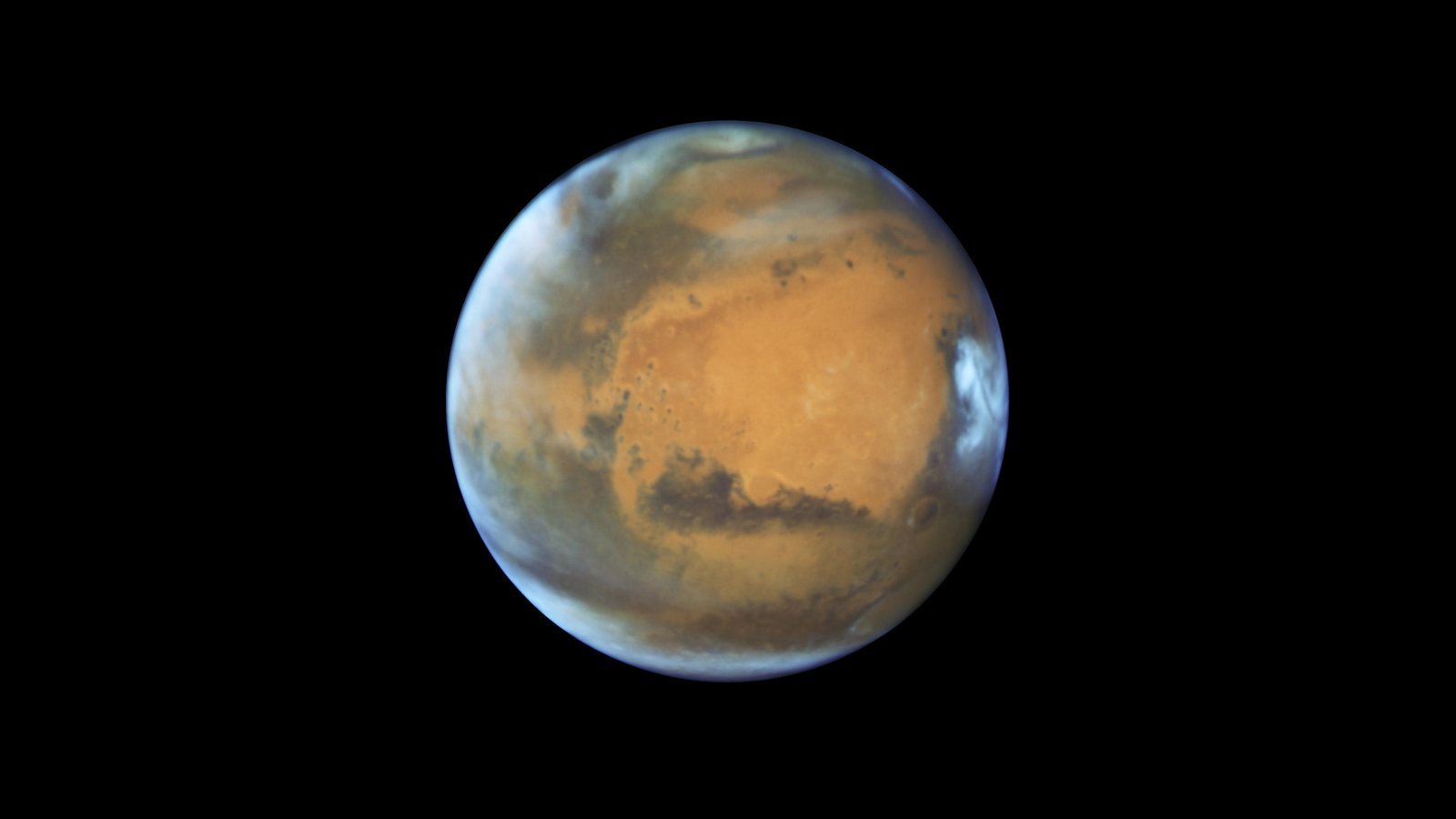
By Bill McCoy · Photo: NASA, ESA, the Hubble Heritage Team (STScI/AURA), J. Bell (ASU) and M. Wolff (Space Science Institute); Hubble, May 12, 2016
Published November 27, 2026. Facts as of that day. Some details may have changed since.
Set an alarm for one morning this week. Go outside an hour or two before sunrise, face south, and look about halfway up the sky. You will see a bright point of light with an orange tint that shines steadier than the stars around it.
That is Mars. Tonight it is about 111 million miles from you. Every night from now until February it will be a little closer and a little brighter. And if you like the idea that people will one day stand on it, this is a good winter to start paying attention, because a lot is happening at once.
How to find it this week
This week Mars rises in the east at about 11 p.m. local time, almost anywhere in the United States. Between 5 and 6 a.m. it stands highest, in the south, more than halfway up.
It has a neighbor that helps. Mars sits about two degrees, roughly a finger's width at arm's length, above and to the left of Regulus, the brightest star in the constellation Leo. Mars is the brighter of the two, and the more orange. Regulus is blue-white.
Monday morning, November 30, is the easiest morning of all. The Moon, a little more than half lit, moves in beside them. Before dawn you will see three lights in a short line across the southern sky: the Moon on the right, Regulus in the middle and Mars on the left, about five degrees from the Moon. Five degrees is about the width of three fingers held at arm's length.
You don't need a telescope. If you want the exact times for your own town, Tonight's Sky works them out for any place you pick, and the planets tonight lists every planet that is up.
Why Mars is getting closer
Earth and Mars both circle the Sun, but Earth is on the inside track and moves faster. About every 26 months Earth catches up with Mars and passes it. When that happens, the two planets are as close as they get for that lap, and Mars sits exactly opposite the Sun in our sky. Astronomers call it opposition.
The next opposition is February 19, 2027. That night Mars will rise as the Sun sets and stay up all night. A day later it will be closest to Earth, about 63 million miles away, according to NASA's Jet Propulsion Laboratory (JPL).
Between now and then, JPL's numbers say Mars will grow about five times brighter. By the middle of January it will rise around 8:30 in the evening, so you won't need an alarm clock any more. By February it will outshine every star in the night sky except Sirius.
The door to Mars opens on the same clock
That same 26-month rhythm decides when anyone can go. A spacecraft heading to Mars doesn't fly straight at it. It leaves Earth on a long curve around the Sun and meets Mars where Mars will be months later. The curve that takes the least fuel only lines up for a few weeks out of every 26 months. Engineers call those weeks a launch window.
One of those windows is open now, in late 2026. The next one comes around the start of 2029. That is why the Mars missions you will read about bunch together every two years or so, and why a missed window costs a project two years.
Two spacecraft are on their way right now
On November 13, 2025, Blue Origin's New Glenn rocket lifted off from Cape Canaveral in Florida with two small NASA spacecraft named Blue and Gold. Together they are ESCAPADE, short for Escape and Plasma Acceleration and Dynamics Explorers. Rocket Lab built them, and the University of California, Berkeley, runs the mission.
They launched a year early, on purpose. Earth and Mars were on opposite sides of the Sun then, so instead of heading for Mars, the pair spent a year looping around a point in space about a million miles from Earth, waiting for the planets to line up.
This month they came back. Blue swung past Earth about 1,000 miles up at 5 a.m. Eastern on Saturday, November 7. Gold followed at 6 a.m. Eastern on Monday, November 9, about 650 miles up. Each fired its engine for about nine minutes at the closest point and used Earth's gravity to fling itself toward Mars. NASA says it was the first time the agency has used a powered Earth flyby to send a spacecraft to Mars.
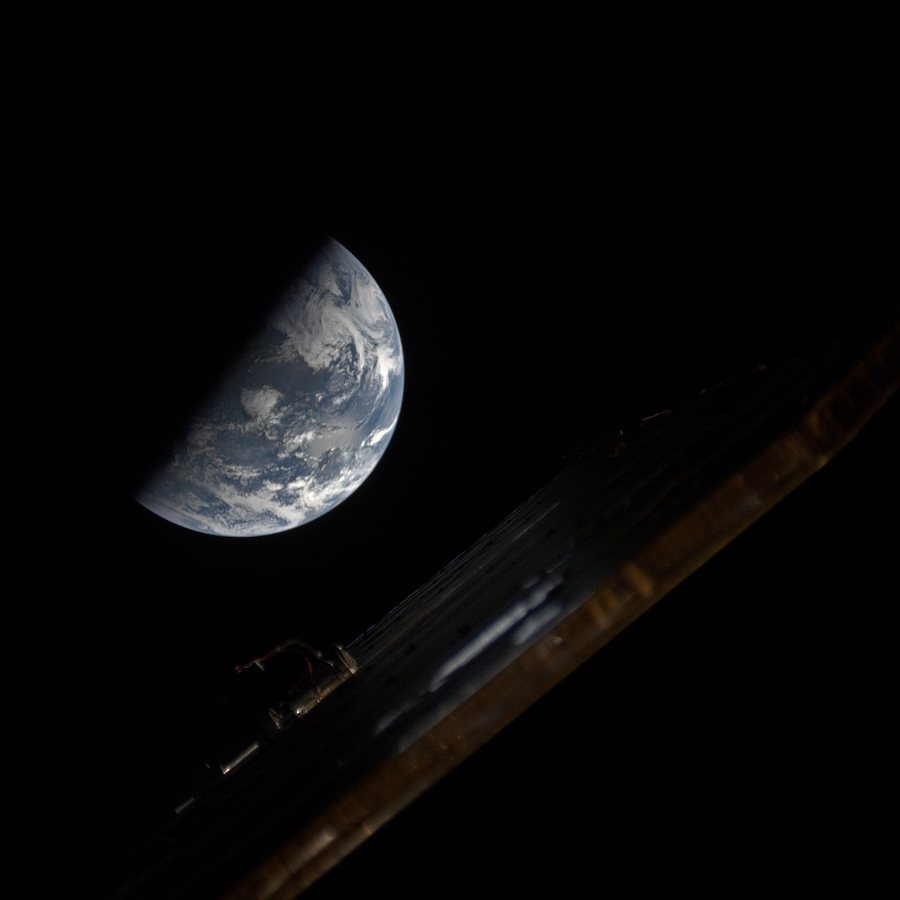
About three hours after its flyby, Gold turned its camera around and took a farewell picture of Earth from 38,500 miles away. It is beside these words.
The two are due to go into orbit around Mars on September 7 and September 9, 2027. Once there they will fly in formation and study how the solar wind, a stream of particles from the Sun moving at about a million miles an hour, strips away the thin Martian air. That matters for people. "By better understanding how the solar wind affects the Martian environment, ESCAPADE's findings could help us plan and prepare for future human exploration of the Red Planet," said Michele Cash, the mission's program scientist at NASA.
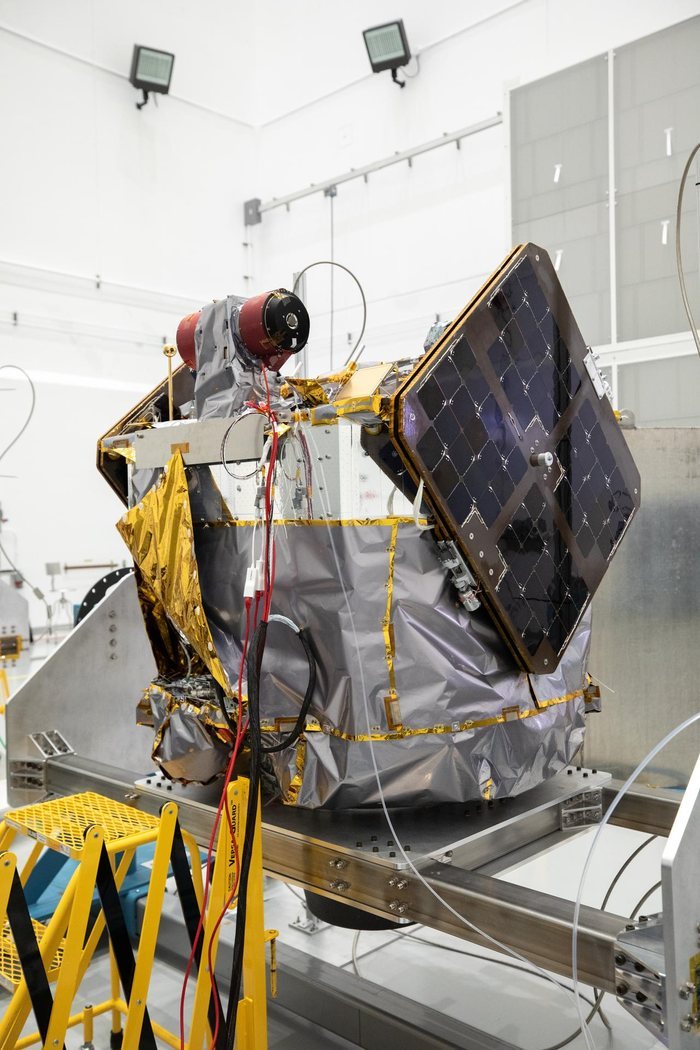
So when you look up at Mars this winter, two spacecraft are out there between you and it, closing the distance.
So when do people go?
Not this window. SpaceX had talked about sending its first uncrewed Starships to Mars in late 2026. Then, on February 8, 2026, Elon Musk wrote that SpaceX would put its effort into a "self-growing city" on the Moon first. His reason was the same clock in this story: a ship can leave for the Moon about every ten days, but for Mars only once every 26 months. He said work toward a city on Mars would still begin in five to seven years. No new Mars mission launched this fall, according to the launch record SpaceDew keeps.
That can sound like a step back. It is less of one than it looks. Almost everything a crew needs for Mars has to be learned closer to home first, and the hardest parts are the same for both places:
- A ship that comes back to fly again. On November 14, SpaceX caught a Starship in the arms of its launch tower after about 14 trips around the Earth. We wrote about why that matters.
- Refueling in space. No ship can carry enough fuel from the ground to reach the Moon's surface or Mars. It has to fill up in orbit, from other ships. Nobody has done that yet at this size.
- Living away from Earth for months. Air, water, food and power, far from help. The Moon is a few days away. Mars is many months away.
How close are we, really?
SpaceDew keeps a score for this called the Dew Point. It runs from 0 to 100, where 100 means a city on Mars that can feed and supply itself. It moves only when something real happens, and every milestone it counts is backed by a public source. On the day this story was written it stood at 34.
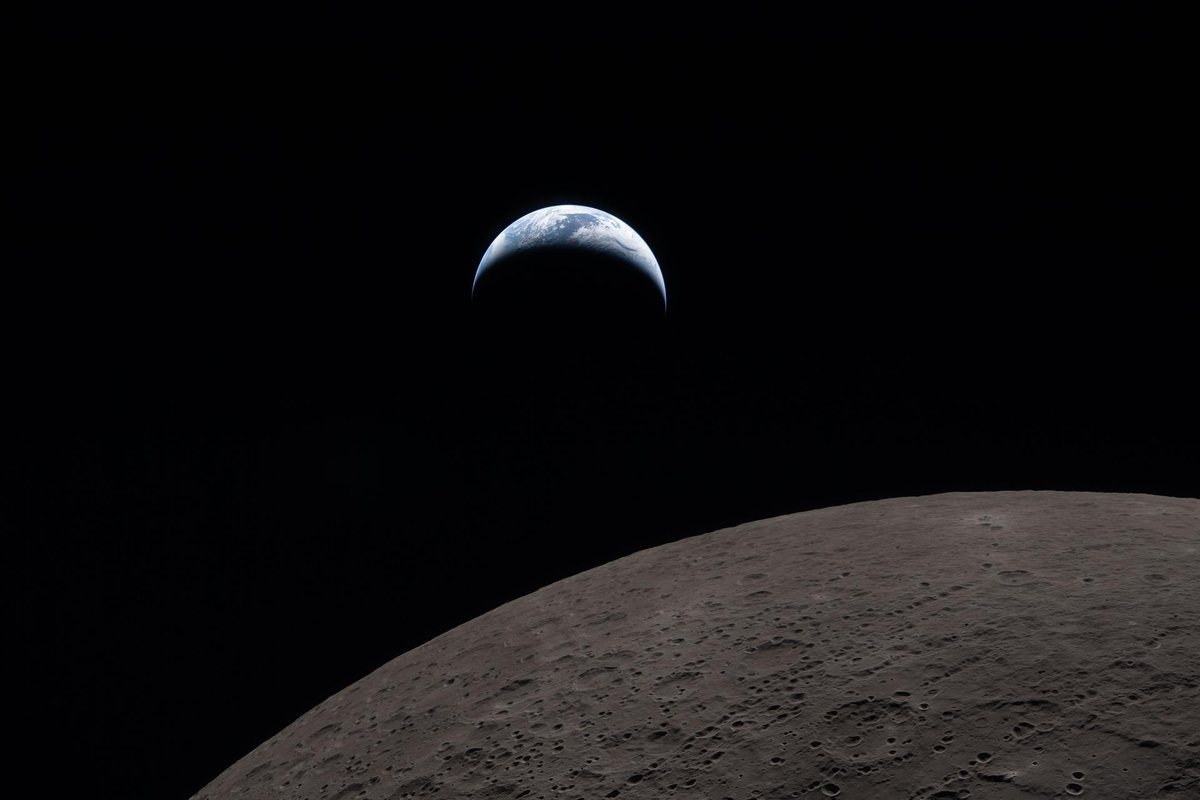
Most of those 34 points are things that already happened. Rockets now land and fly again routinely. Private companies carry astronauts to orbit. Commercial landers have delivered cargo to the Moon. And in April 2026 four people flew around the Moon on Artemis II. The picture of Earth setting behind the Moon, higher up in this story, is theirs.
The next steps are the ones above: both halves of a giant rocket recovered on the same flight, refueling in orbit, and astronauts walking on the Moon again. You can see the whole ladder, step by step, on How close are we to Mars?
Follow along
Mars will be with us all winter. In January it rises in the evening. On February 19 it rises at sunset and stays up all night, as bright as it gets this time around. In September 2027, Blue and Gold arrive.
If you want a short note each morning with what is launching, what moved in the space business and what is in the sky tonight, the Morning Dew is free, and you can sign up here. Every launch we follow is on the launch schedule.
But first, set that alarm. Monday morning, look south. Mars is the finish line, and this week you can see it from your own front yard.
Sources
- NASA, ESCAPADE completes powered Earth flybys, now en route to Mars, November 9, 2026
- NASA, ESCAPADE captures parting images of Earth on its way to Mars, November 23, 2026
- NASA, ESCAPADE mission page
- NASA JPL, Horizons: Mars's distance and brightness on November 28, 2026, December 15, 2026, January 15, 2027 and February 19 and 20, 2027, and the Moon and Mars on November 30, 2026
- NBC News, In a reversal, SpaceX prioritizes 'city' on the moon over Mars project, Musk says, February 2026
- Rising times and directions: SpaceDew's sky model for New York, Chicago, Denver, Los Angeles and Cape Canaveral, checked against JPL Horizons
Get SpaceDew by email
Free. Tick what you want, and nothing else is sent.