Thanksgiving Off the Planet: From a Moon Crew in a Trailer to Greens Grown in Orbit
In 1969 three men back from the Moon spent Thanksgiving sealed inside a trailer on an aircraft carrier. Since then the holiday meal has gone into orbit, picked up tortillas and a cardboard turkey, and grown its own greens. The next step is the hardest: a dinner a Mars crew will have to grow.
By Bill McCoy · Photo: NASA (ISS003-E-08151, November 22, 2001)
Published November 26, 2026. Facts as of that day. Some details may have changed since.
This year we celebrate Thanksgiving on Thursday, November 26. It is the same date as the first Thanksgiving a president of the United States ever proclaimed. On October 3, 1789, in New York, George Washington issued a proclamation that recommended and assigned "Thursday the 26th day of November next" as a day for the people of the new country to give thanks. Two hundred thirty-seven years later, the calendar has come back around to the same Thursday.
Washington's America was a country of about four million people, by the count of the first census the next year. Since then Americans have carried his holiday off the planet. Astronauts have been thinking about Thanksgiving dinner for more than fifty years, and following that meal gives you a short history of how people learned to live away from Earth, one plate at a time. It starts in a trailer on a ship and ends with a question nobody has answered yet.
1969: Thanksgiving in a trailer
Apollo 12 splashed down in the Pacific on November 24, 1969, ten days after launch. Charles "Pete" Conrad and Alan Bean had walked on the Moon. Richard Gordon had circled it alone.
Nobody knew yet for sure whether the Moon carried germs. So within an hour of splashdown the three were sealed inside the Mobile Quarantine Facility, a converted Airstream trailer lashed to the deck of the carrier USS Hornet, with a NASA flight surgeon and a recovery engineer. The five men lived in it for the next five days.
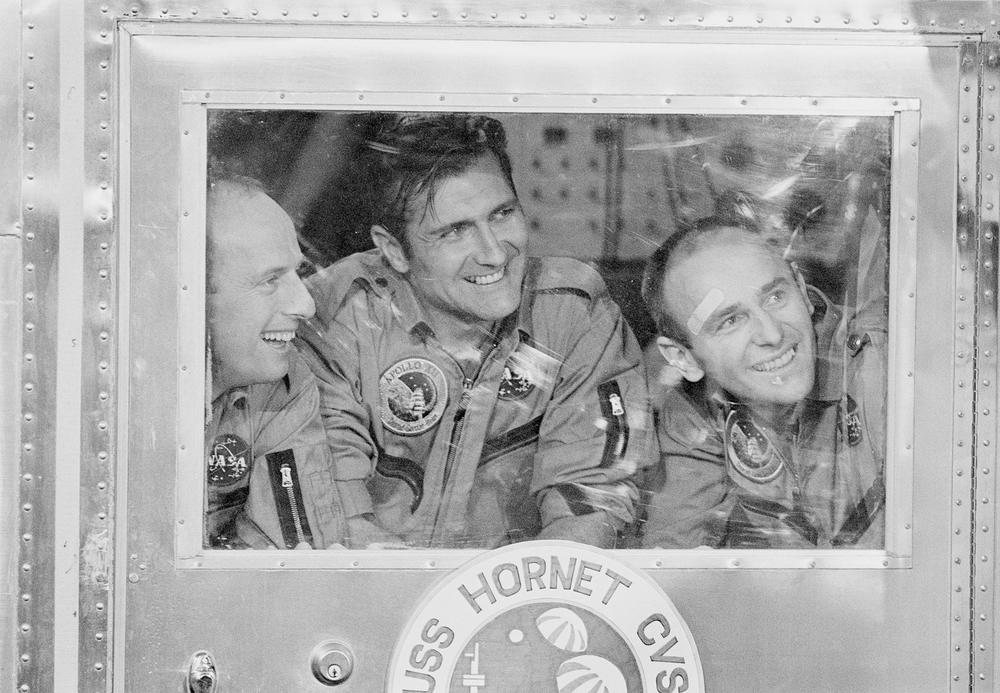
That is where they spent Thanksgiving, on November 27, as the Hornet sailed for Hawaii. NASA's history office notes one luxury on board that was new to most Americans in 1969: a microwave oven.
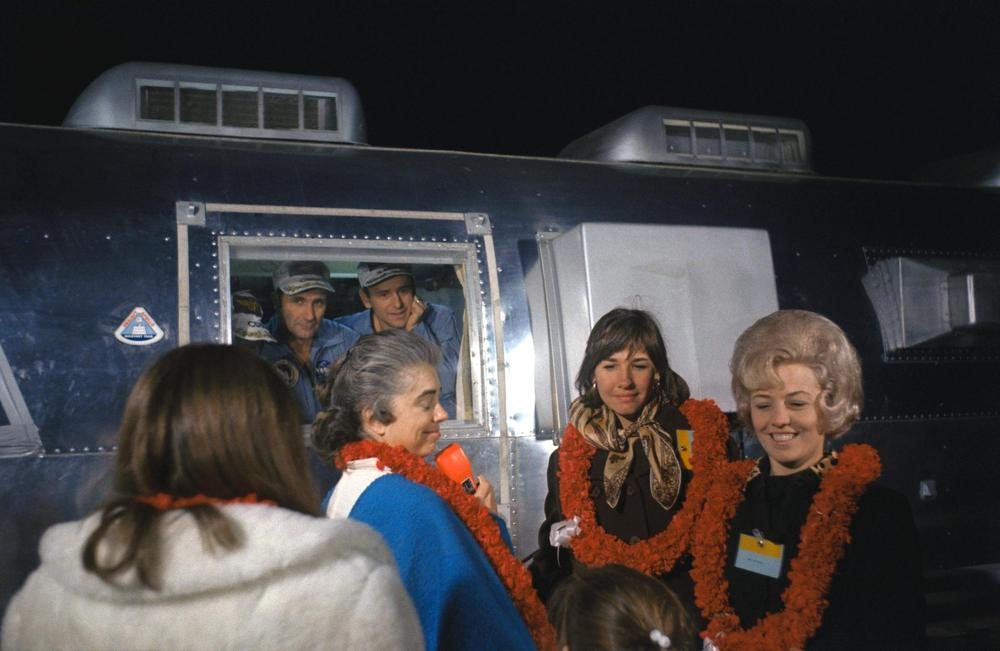
On November 29 the trailer was flown to Ellington Air Force Base in Houston. Their wives and children were waiting. The families could see the men through the window and talk to them by telephone, but not touch them. Then the trailer was driven to the Lunar Receiving Laboratory, where the crew stayed until December 10. When they came out, Conrad told the crowd the lab "was really quite pleasant." All three said they were glad to breathe air that nobody had made.
A year earlier, food in space had taken a big step. On Christmas Day 1968, the Apollo 8 crew found a surprise in their locker: turkey and gravy in a foil "wetpack," made with help from the Army's Natick laboratories, that could be eaten with a spoon. Until then, NASA's historians write, astronauts had eaten purées, bite-size cubes and food rehydrated in a bag, "but never chunks of meat like turkey." Jim Lovell radioed down that it was "outstanding." The holiday meal had started its climb.
1973: the first Thanksgiving in space, and no turkey
The first crew to spend Thanksgiving in orbit was Skylab 4: Gerald Carr, Edward Gibson and William Pogue, on November 22, 1973. It was day seven of an 84-day mission.
Nobody had a holiday meal. Gibson and Pogue spent the day on a spacewalk of 6 hours and 33 minutes. Carr stayed inside the station's docking adapter and, according to NASA, had no access to food the whole time. All three made up for the missed lunch by eating two meals at dinner. NASA's account adds that neither meal included anything special for Thanksgiving.
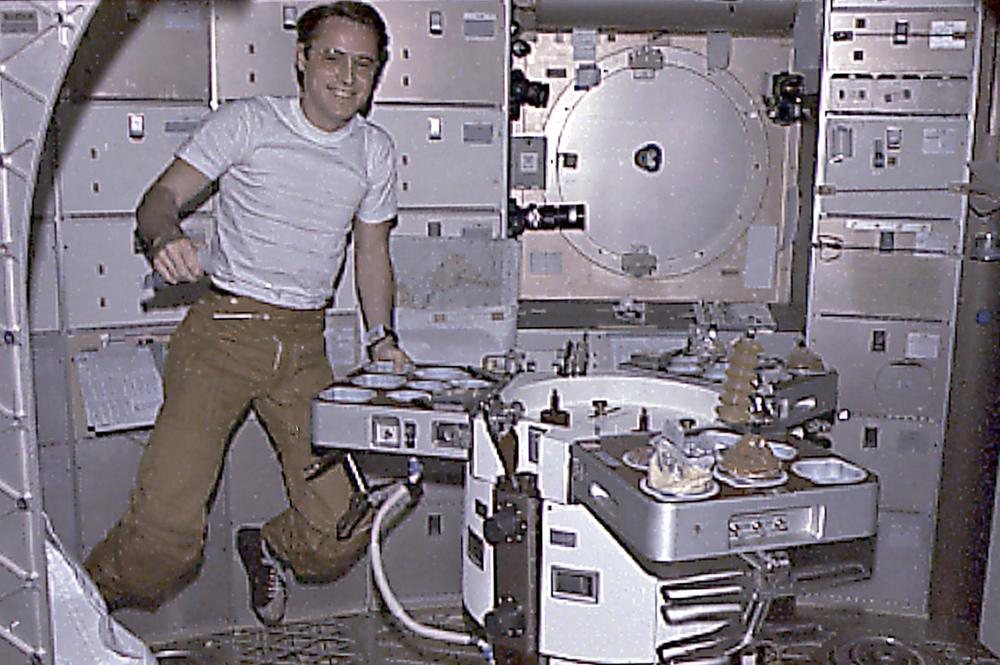
Still, Skylab's kitchen was a leap. It was a real table with a heated tray, and each astronaut picked his own menu. The first Thanksgiving in space was a work day with a late dinner, which may make it the most ordinary Thanksgiving of all.
1985: shrimp cocktail, irradiated turkey and the tortilla
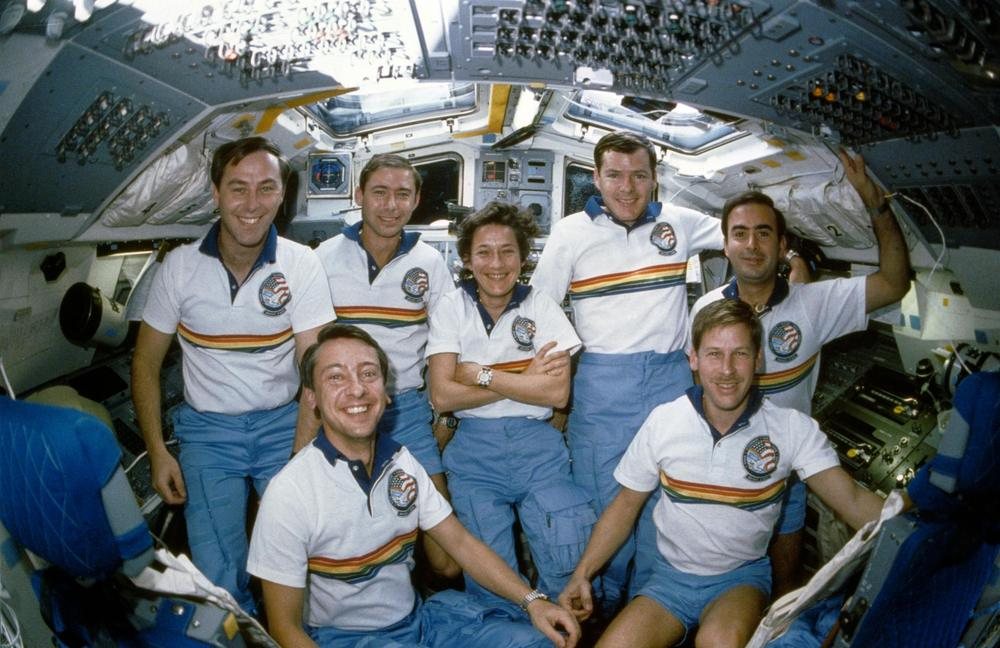
Twelve years passed before the next one. Space shuttle Atlantis launched on STS-61B at 7:29 p.m. Eastern on November 26, 1985. Two days later its seven crew members sat down to shrimp cocktail, irradiated turkey and cranberry sauce.
One of them was Rodolfo Neri Vela, the first Mexican in space. He brought tortillas. NASA credits him with introducing them to space menus, and they have stayed. Bread throws off crumbs, and in weightlessness a crumb floats until it lands in someone's eye or a piece of equipment. A tortilla doesn't. Astronauts have been wrapping their dinners in them ever since.
2000 onward: the station sets a table
The first Thanksgiving on the International Space Station came on November 23, 2000, three weeks after the first crew moved in. William Shepherd, Yuri Gidzenko and Sergei Krikalev ate ham and smoked turkey and radioed their thanks to the people on the ground.
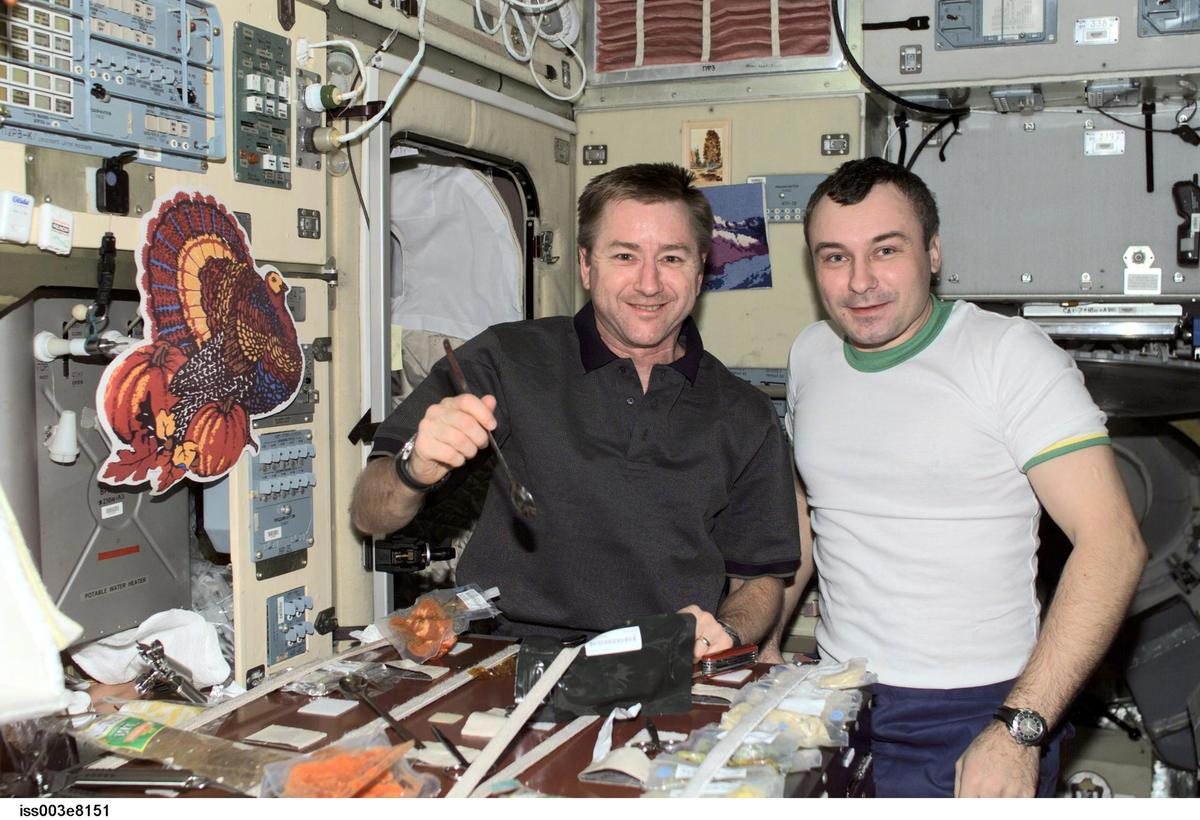
The next year's crew, Frank Culbertson, Vladimir Dezhurov and Mikhail Tyurin, had what NASA calls the first real Thanksgiving on the station, complete with a cardboard turkey on the wall. It is in the photograph at the top of this story. An American and two Russians sat at one table for an American holiday 400 kilometers up.
The station has had people aboard every day since November 2000, so every Thanksgiving since has had a crew in orbit. Along the way:
- 1996: John Blaha, on the Russian station Mir, traded holiday greetings by radio with the shuttle Columbia's crew in a different orbit. NASA says it was the most people in space on Thanksgiving up to then.
- 2002: the first Thanksgiving Day spacewalk at the station, then dinner for ten.
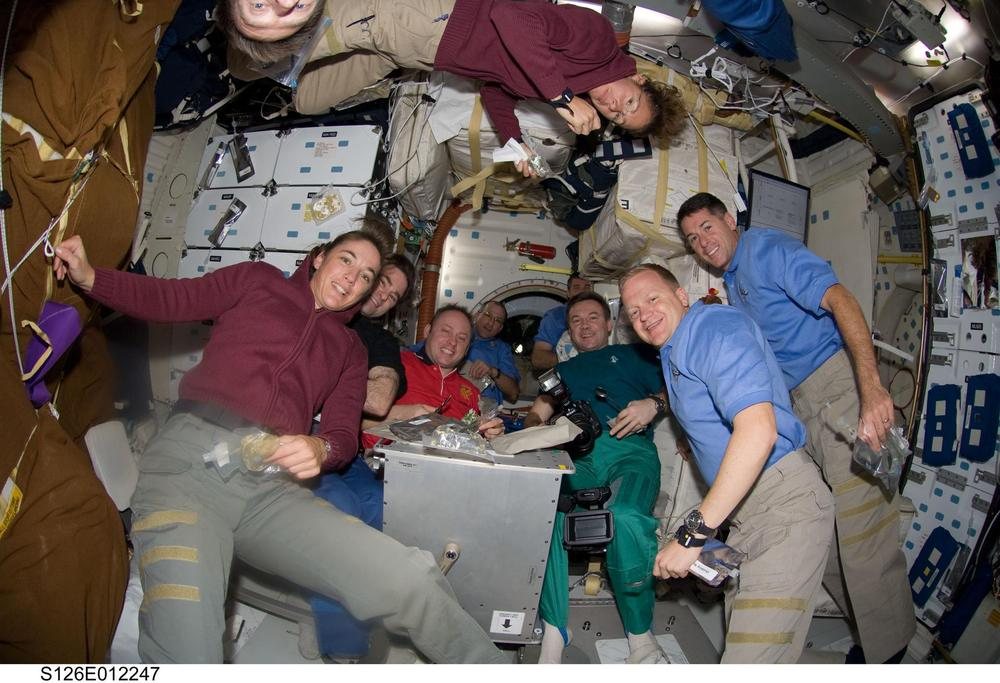
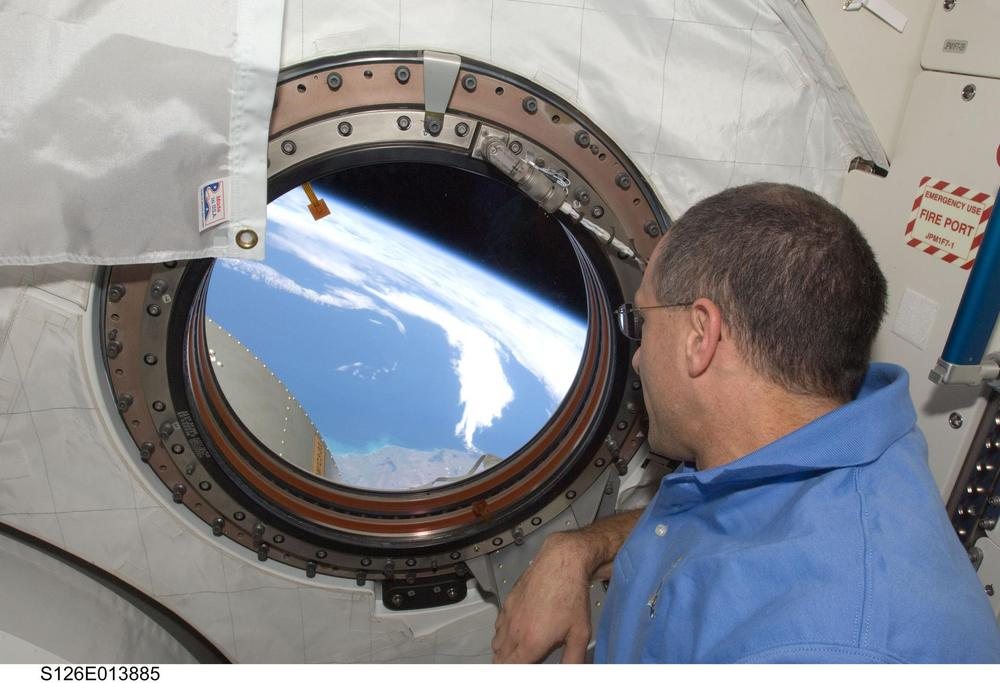
- 2008: the shuttle Endeavour's crew and the station's crew, ten people, ate together on the shuttle's middeck: smoked turkey, candied yams, green beans and mushrooms, cornbread dressing and a cranapple dessert.
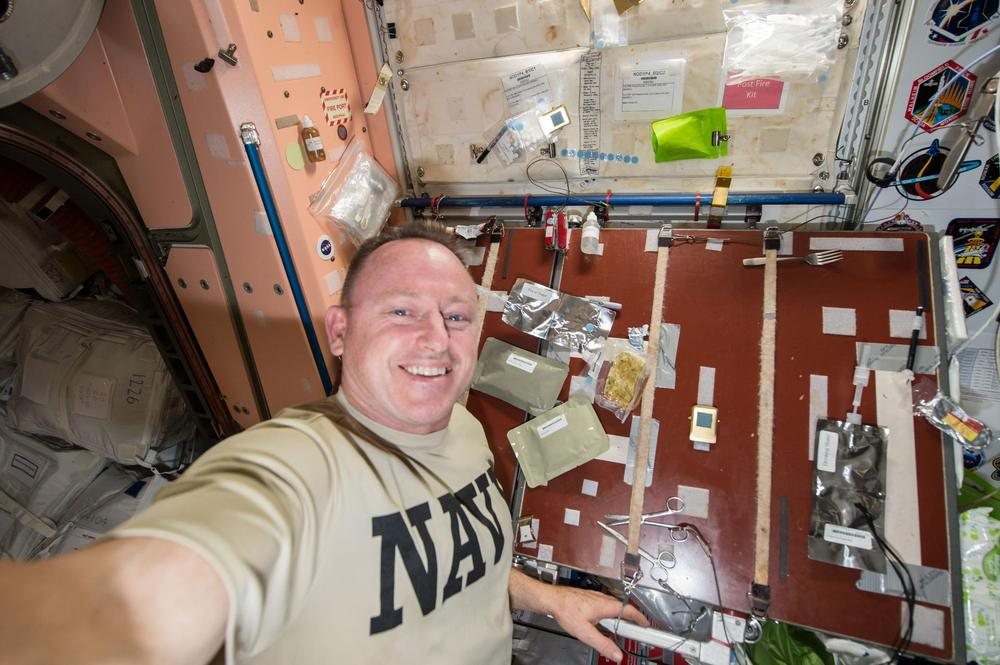
The menu settled into a tradition. In 2014 the station's commander, Barry "Butch" Wilmore, laid out his Thanksgiving packets days early and took a selfie with them: smoked turkey, cornbread dressing, cranapple dessert, tea with sugar.
2019: a harvest on Thanksgiving Day
On Thanksgiving Day 2019, Christina Koch and Jessica Meir harvested Mizuna mustard greens from Veggie, the station's small plant chamber. A holiday meal can't get much more traditional than that: a harvest, brought in on the day, by the people who grew it.
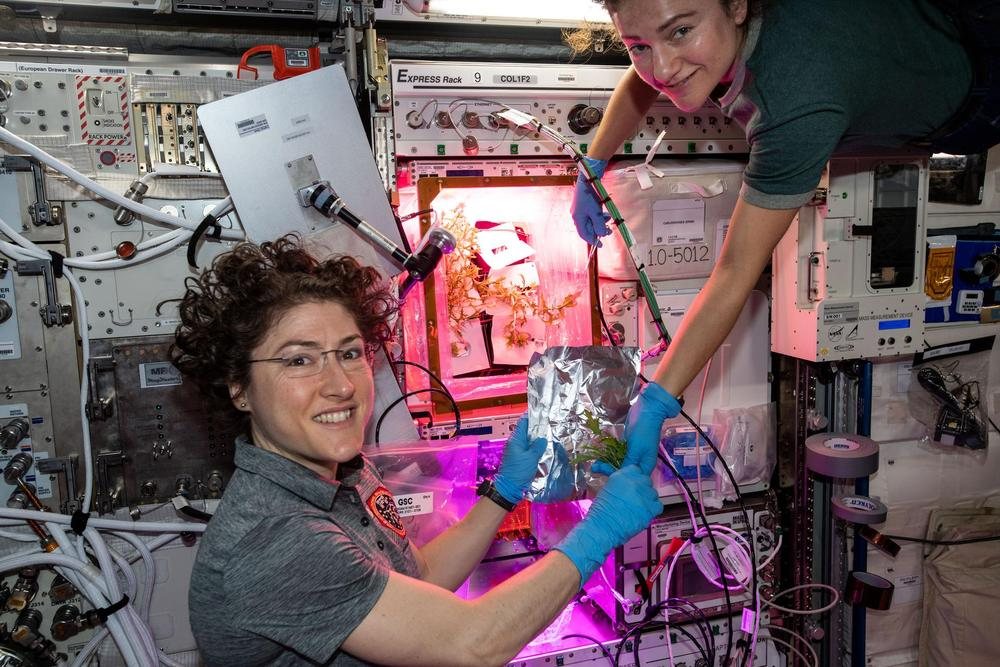
It was also a very small harvest, and that matters. NASA plant scientist Raymond Wheeler writes that the station's plant chambers have about 0.15 square meters of growing room or less. They are meant only to add some fresh food to a packaged diet, though he notes that fresh food does a lot for a crew's health and spirits.
The dinner a Mars crew will have to grow
Here is the problem the station's greens point to. In Wheeler's account, a commonly discussed Mars mission takes 6 to 9 months to get there, then about 500 days on the surface waiting for Earth and Mars to line up again, then 6 to 9 months home. By some estimates, that would take nearly 10 metric tons of packaged food for a crew of four.
There are no resupply ships on that trip, and there's no ordering more. The further people go, Wheeler writes, the more growing their own food becomes a necessity rather than a treat. He does not expect a farm on the first visit to Mars. He sees it growing mission by mission, with crops in water rather than soil (Mars has about three-eighths of Earth's gravity, so water runs downhill again), fed by Martian ice, minerals and recycled waste.
So the holiday's history in space runs from a turkey sealed in foil, through a trailer on a ship, a missed lunch, a tortilla and a cardboard turkey, to one bag of greens. The first Thanksgiving on Mars will close the circle. It will be what the first one in 1621 was: a harvest dinner, made from what the people at the table managed to grow, a very long way from home.
Happy Thanksgiving.
Sources
- George Washington, Thanksgiving Proclamation, New York, October 3, 1789, as transcribed by the National Archives' Founders Online and quoted in Wikipedia, Thanksgiving (United States), read November 26, 2026
- NASA, John Uri, Thanksgiving Celebrations in Space, November 23, 2022 (Skylab 4, STS-61B and its menu, the tortillas, Mir in 1996, the station from 2000 to 2008), read November 26, 2026
- NASA, Jennifer Ross-Nazzal, An Apollo 8 Christmas Dinner Surprise: Turkey and Gravy Make Space History, December 22, 2023 (the wetpack, Natick, Lovell's words)
- NASA, 50 Years Ago: Apollo 12 Return to Houston (Thanksgiving on November 27 aboard the Hornet, the microwave oven, the arrival at Ellington)
- NASA, 50 Years Ago: "Three More Like Before," the Recovery of Apollo 12 (the trailer sealed an hour after splashdown, five men, five days)
- NASA, 50 Years Ago: Apollo 12 Astronauts Leave Quarantine (Conrad's words on leaving the laboratory)
- Raymond M. Wheeler, NASA Kennedy Space Center, Space Agriculture: Going Where Farming Has Never Gone Before (the station's plant chambers, the Mars mission's length and food mass, farming under Mars gravity)
- Photos, all NASA, from the NASA Image and Video Library with their NASA captions: ISS003-E-08151 (November 22, 2001), 6903670 (November 24, 1969), S69-60759 (November 29, 1969), 7450716 (Skylab 4, 1973), 61B-21-008 (November 1985), S126-E-012247 (November 27, 2008), ISS042-E-007110 (November 2014), ISS061-E-061596 (November 28, 2019), S126-E-013885 (November 27, 2008)
Get SpaceDew by email
Free. Tick what you want, and nothing else is sent.