Telescopes: which kind does what?
Why telescopes matter, the main kinds, and what each one is good for.
The big idea: a telescope's main job is to collect light. The wider its main lens or mirror (the aperture), the fainter the things it can show you. Magnification is easy: swap the eyepiece. Aperture is what you pay for.
REFRACTOR
a lens telescope
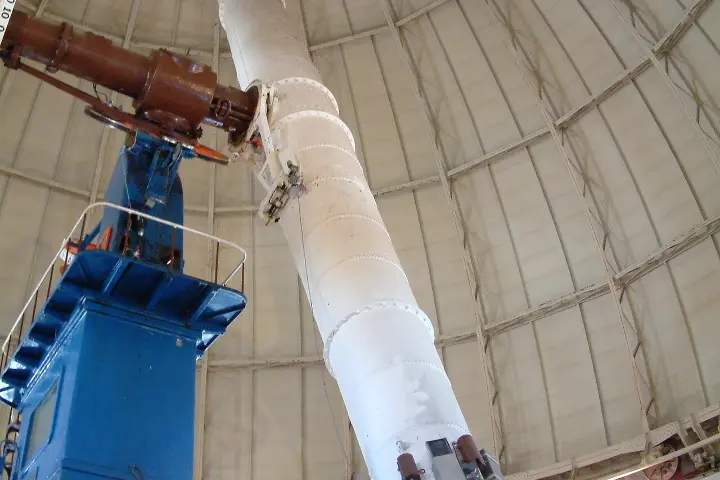
- How:
- A lens at the front bends the light to a focus at the back.
- Good for:
- The Moon, planets and double stars. Sharp, sturdy, a sealed tube, almost no upkeep.
- Watch out:
- Big lenses get heavy and expensive fast, and cheap ones show color fringes.
- Famous:
- Yerkes Observatory's 40-inch in Wisconsin, the largest refractor ever used for research. Binoculars and finder scopes are small refractors.
REFLECTOR
a mirror telescope: Newtonian, Dobsonian
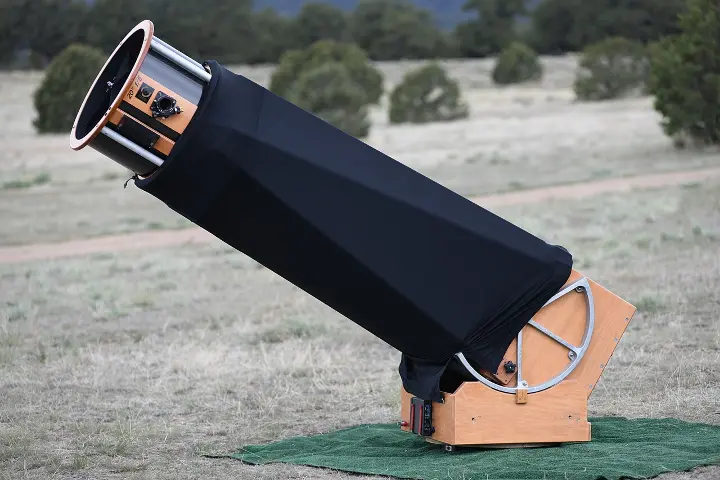
- How:
- A curved mirror at the bottom collects the light, and a small flat mirror sends it out the side to the eyepiece.
- Good for:
- Faint galaxies, nebulae and star clusters. The most aperture for your money. A Dobsonian is a reflector on a simple rocking base, a great telescope for a group.
- Watch out:
- The mirrors need lining up (collimating) now and then, and it needs time outside to cool down.
- Famous:
- Almost every big research telescope is a reflector: the Gran Telescopio Canarias, Keck, Hubble and Webb.
COMPOUND
catadioptric: Schmidt-Cassegrain, Maksutov
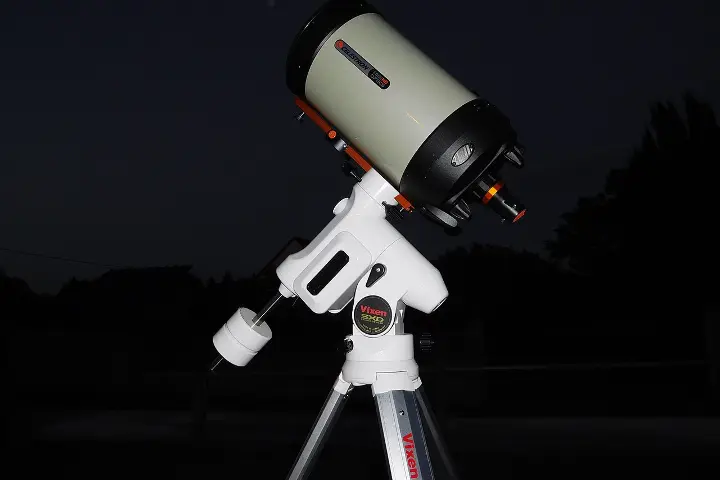
- How:
- A thin corrector lens plus two mirrors fold the light path, so a long telescope fits in a short tube.
- Good for:
- The Moon, planets, astrophotography and travel. Many come on computer "GoTo" mounts that find objects for you.
- Watch out:
- It costs more for the same aperture, and the front lens fogs up with dew.
BEYOND VISIBLE LIGHT
Light we can see is a small slice of what the sky sends. Some telescopes are built for the rest.
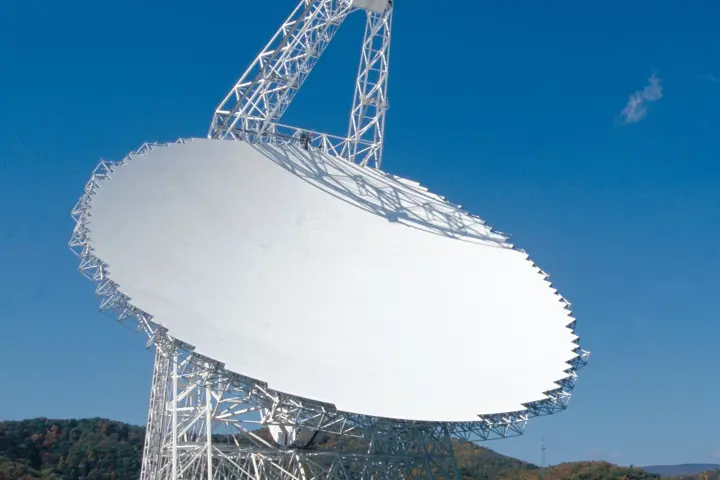
Radio
Big metal dishes catch radio waves from cold gas, pulsars and black holes. They work day or night and through clouds, but they need radio-quiet places: no cell phones near Green Bank or FAST.
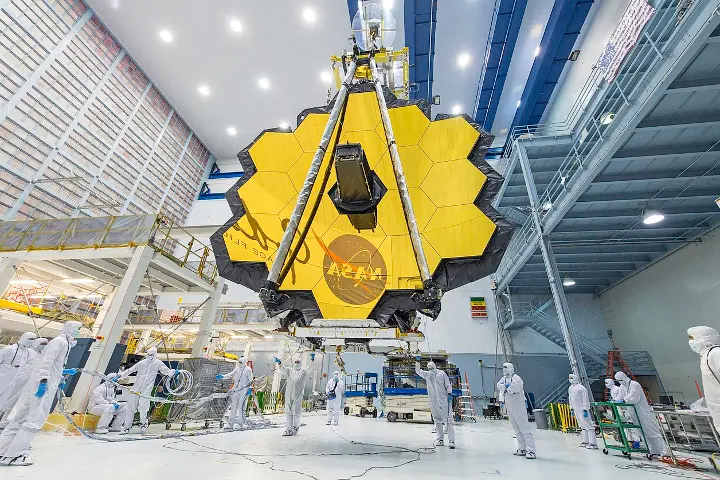
Infrared
Sees heat, and sees through the dust clouds where stars are born. Water vapor in the air blocks much of it, so infrared telescopes go high and dry, or to space like Webb.
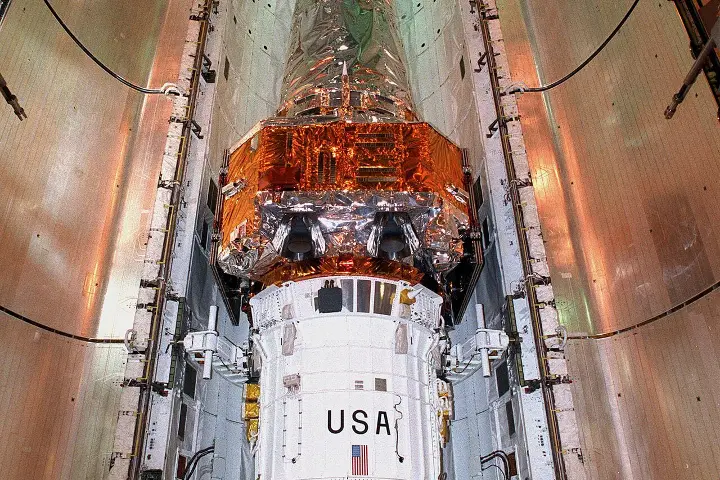
X-ray and ultraviolet
Earth's air blocks these completely, so these telescopes must fly in space. One is the Chandra X-ray Observatory, named for the Yerkes astronomer Subrahmanyan Chandrasekhar.
PICK THE RIGHT TOOL
- The Moon and planets up close
- A refractor or a compound telescope, with a higher power eyepiece.
- Faint galaxies, nebulae, star clusters
- The biggest reflector you can get (a Dobsonian), low power, a dark site.
- The Milky Way, star fields, a first look
- Binoculars. "10x50" means 10 times magnification and 50 mm lenses. The best first instrument.
- Camping and travel
- A small refractor or a Maksutov: light, tough, quick to set up.
THE SUN
Only with a certified solar filter covering the front of the telescope. Never look at the Sun through any telescope, binoculars or camera without one. And never look at the Sun with your bare eyes, not even for a second. To see it safely without a telescope, use certified eclipse glasses (ISO 12312-2) or project its image onto paper.
Want to stand under a real one? Observatories you can visit lists the big telescopes of the world that take visitors, by country and state. And Tonight's Sky says what is worth pointing a telescope at tonight.
Telescopes: which kind does what? A one-page handout on the main kinds of telescope and what each is good for. 1 page, 93 KB.
Working on the Astronomy merit badge? This page covers requirement 3; the Scouts page has the rest.
The photographs are real: NASA's own, or Wikimedia Commons files under a free licence, each credited under the picture with a link to its source. The drawings are diagrams, not to scale.