Sky help for the Astronomy merit badge
Working on the Astronomy merit badge? We have put together our own easy-to-use worksheet for the whole badge, free to download and print, and this page to go with it: a planet chart worked out for your own town, the Moon's phases, and tonight's bright stars.
Pick your town first. The planet chart, the Moon and the stars below all follow it.
Reading your place and the date.
Start here: download the field log
The worksheet for the whole badge
Our own Astronomy field log is a 9-page worksheet built for the telescope, not the desk. It is not a book report: you talk each requirement through, find it in the real sky, sketch what you see and check it off. Every requirement is on it, with room to write and draw, hints along the way, and a sign-off tracker for your counselor.
Two more handouts
Telescopes: which kind does what? A one-page handout on the main kinds of telescope and what each is good for. 1 page, 93 KB.
Telescope travel guide. The three biggest telescopes drawn to one scale, and the major observatories of the world. 6 pages, 280 KB.
Both are pages here too, with real photographs: Telescopes (requirement 3) and Observatories you can visit (requirement 8a).
About the merit badge
For the requirements themselves and the merit badge pamphlet, go to Scouting America's own pages. Each opens in a new tab.
Planet chart
Twelve months of evening planets for your town, and the five planets up close.Open
Planets in the evening sky · Requirement 5b: the twelve-month chart
Mercury, Venus, Mars, Jupiter and Saturn down the side, the next twelve months across the top starting with this month, and a box filled for each month the planet is up in the evening over your town.
Reading your place and the date.
The five planets up close
Requirements 5a and 5c: phases and motion
Reading your place and the date.
Why only Mercury and Venus show phases (5a)
Mercury and Venus circle the Sun inside Earth's orbit. Sometimes they are on the far side of the Sun and we see their whole lit face; sometimes they pass between us and the Sun and we see only a thin crescent. So they go through phases like the Moon's. Mars, Jupiter and Saturn circle outside Earth's orbit, so we always look at them from the Sun's side and see nearly the whole lit face. You need a telescope to see any planet's phase.
Why planets wander, and sometimes go backward (5c)
The stars keep their patterns; the planets drift through them from week to week. The Greeks called them wanderers, which is where the word planet comes from. They all stay close to one line across the sky, the ecliptic, the Sun's own yearly path, which runs through the constellations of the zodiac. Most of the time a planet drifts eastward against the stars. When Earth overtakes an outer planet, or an inner planet overtakes Earth, it seems to drift backward (westward) for some weeks. That is retrograde motion: nothing reverses, it is the view from a moving Earth.
A planet almost stands still at each end of a backward spell, so those dates are good to a day or two. The constellation is the one the ecliptic runs through at the planet's place; a planet near a border may sit next door. The discs are drawn from each planet's lit share.
Moon phases
Tonight's Moon, the next phases with dates, and a week of Moons for your sketches.Open
Requirements 6d and 6b
The Moon is a ball with one half always lit by the Sun. As it circles Earth, once every 29 and a half days, we see more or less of that lit half. That is all a phase is.
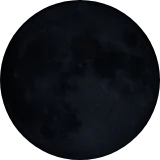 New
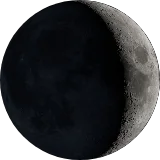 Waxing crescent
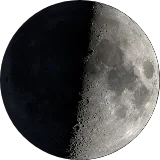 First quarter
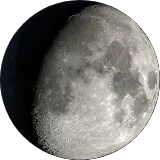 Waxing gibbous
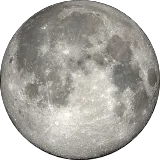 Full
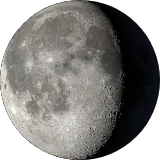 Waning gibbous
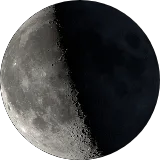 Last quarter
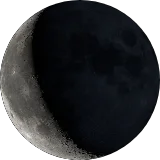 Waning crescent
The next phases
Reading your place and the date.
Phase times are good to about an hour.
What each phase means, and when eclipses happen (6d)
New Moon. The Moon is between Earth and the Sun. Its lit half faces away from us. Rises and sets with the Sun, so we do not see it.
First quarter. The Moon is a quarter of the way around its orbit. We see half of its lit half. High in the sky at sunset; sets around midnight.
Full Moon. Earth is between the Sun and the Moon. Its whole lit half faces us. Rises at sunset and is up all night.
Last quarter. The Moon is three quarters of the way around. We see the other half lit. Rises around midnight; still up in the morning sky.
Eclipses. A solar eclipse can only happen at new Moon, when the Moon passes exactly between the Sun and Earth and its shadow lands on us. A lunar eclipse can only happen at full Moon, when the Moon passes through Earth's shadow. They do not happen every month because the Moon's orbit is tilted about 5 degrees against Earth's, so most months the Moon slips above or below the line. This page does not forecast eclipses; NASA publishes the dates.
A week of Moons, for the four sketches in 6b
6b asks for the Moon at the same hour and place on four nights in one week. Pick a week when it is up at that hour. Here is the Moon one hour after sunset for the next two weeks. Each night it rises about 50 minutes later and sits farther east at the same hour.
Reading your place and the date.
Bright stars tonight
Where to look, and each star in its real colour.Open
Requirements 4b, 7c and 4c
Where the brightest stars stand over your town tonight, once the sky is dark enough to see them and again three hours later. A star's colour tells you how hot its surface is: blue stars are the hottest, yellow ones like the Sun are in the middle, red ones are the coolest. Each star below is drawn in its own colour.
Reading your place and the date.
The twenty brightest stars and Polaris, shown when at least 10 degrees up. Requirement 4 has to be done outside under the real sky; this only tells you where to look.
The rest of the log
- 5d, observe a planet. Tonight's Sky says which planets are up tonight, when, and which way to look.
- 4d, the Milky Way. It needs a dark site and no Moon.
- 6a, the Moon's seas and craters. Craters stand out along the shadow line near first quarter.
- 8b, an observing session. Tonight's Sky lists the space station's passes and takes a later date, so you can plan the night ahead.
- Everything else (1, 2, 3, 6c, 7a, 7b, the rest of 8, and 9) is safety, telescopes, the Sun and your own plans: a talk with your counselor. Nothing here works those out.
SpaceDew is not part of Scouting America, and this is not an official merit badge page. Requirement numbers follow the Astronomy merit badge requirements as checked against scouting.org on Nov 11, 2026, for the field log this page goes with; requirements change, so check scouting.org. Clock times are US Eastern, with your own clock beside them when it differs, and a town outside the US shows its own clock first. The Sun and Moon follow the Astronomical Almanac's formulae and the planets JPL's approximate elements, good to about a degree and held to published dates at every build. The planet pictures are NASA spacecraft images (NASA/JHUAPL/Carnegie Institution of Washington; NASA/JPL-Caltech; NASA/JPL/Malin Space Science Systems; NASA/JPL/University of Arizona; NASA/JPL/Space Science Institute); the Moon pictures are NASA's Scientific Visualization Studio, from Lunar Reconnaissance Orbiter imagery, at the nearest of thirty phases. Your place stays in this browser.