Update: Hubble Images Galactic Bulge Stars to Prepare Roman's Search for Planets
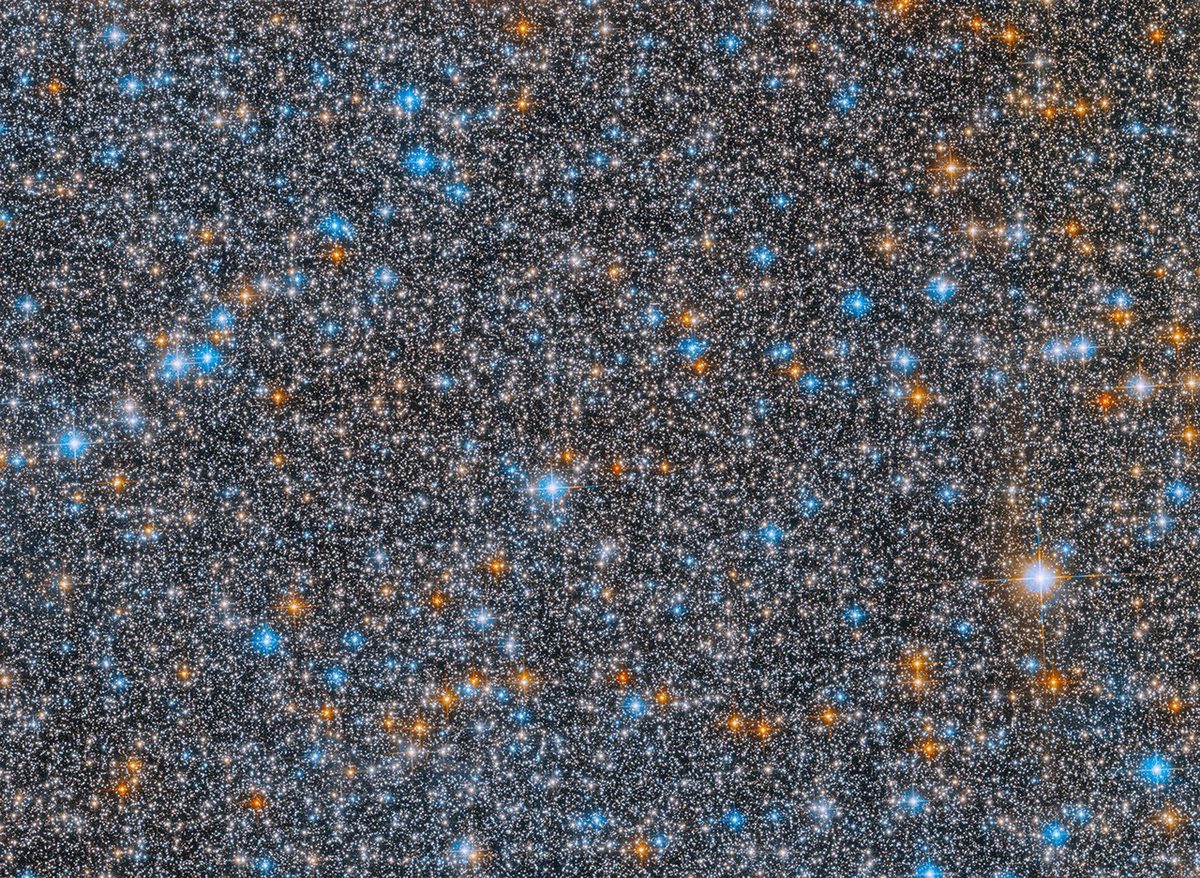
NASA released Hubble Space Telescope images of the Milky Way's galactic bulge on science.nasa.gov, the agency said, to help the Roman telescope find planets and characterize stars there.
The release gives no clock time and no place for the release itself. It does give the reason for the work: Roman will look at this crowded region, and Hubble is mapping it first.
This follows the Hubble lens gallery we covered on November 13, which prepared Roman for dark matter work. This new set prepares it for a different job, hunting planets around stars.
What NASA says
NASA describes the images as an expanse of stars in a rainbow of colors. They point toward the galactic bulge, which NASA defines as a densely packed, spherical region of stars surrounding the center of a galaxy's disk.
NASA says the bulge holds nearly a quarter of the Milky Way's stellar mass. Other galaxies have bulges too, but NASA says they are too jam-packed and far away for astronomers to pick out single stars. Ours is close enough to study in detail. Researchers hope to find new planets there and better understand how galaxies form, evolve and interact over billions of years, according to the release.
The images are part of a survey. NASA says it will help researchers interpret upcoming Roman observations as they characterize stars and search for exoplanets, which are planets around other stars.
Why Hubble looks first
Hubble sees mainly ultraviolet, visible and near-infrared light, NASA says. Roman collects near-infrared light and some visible light. So Hubble looked at the bulge in the wavelengths the two telescopes share: the red end of the visible spectrum and the near-infrared. That lets researchers compare the two sets of data directly, according to NASA.
NASA says Hubble's sharp resolution lets its instruments record the brightness, ages, composition and motion of stars over time. With that, astronomers can search for potential exoplanets, locate black holes or dark matter, and better understand the galaxy's environment and evolution.
The microlensing connection
The release ties this work to a key part of Roman's plan: finding planets through microlensing. NASA defines a microlensing event as a kind of gravitational lensing in which light from a more distant object is magnified and distorted by the mass of a closer object along the line of sight.
The distortion carries clues. NASA says the way a distant star's light is bent and brightened can reveal the nature of the foreground star and any planets it has.
Here is where Hubble comes in. NASA says Hubble's observations will characterize stars in the region before they undergo a lensing event. Months or years in the future, when Roman captures such an event, researchers can compare Hubble's earlier data with Roman's, which NASA says makes the event easier to interpret.
NASA also notes the scale. These microlensing events involve stars and planets, much smaller than the lenses around galaxies and galaxy clusters in the gallery we covered earlier.
Context
NASA says Hubble has observed the central bulge many times over its lifetime. The release names two earlier surveys. One is the WFC3 Galactic Bulge Treasury Program, which used Hubble's Wide Field Camera 3 to study the brightness, precise positions and motions of stars in the congested region. The other is the Sagittarius Window Eclipsing Extrasolar Planet Search, known as SWEEPS, which used the Advanced Camera for Surveys to look at 180,000 stars in the bulge, NASA says.
The new images come from Hubble observing program 17776, led by S. Terry, according to the release. NASA says the program is designed to aid Roman in its search for exoplanets, black holes, neutron stars and more. The data also adds to Hubble's long record of high-precision bulge observations, NASA says.
One detail from the release is worth a note. The program is set up as a before-and-after comparison. Hubble records the stars now, and Roman's later view of a lensing event gets read against that baseline.
Another NASA page, about an October 22, 2026, Hubble image, says the agency has taken many gravitational lensing images with Hubble in preparation for Roman science. That page credits NASA, ESA and X. Huang (University of San Francisco), with processing by Gladys Kober (NASA/Catholic University of America). It shows the bulge survey is one of several Hubble efforts feeding Roman's work.
What is next
Roman is described by NASA throughout as upcoming. The release gives no launch date and no date for Roman's first bulge observations, so neither can be reported here. It says only that a microlensing event could be captured months or years in the future.
What NASA does say is that the comparison between Hubble and Roman data is planned. When Roman sees a lensing event in the bulge, researchers will set it beside the Hubble images released now. The groundwork is done; the planet hunt waits on Roman.
Stay curious.
Find more at spacedew.com and @boggleriley on X
Get SpaceDew by email
Free. Tick what you want, and nothing else is sent.