Hubble Image Set Maps Gravitational Lenses for Roman Telescope's Dark Matter Hunt
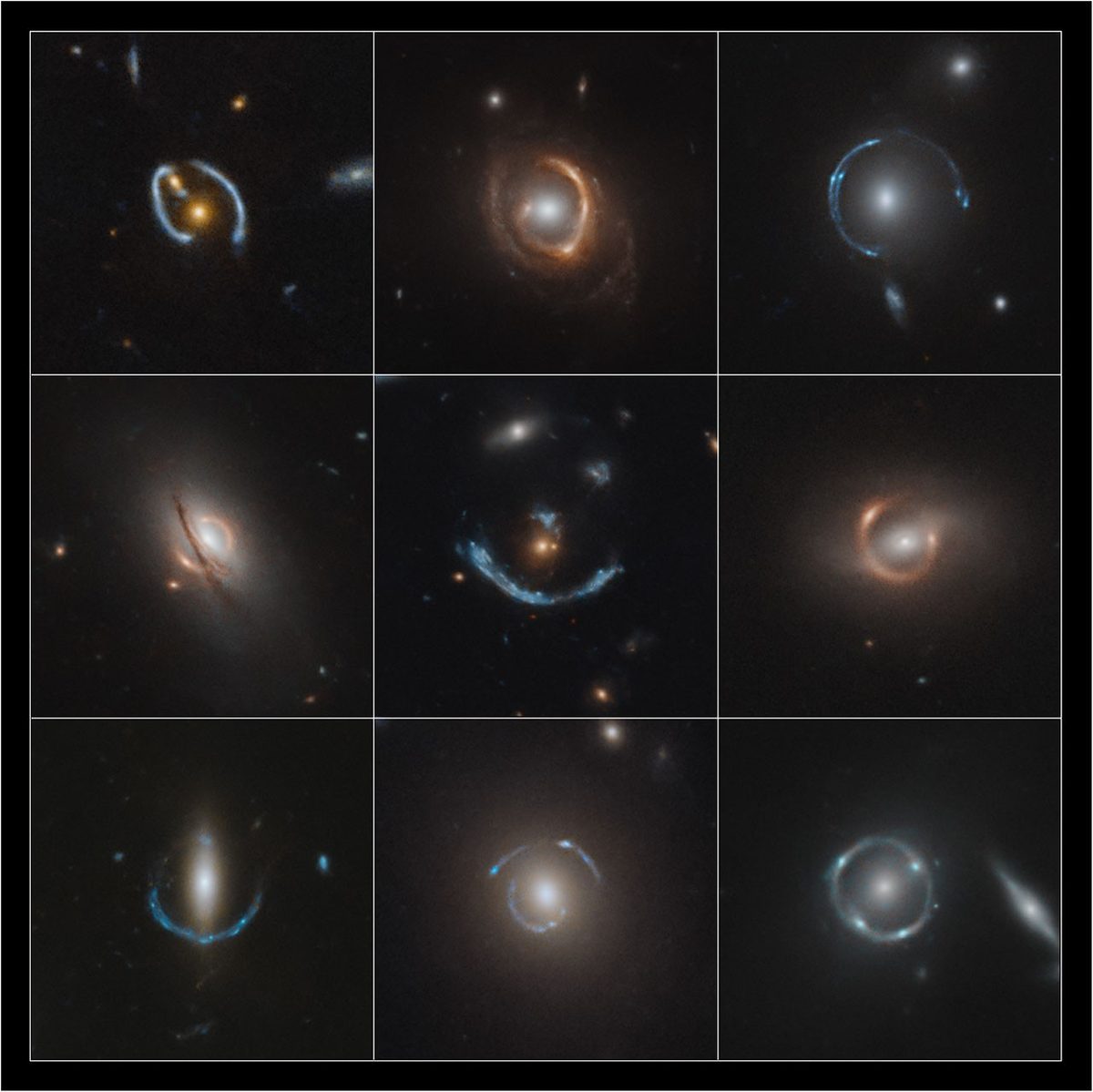
NASA released a gallery of gravitational lenses from the Hubble Space Telescope on November 12, 2026, to prepare for dark matter studies by the new Nancy Grace Roman Space Telescope, NASA said.
The release on science.nasa.gov does not give a clock time or a place for the release itself. It gives the reason for the work, which is dark matter.
What NASA says
A gravitational lens forms when a massive foreground object, such as a galaxy or a cluster of galaxies, bends and magnifies the light of a more distant galaxy behind it. NASA's release says the effect works like a giant lens in space, one that lets astronomers see objects much farther away than any telescope could see alone.
The lenses in the new image come from a precise alignment of a distant background galaxy with the mass of a foreground galaxy. The result is distorted, magnified copies of the background galaxy that show up as arcs around the foreground one.
Astronomers plan to build lens models from a large and varied set of these systems. The models should show how much mass sits in each foreground galaxy, and NASA says that could "potentially prove or dispel a theory about dark matter." Dark matter is the invisible material that does not give off or block light but still pulls on things with gravity.
The release names the theory in question: cold dark matter. It predicts many small clumps of dark matter, between a million and a billion solar masses each, according to NASA. For comparison, NASA puts the dark matter halo of the Milky Way at around 1.3 trillion solar masses. Hubble's sharp images and precise models should let researchers spot small flaws in the lensed arcs that would point to such clumps.
A tour of the panels
NASA's release walks through several panels of the image.
- Panel A is an arc-counterarc case. The background galaxy shows up as a pair of arcs, magnified by a pair of foreground galaxies.
- Panel F is an Einstein Ring. The alignment is so close that the lensed galaxy almost fully encircles the foreground galaxy.
- Panels I and C each show a quadruply lensed galaxy, meaning the background galaxy appears four times. In panel C, NASA says the double knots are most likely strong star-forming regions.
- Panel D has a visible dust lane in the foreground galaxy, which NASA calls rare in a lensing galaxy.
The panel D detail is the one I would point to. NASA says the lensed background galaxy there could be an Einstein Ring, with the dust lane "breaking" our view of it. Infrared light is less blocked by dust, so NASA says future Roman infrared observations could help show whether the arcs form a fuller ring.
Colors carry information too. NASA says bluish arcs indicate young stars and reddish arcs indicate older ones, and that Roman and Hubble will use those differences to study how galaxies evolved earlier in the universe.
Most of the foreground lensing galaxies are ellipticals, which NASA describes as older, denser and more compact. Not all are. In panel G the foreground galaxy looks elongated, which NASA says may be real or a trick of perspective. In panels B and F the foreground galaxies appear to have spiral arms.
Why two telescopes
NASA's release lays out the split in plain terms. Hubble looks mainly in visible and ultraviolet light, with some infrared, and gives a high-resolution view of single objects. Roman sees mainly infrared and some visible light, over a much larger field of view, to build panoramas.
So Hubble gets the better look at any one lens, and Roman can catch more lenses. If Roman finds an especially interesting one, NASA says researchers may point Hubble at it for follow-up in visible and ultraviolet light.
The lenses in the gallery were first found with the Dark Energy Spectroscopic Instrument at Kitt Peak, NASA says. Hubble then observed them, and Roman will take further observations.
Context
NASA's page for a related Hubble image says a barred galaxy dominates an October 22, 2026, picture, but the gravitational lensing at bottom right is the real target. NASA describes it as one of many lensing images Hubble has taken to prepare for Roman science. The credit reads: NASA, ESA, and X. Huang (University of San Francisco); processing by Gladys Kober (NASA/Catholic University of America).
Dark matter mapping is already underway with another telescope. In a NASA release about the James Webb Space Telescope, the agency said a Webb map of dark matter was published on Monday, January 26, in Nature Astronomy. NASA said Webb watched that patch of sky for about 255 hours and identified nearly 800,000 galaxies. That release also says Roman will map dark matter over an area 4,400 times bigger than the region Webb mapped, though Roman's maps will not beat Webb's sharpness.
What is next
Researchers intend to study the Hubble lens images in detail to build a search tool, which NASA calls a "super-intelligence tool," for finding similar arcs in Roman's images, according to the release. That is an intention, not a finished product. NASA says the Hubble images are expected to produce their own dark matter results and to pave the way for analysis of Roman's larger sample of lenses.
The release gives no date for Roman's lens observations and no date for the first results. Those are not in NASA's record, so there is nothing to report on timing yet. What NASA does say is that Roman joins Hubble, the Chandra X-ray Observatory and the James Webb Space Telescope among the large space observatories.
Stay curious.
Find more at spacedew.com and @boggleriley on X
Get the Morning Dew
The daily brief, live quotes and the newest File Zero story, every morning. Plus a Friday recap of the week. Nothing else, ever.