The Space Shuttle, the Truck That Built a Space Station
Thirty years, five orbiters and 135 flights. The machine that made spaceflight look routine, and taught us what routine costs.
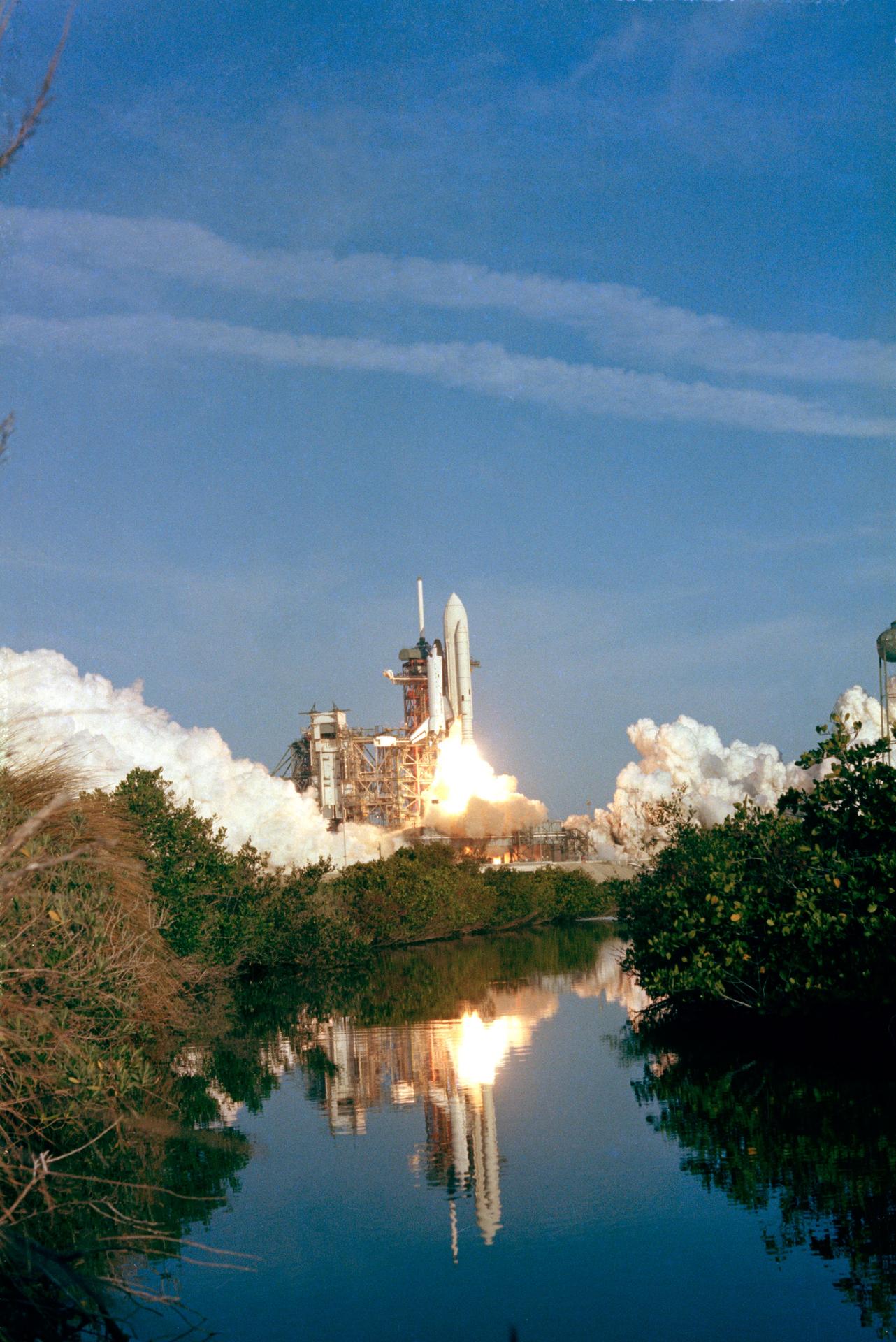
By SpaceDew · Photo: NASA
On the morning of April 12, 1981, two men sat on top of a rocket that had never flown. That was not how it was done. Every crewed American spacecraft before it had flown first without anyone aboard. But Space Shuttle Columbia could not fly itself home, so John Young and Robert Crippen rode it on its very first trip. It was twenty years to the day after Yuri Gagarin became the first person in space.
Two days and six hours later, Columbia glided onto a dry lakebed at Edwards Air Force Base in California and rolled to a stop like an airliner. A spacecraft had come back in one piece, ready to fly again. Nothing like it had ever existed.
For the next thirty years the Space Shuttle was what most people pictured when they heard the word "astronaut." It carried 355 people from 16 countries into orbit. It launched the Hubble Space Telescope, then went back five times to fix and upgrade it. It hauled up most of the International Space Station, piece by piece. It also killed fourteen people, in two disasters that changed how NASA thinks about risk.
This is the story of that machine.
A truck for space
The idea was simple, and it was the idea that sold it. Rockets in the 1960s were thrown away after every flight. A Saturn V that cost hundreds of millions of dollars ended up in the ocean in pieces. What if you built a spacecraft that landed on a runway and flew again a few weeks later, like an airplane? Space would get cheaper. Flights would become routine. The shuttle would be a truck: it would carry satellites up, bring broken ones back, and give scientists a laboratory in orbit.
President Richard Nixon approved the program in January 1972. What NASA built was three things bolted together:
- The orbiter, the winged spaceplane everyone recognizes, with three main engines in its tail and a cargo bay long enough to hold a school bus.
- The external tank, the big orange tank of liquid hydrogen and oxygen that fed those engines. It was the one part thrown away on every flight.
- Two solid rocket boosters, which did most of the pushing for the first two minutes, then parachuted into the Atlantic to be fished out and reused.
Before anything went to orbit, NASA tested the gliding part. In 1977 a prototype orbiter named Enterprise rode on the back of a Boeing 747, was released in midair, and glided to a landing in the California desert. Enterprise had no engines and never went to space. It proved the hardest part of the idea: a spacecraft could land on a runway.
The fast years
After Columbia proved the machine worked, the fleet grew to four orbiters: Columbia, Challenger, Discovery and Atlantis. The flights came quickly, and the firsts came with them.
In June 1983, Sally Ride flew on Challenger as the first American woman in space. Two months later, Guion Bluford became the first African American in space. In February 1984, Bruce McCandless stepped out of Challenger wearing a jet-powered backpack and flew free of the spacecraft, with no tether at all, the first person ever to do it. Two months after that, a crew caught a broken science satellite called Solar Maximum, repaired it in the cargo bay and set it loose again. Nobody had ever fixed a satellite in space before.
The shuttle was doing what it was built for. In 1985 it flew nine times, the most in any single year of the program.
January 28, 1986
Seventy-three seconds after launch, Challenger broke apart over the Atlantic. All seven people aboard died, among them Christa McAuliffe, a high school teacher from New Hampshire who was going to teach lessons from orbit. Millions of schoolchildren were watching.
A presidential commission found the cause. The morning had been unusually cold, and a rubber seal called an O-ring, in a joint of the right solid rocket booster, failed to seal. Hot gas burned through. The commission also found that engineers had warned about the seals in cold weather, and that the warnings had not made it to the people deciding whether to launch.
The shuttles did not fly again for 32 months. When they did, they stopped carrying most commercial satellites for paying customers. A fifth orbiter, Endeavour, was built to replace Challenger, and first flew in 1992.
The telescope and the station
The shuttle's greatest work came after the disaster.
In April 1990, Discovery carried the Hubble Space Telescope into orbit. Within weeks, astronomers found a problem: its main mirror had been ground to the wrong shape, by about one fiftieth of the width of a human hair, and its pictures came out blurry. In December 1993, Endeavour flew up to it. Over five spacewalks, astronauts installed corrective optics, in effect giving the telescope glasses. Hubble's pictures have been sharp ever since, and shuttle crews went back to service it four more times. The last visit, by Atlantis in 2009, was the final shuttle flight that did not go to the space station.
Then came the biggest job of all. In 1995, Atlantis docked with Russia's Mir space station, the first of a series of visits that taught both countries how to work together in orbit. In December 1998, Endeavour carried up Unity, the first American piece of the International Space Station, and joined it to the first Russian module already in orbit. Over the next twelve years, shuttle after shuttle delivered the station's modules, trusses, solar wings and robotic arms. This is the truck from the original sales pitch, finally doing exactly what a truck does.
February 1, 2003
Columbia, the first shuttle, was coming home from a sixteen-day science mission when it broke apart over Texas, sixteen minutes before landing. All seven crew members died, among them Ilan Ramon, the first Israeli astronaut.
The cause traced back to launch day. About 82 seconds after liftoff, a piece of foam insulation, the size of a briefcase, fell off the external tank and struck the front edge of Columbia's left wing. It cracked the heat shield there. During the fiery trip back through the atmosphere, superheated air got inside the wing and destroyed it from within. The investigation board found that foam falling off the tank had been seen on earlier flights, and had come to be treated as normal.
The shuttles were grounded again, this time for two and a half years. When they returned, every crew inspected its own heat shield in orbit with a camera on a long boom. In January 2004, the White House announced that the shuttle would retire once the space station was finished.
The last flight
On July 8, 2011, Atlantis lifted off on the 135th and final shuttle mission, carrying four astronauts and a year's worth of supplies to the space station. On July 21, it landed at Kennedy Space Center before dawn. It was the 133rd landing in shuttle history.
The orbiters are museum pieces now. Discovery is at the Smithsonian's Udvar-Hazy Center outside Washington, D.C. Atlantis is at the Kennedy Space Center Visitor Complex in Florida, displayed as if in flight with its cargo bay doors open. Endeavour is at the California Science Center in Los Angeles. Enterprise, the glider that never went to space, is on the deck of the aircraft carrier Intrepid in New York.
But the shuttle has not entirely stopped flying. Its main engines, the RS-25, were saved. Four of them power the core stage of NASA's Space Launch System, the rocket that carries Artemis astronauts toward the Moon. Some of the engines that launched shuttles have now launched again, headed farther from Earth than a shuttle ever went.
What the shuttle got right, and what it cost
The shuttle never became cheap or routine, which was the promise that got it built. It flew far less often than planned, and each flight cost far more. But it did things no other spacecraft could: it brought satellites and experiments home, it gave astronauts a workshop big enough to repair a telescope, and it built a space station that people have lived on without a break since 2000.
It also taught a hard lesson, twice. Both disasters came from problems that were known, and that had become familiar. On the road to Mars, that may be the shuttle's most important legacy of all.
The shuttle by the numbers
| Missions | 135, from April 12, 1981 to July 21, 2011 |
| Landings | 133 (two orbiters were lost) |
| Time in space, all missions | 1,322 days, 19 hours: more than three and a half years |
| Longest mission | 17 days, 15 hours (STS-80, Columbia, 1996) |
| Shortest completed mission | 2 days, 6 hours (STS-1 and STS-2, Columbia, 1981) |
| Busiest year | 1985, with 9 flights |
| People flown | 355, from 16 countries, who flew 852 times in all |
| Distance traveled | More than 542 million miles |
| Payloads | 180 deployed, 52 brought back from orbit, 7 repaired and released |
Where they landed
| Landing site | Landings |
|---|---|
| Kennedy Space Center, Florida | 78 |
| Edwards Air Force Base, California | 54 |
| White Sands, New Mexico | 1 (STS-3, 1982, after rain flooded the Edwards lakebed) |
Twenty-six of the landings were at night. Every mission launched from Kennedy Space Center: 82 from Pad 39A and 53 from Pad 39B.
The five orbiters
| Orbiter | Flights | First flight | Last flight | Days in space (about) | What became of it |
|---|---|---|---|---|---|
| Columbia | 28 | April 1981 | January 2003 | 300 | Lost on re-entry, February 1, 2003 |
| Challenger | 10 | April 1983 | January 1986 | 62 | Lost during launch, January 28, 1986 |
| Discovery | 39 | August 1984 | February 2011 | 363 | Smithsonian, Virginia |
| Atlantis | 33 | October 1985 | July 2011 | 306 | Kennedy Space Center, Florida |
| Endeavour | 25 | May 1992 | May 2011 | 296 | California Science Center, Los Angeles |
Days per orbiter are summed from each mission's length rounded to the hour, so they are approximate. Every one of the 135 missions, with its dates, orbiter, crew size, landing site and length, is in SpaceDew's launch data.
Sources
- NASA, The Space Shuttle and the Space Shuttle program pages
- NASA, STS-1 mission page
- NASA, NASA's Proud Space Shuttle Program Ends With Atlantis Landing, July 21, 2011 (program totals, the final landing)
- Report of the Presidential Commission on the Space Shuttle Challenger Accident, 1986
- Columbia Accident Investigation Board report, 2003
- NASA, RS-25 engine fact sheet, Space Launch System
- List of Space Shuttle missions (Wikipedia), for each mission's dates, length and landing site, checked against NASA's totals
- Smithsonian National Air and Space Museum, Space Shuttle Discovery; Kennedy Space Center Visitor Complex, Space Shuttle Atlantis
Get the Morning Dew
The daily brief, live quotes and the newest stories, every morning. Plus a Friday recap of the week. Nothing else, ever.