USSF-153: SpaceX Puts a Secret Payload in Orbit, and the Pentagon Has Been Planning for...
USSF-153: SpaceX Puts a Secret Payload in Orbit, and the Pentagon Has Been Planning for This Moment for Decades
File Zero | September 14, 2026
SpaceX launched USSF-153, a classified U.S. Space Force mission, Thursday from Vandenberg Space Force Base in California, carrying an undisclosed payload to orbit aboard a Falcon 9 rocket as the U.S. military's reliance on commercial launch infrastructure reaches a scale that would have seemed implausible a generation ago.
The booster that carried USSF-153 aloft had already flown 26 times. It landed itself on a droneship in the Pacific Ocean called Of Course I Still Love You. Residents near Santa Barbara were warned they might hear sonic booms. The payload itself? The Space Force isn't saying.
What We Know
The mission lifted off at 11:42 a.m. EDT on Thursday, five minutes after its launch window opened. SpaceX live-streamed the launch, then said almost nothing about what was on top of the rocket.
That is standard practice for classified national security missions. What is not standard is the scale at which it now happens. USSF-153 is SpaceX's 104th Falcon 9 mission of 2026. Eighty of those launches have been dedicated to Starlink, the company's broadband constellation, which now counts more than 11,000 active satellites in low Earth orbit. The national security missions ride alongside that cadence, normalized by sheer volume.
Analysts have noted that the drop zones for USSF-153's rocket stage match those used in past Starlink Group 15 missions, according to reporting by The Debrief. That detail matters because SpaceX operates a classified satellite platform called Starshield, which uses the same underlying technology as Starlink but is built for national security customers. If USSF-153 carried a Starshield payload, it would represent another increment in a quiet but significant shift: the U.S. military is increasingly flying its most sensitive hardware on the same buses, and from the same launch pads, as commercial broadband satellites.
SpaceX described the mission plainly: "SpaceX's ongoing work with the Department of Defense and other partners demonstrates our ability to provide in-space and on-ground capability at scale."
Scale is the operative word.
The Longer Arc
The idea of military competition in orbit is not new. It just used to be someone else's problem to worry about.
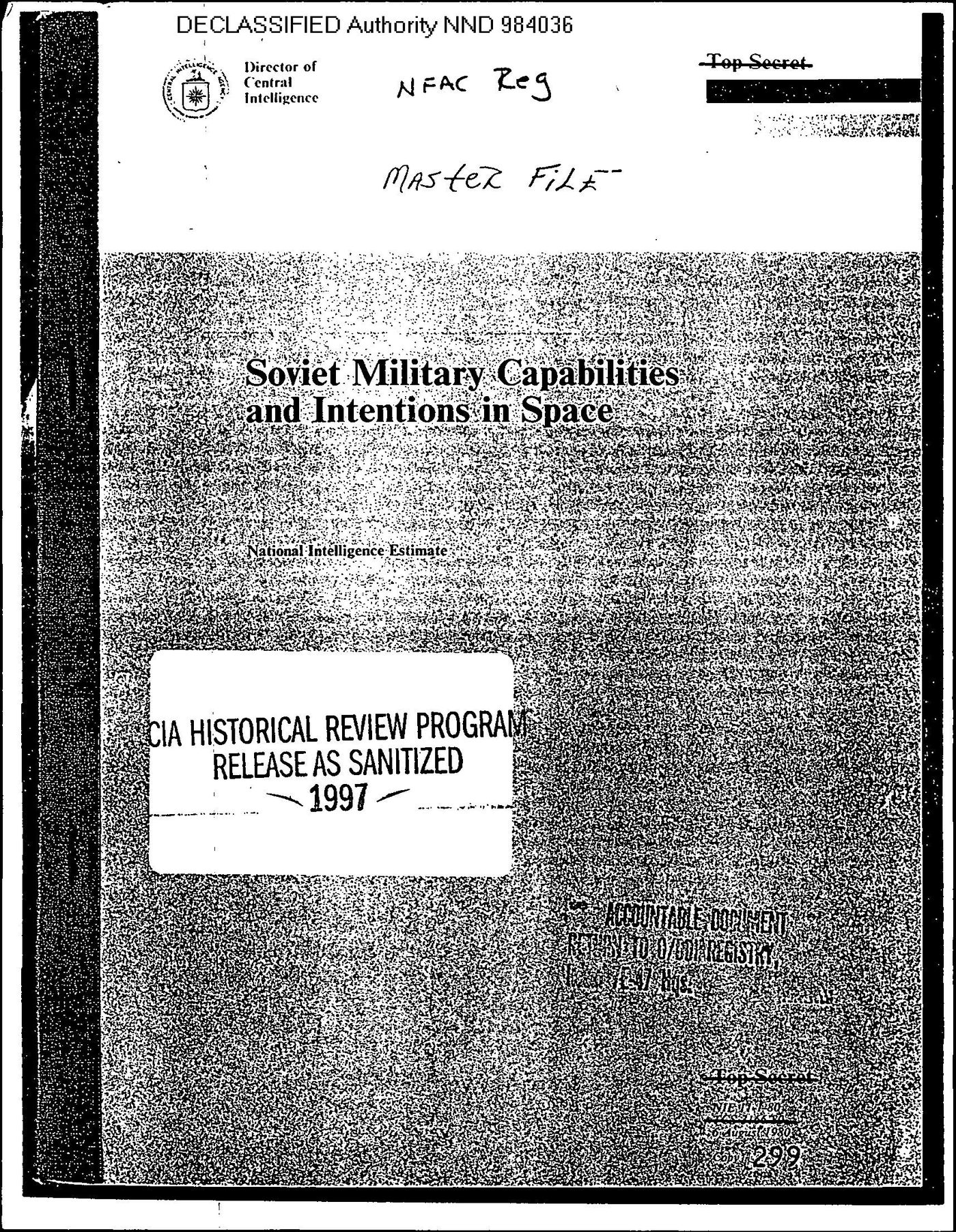
NIE 11-1-80, 6 Aug 80, Soviet Military Capabilities and Intentions in Space
Source: NIE 11-1-80, 6 Aug 80, Soviet Military Capabilities and Intentions in Space. Credit: National Archives, NAID 7327254.
The National Archives holds a series of CIA National Intelligence Estimates on Soviet space programs stretching from 1962 through the mid-1980s. NIE 11-1-80, dated August 6, 1980, is titled "Soviet Military Capabilities and Intentions in Space." That title alone is worth sitting with for a moment. In 1980, the U.S. intelligence community was formally estimating what an adversary might do to American assets in orbit. The document is in the public record. Its contents are what they are. But the fact that analysts were war-gaming orbital conflict forty-six years ago reframes what looks like a new problem.
The series runs earlier and later. NIE 11-1-62, signed December 5, 1962, assessed the Soviet space program at the height of the Cold War. NIE 11-1-83, from July 1983, came in two volumes, one of which carried the "JX" suffix indicating a joint assessment with allied intelligence services. By 1985, NIE 11-1-85J was titled simply "Soviet Space Programs," plural. The threat had grown complex enough to require the plural.
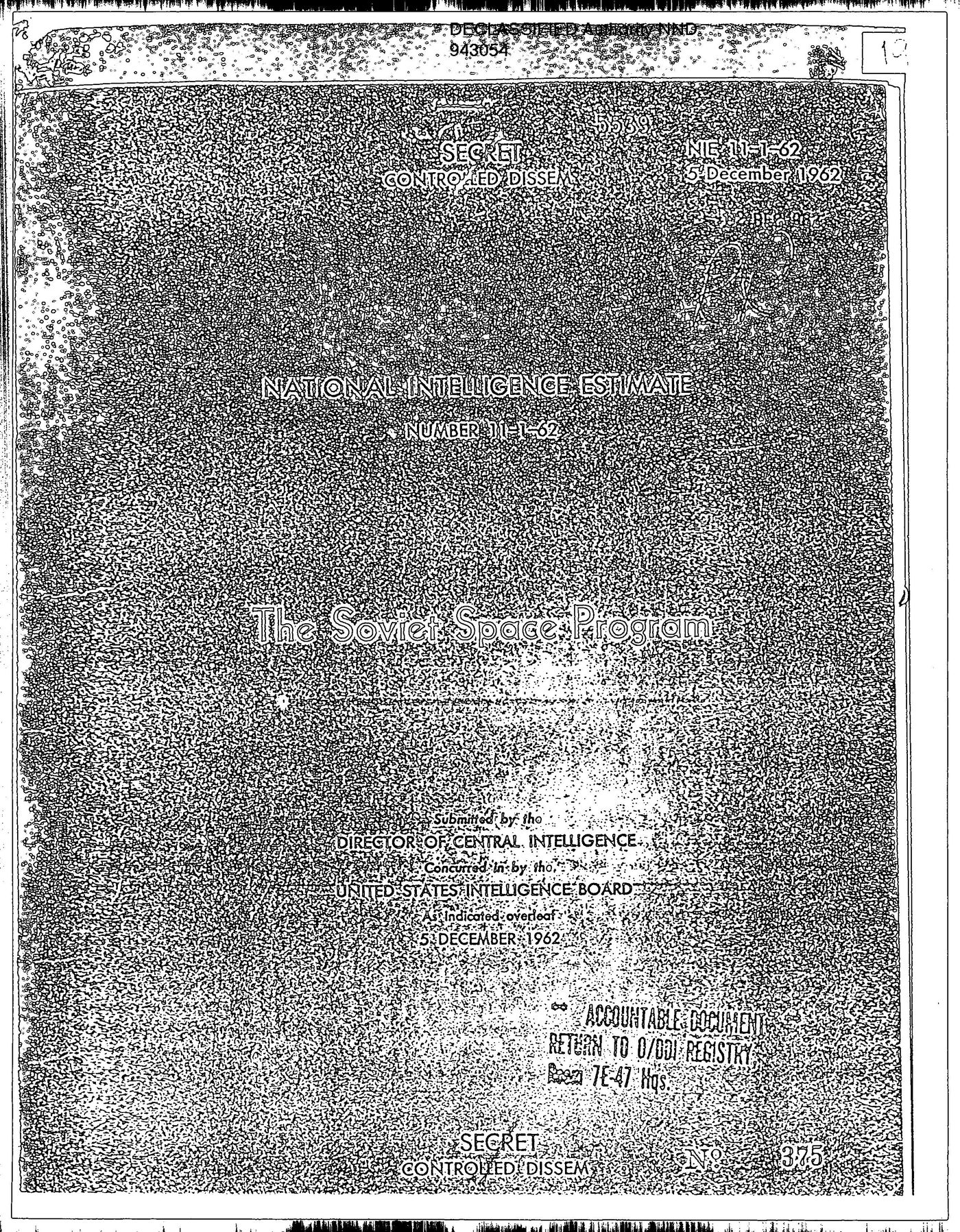
NIE 11-1-62, 5 Dec 62, The Soviet Space Program
Source: NIE 11-1-62, 5 Dec 62, The Soviet Space Program. Credit: National Archives, NAID 7327044.
None of those estimates described a world where the United States would eventually outsource its launch capacity to a private company flying reusable rockets on a commercial cadence. That part nobody predicted.
The Buried Lede
The ground USSF-153 launched from has its own history in the archives.
The National Archives holds the National Historic Landmark nomination for Space Launch Complex 10 at Vandenberg, filed under National Park Service records. SLC-10 is not the pad SpaceX uses today, but it is the pad where the U.S. Air Force first demonstrated that a ballistic missile could be launched from the California coast toward the Pacific, a capability that defined American deterrence posture for decades. The nomination record is a reminder that Vandenberg was built specifically to give the military a launch azimuth that the Florida coast could not provide: polar orbit, useful for reconnaissance satellites that needed to pass over the Soviet Union on every pass.
Starshield satellites in polar orbit would serve a similar function today, just with different hardware and a different adversary in mind.
The continuity is not a conspiracy. It is a design feature.
The Competition Context
Experts have been warning for several years that Earth's orbit is becoming a contested domain. China's Shenlong spaceplane has conducted rendezvous operations that defense analysts describe as consistent with on-orbit inspection or interference capabilities. Russia has tested anti-satellite weapons. The U.S. and allied nations have demonstrated similar proximity operations.
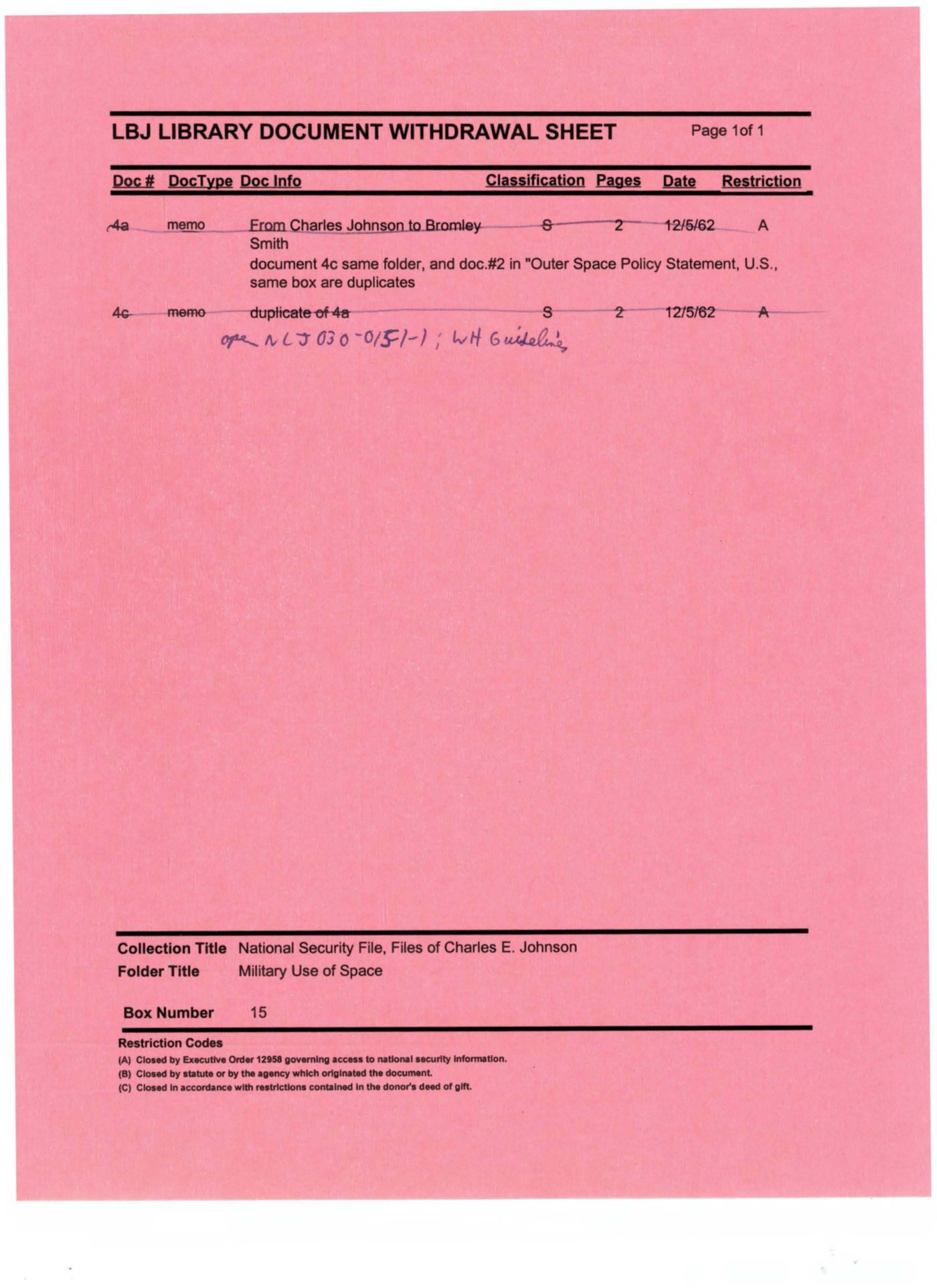
Military Use of Space
Source: Military Use of Space, Files of Charles E. Johnson, National Security Files, Lyndon Baines Johnson Library. Credit: National Archives, NAID 114639176.
The Lyndon Baines Johnson Library holds a file titled "Military Use of Space" in the records of Charles E. Johnson, a National Security Council staffer in the 1960s. The catalog entry does not describe the file's contents in detail, and the contents are not in front of us. What the record establishes is that the question of how the military uses space was being formally staffed at the NSC level well before the Space Force existed as a separate branch. The Space Force was established in December 2019. The policy groundwork goes back considerably further.
USSF-153 is not an anomaly. It is the current expression of a posture the U.S. government has been developing, debating, and classifying for the better part of sixty years.
What's Next
The Space Force has not announced a manifest for what comes after USSF-153, which is itself unremarkable. What is worth watching is whether the Starshield program begins to surface in budget documents or contract awards in ways that allow analysts to estimate its actual scale. Commercial satellite constellations are visible. Classified ones, by definition, are not. At some point, the gap between what is publicly acknowledged and what is actually in orbit becomes a story of its own. We are probably not there yet. But the cadence of classified launches in 2026 suggests the gap is not shrinking.
Stay curious.
Find more at spacedew.com and @boggleriley on X
Correction, September 14, 2026: An earlier version of this article gave 11:37 a.m. EDT, when the launch window opened, as the liftoff time, and said the Charles E. Johnson file is held by the George W. Bush Presidential Library. Liftoff was at 11:42 a.m. EDT, and the file is held by the Lyndon Baines Johnson Library.