The Malmstrom Missile Shutdown
The Other Thing Happening at Malmstrom in 1967
In the summer of 1967, while Air Force officers at Malmstrom AFB filed reports about unidentified objects disabling nuclear missiles in Montana, the CIA was running a classified exercise — titled "Spy Mission to Montana" — simulating an enemy effort to map the exact Minuteman silos that had just gone dark.
The Malmstrom incident has been a UFO story for fifty years. Echo Flight, March 1967. Ten Minuteman ICBMs drop off-line in sequence. Officers report a glowing red object hovering near the gate. The Air Force investigates, finds no mechanical explanation, and the incident disappears — not into Blue Book, not into any public record. It becomes a staple of disclosure hearings and late-night cable documentaries. The working assumption has always been that the Air Force saw something it couldn't explain and chose silence.
That assumption has a problem. And it's sitting in the National Archives.
What the CIA Was Doing That Summer
Record Group 263 — CIA records — contains a Studies in Intelligence article from Summer 1967, written by a CIA analyst named Walter W. Romig. The title is not ambiguous: Spy Mission to Montana: Simulation of Assumed Enemy Effort to Plot Minuteman Silo Positions.
Read that again.
The CIA, in the same season Air Force personnel were reporting unexplained aerial phenomena over Minuteman launch facilities in Montana, was running an exercise specifically designed to simulate an adversary mapping those silos from the outside. The exercise was documented in the CIA's own internal journal. It's unrestricted. It's been sitting in College Park this whole time.
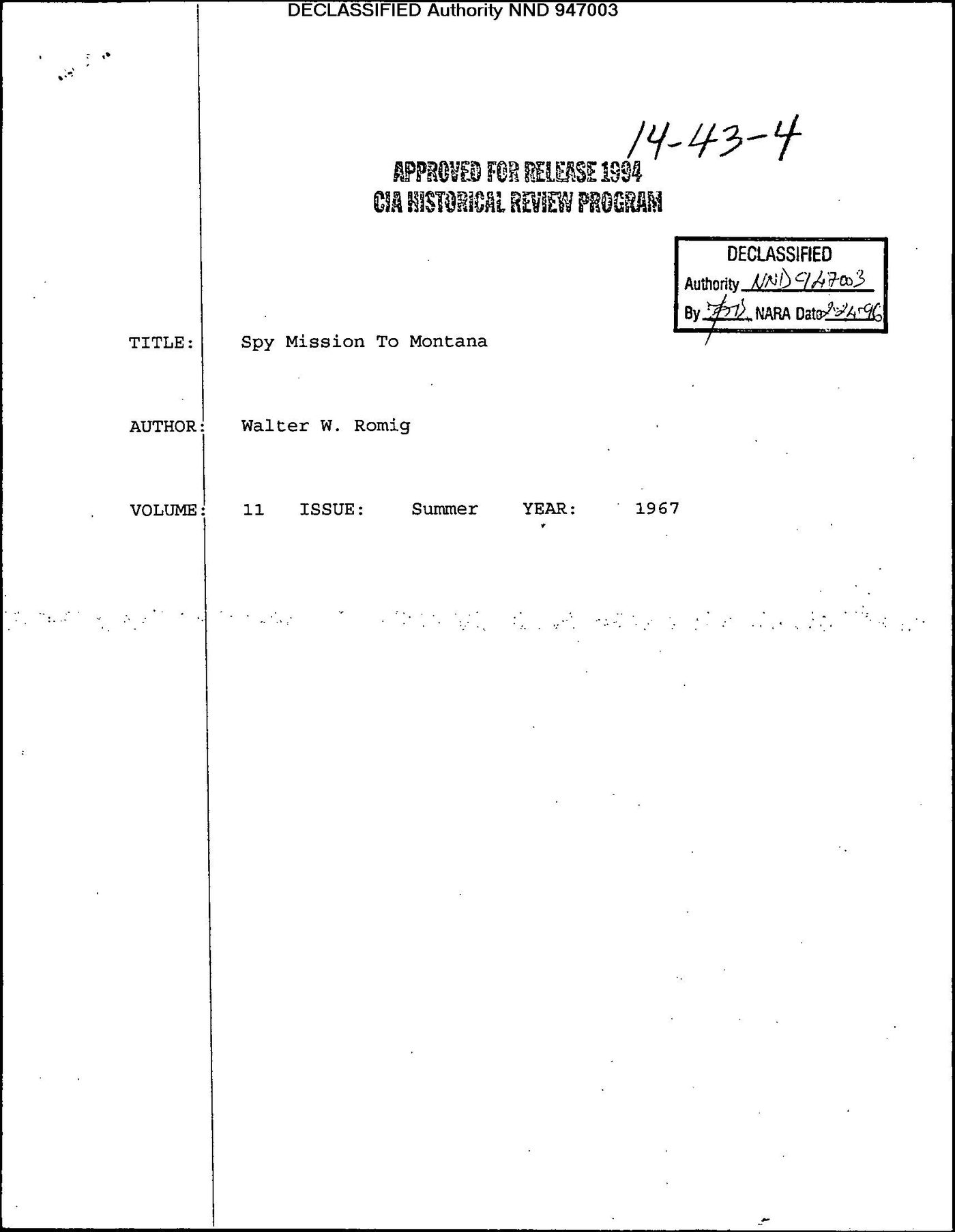
CIA Studies in Intelligence — Spy Mission to Montana, page 1
Source: National Archives, NAID 7283642. View full document
The question nobody has publicly asked is simple: Were the Air Force personnel at Echo Flight and Oscar Flight told that American intelligence assets might be operating near their perimeter? Because if they weren't — and the architecture of classified compartmentalization in 1967 strongly suggests they weren't — then what exactly did the gate guards think they were watching?
The Filing Habit That Makes the Gap Visible
Here's what makes the 1967 absence so loud.
Blue Book was meticulous about Montana. The Air Force filed a case on a Forsyth sighting in February 1961. Filed another on Great Falls the following month. Both routine, both catalogued, both now sitting unrestricted in Record Group 341. Earlier still, Blue Book opened a dedicated file on Malmstrom AFB itself after an August 1958 incident — meaning this specific installation had its own entry in the UFO case system nearly a decade before the famous shutdown.
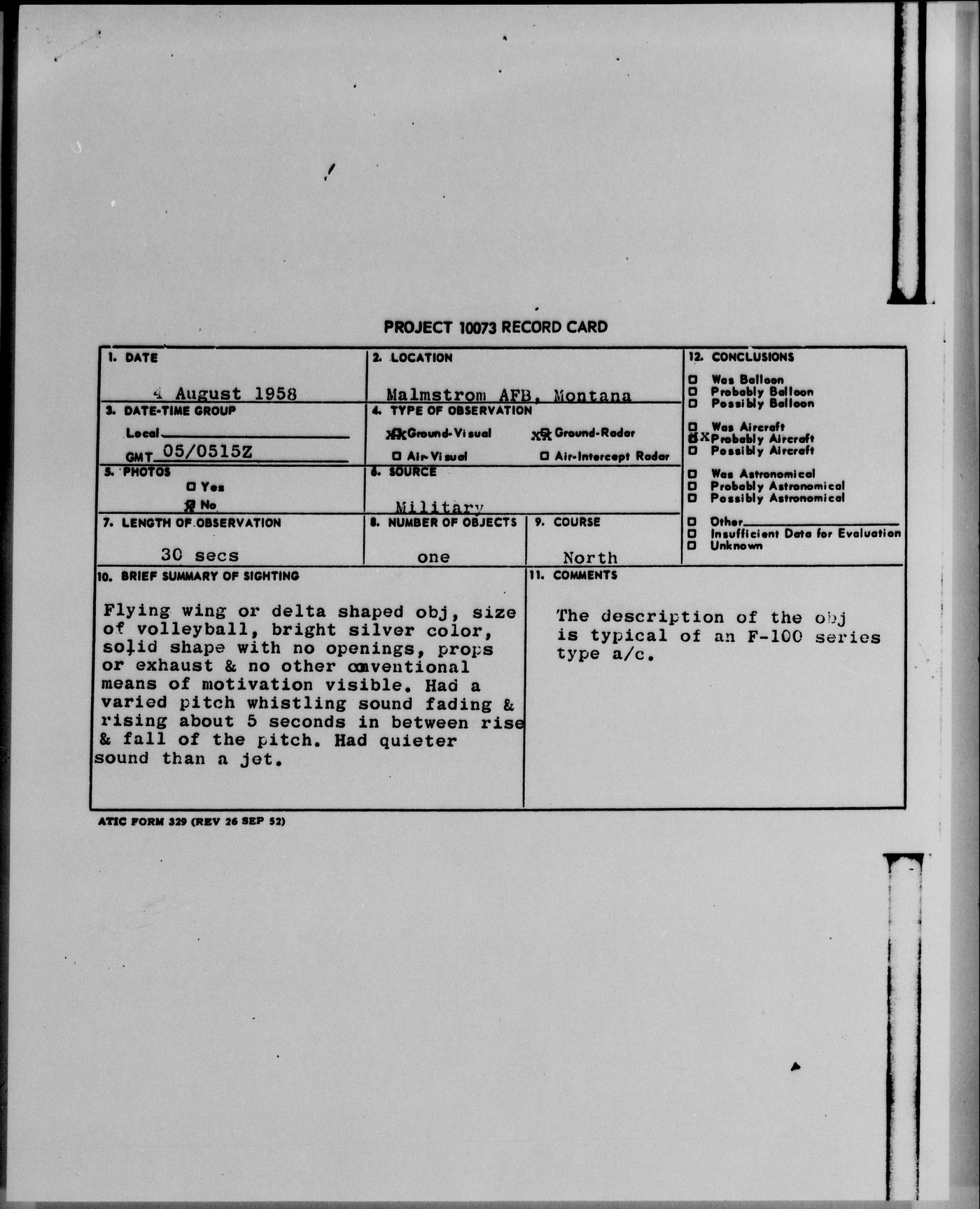
Project Blue Book case file — Malmstrom AFB, Montana, August 1958
Source: National Archives, NAID 28979239. View full document
The Air Force had a protocol. They used it consistently. Montana cases went into Blue Book. Malmstrom had its own file. Then 1967 happens — the most significant incident at the most-documented installation — and nothing surfaces in that same series.
Absence in a consistent filing system is itself a document. It tells you someone made a choice.
The Restricted Page
Then there's the document that won't open all the way.
Somewhere in a Chronological Files series — record group unidentified, which is already unusual — sits a single-page file titled only "April [3]." Partial restriction. Every comparable document in this research set is fully unrestricted. This one isn't. The date fragment could align with the March-April 1967 window. The series name suggests routine administrative filing. Routine administrative files don't get partially restricted after the fact without a reason.
One page. Partly restricted. No identified record group. A date that fits.
That's not proof of anything. But it's the kind of asymmetry that makes a researcher stop and write it down.
The Buried Lede
The Malmstrom story has always been framed as the Air Force versus the unexplained. Witnesses versus silence. Disclosure advocates have spent decades trying to get the government to admit something happened.
But the CIA document reframes the whole picture.
If American intelligence was actively simulating adversary reconnaissance of Minuteman silos in Montana that summer, the Air Force's silence in 1967 might not be evidence of a UFO cover-up. It might be evidence of something more mundane and, in its own way, more interesting: an agency that couldn't explain what its own people saw because explaining it would have required admitting what a different agency was doing two classifications over.
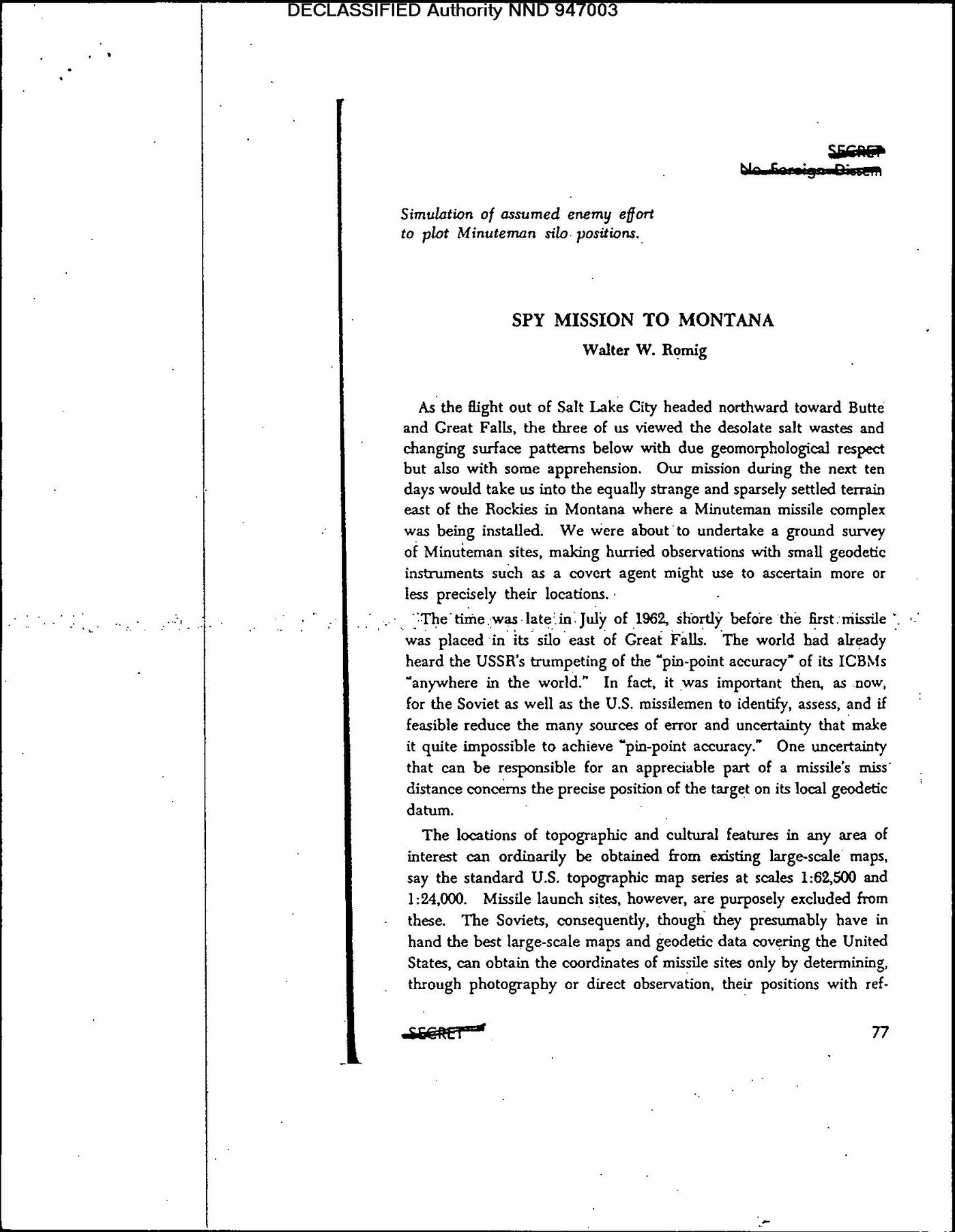
CIA Studies in Intelligence — Spy Mission to Montana, page 2
Source: National Archives, NAID 7283642. View full document
The Air Force saying "we don't know what it was" might have been technically accurate. They didn't know. They weren't cleared to know. Two agencies, same airspace, apparently not comparing notes.
That's not a conspiracy. That's just how compartmentalization works. Which almost makes it worse.
What to Watch For
The Romig article in Studies in Intelligence describes the mechanics of the simulation — how an assumed enemy would approach the problem of mapping silo positions from the ground and air. What it doesn't describe, at least in what's been released, is the deconfliction process: who knew, who was notified, and whether base security at Malmstrom was ever briefed that friendlies might be in the area. That's the document that would settle this. It may exist. It may be restricted. It may have never been written down at all, which would be the most Cold War answer imaginable. The next move is a targeted FOIA request to the CIA for any 1967 communications between the Agency and Strategic Air Command regarding the Montana exercise — specifically any notification to Malmstrom security personnel. Don't hold your breath. But file the request.
Further Reading:
- Forsyth, Montana — Blue Book, February 1961
- Great Falls, Montana — Blue Book, March 1961
- April [3] — Chronological Files, Partly Restricted
Stay curious.
Follow along: @boggleriley · spacedew.com