The Green Fireballs of Los Alamos
The Wrong Folder
How the Air Force buried Lincoln La Paz's green fireball investigation without ever proving him wrong
In November 1951, the U.S. Air Force filed the final report of Project Twinkle — its two-year investigation into unexplained green fireballs over New Mexico nuclear sites — inside Project Blue Book's administrative files, not the counterintelligence series where the active investigation had lived, effectively rendering a credible non-meteor finding into a routine UFO dismissal without a single rebuttal.
That's the whole trick. No press conference. No scientific counter-argument. One folder, wrong drawer.
The Man They Didn't Have to Discredit
Lincoln La Paz was not a crank. He was the director of the University of New Mexico's Institute of Meteoritics. If you wanted someone to look at a streak of light in the sky and tell you what it was, La Paz was a reasonable first call. The Air Force made that call in 1948.
What La Paz found, after methodically documenting the green fireballs appearing over the most sensitive nuclear real estate in the Western hemisphere, was that they were not meteors. Not his opinion. His professional conclusion, delivered formally, to the people who hired him.
The Air Force's response was to stand up Project Twinkle in 1950 — ostensibly to take the phenomenon seriously, set up instrumented observation stations, gather hard data. Two years of work. Then, on November 27, 1951, the final report landed in a filing cabinet under Project Blue Book's administrative series.
Case closed. No argument made. Just a folder.
What the OSI Files Tell You Before You Even Open Them
Here's what most people miss about the green fireball investigation: it wasn't run by scientists. The earliest chronological files — spanning from early 1948 through mid-1949 — sit inside Records of Investigations of Unidentified Flying Objects Relating to the Office of Special Investigations. That's the Air Force's counterintelligence arm. OSI investigated espionage, sabotage, and security threats.
They were not in the habit of chasing weather phenomena.
Four separate OSI chronological file sets cover the active investigation period, running from February 1948 through June 1949. That's the phase when La Paz was in the field. The phase when incident numbers were being assigned to Los Alamos sightings in rapid succession — Incident 275, Incident 276 in March 1949 alone, then Incident 365 out of Los Alamos in May 1949. Three discrete case numbers for the same geographic target in a two-month window.
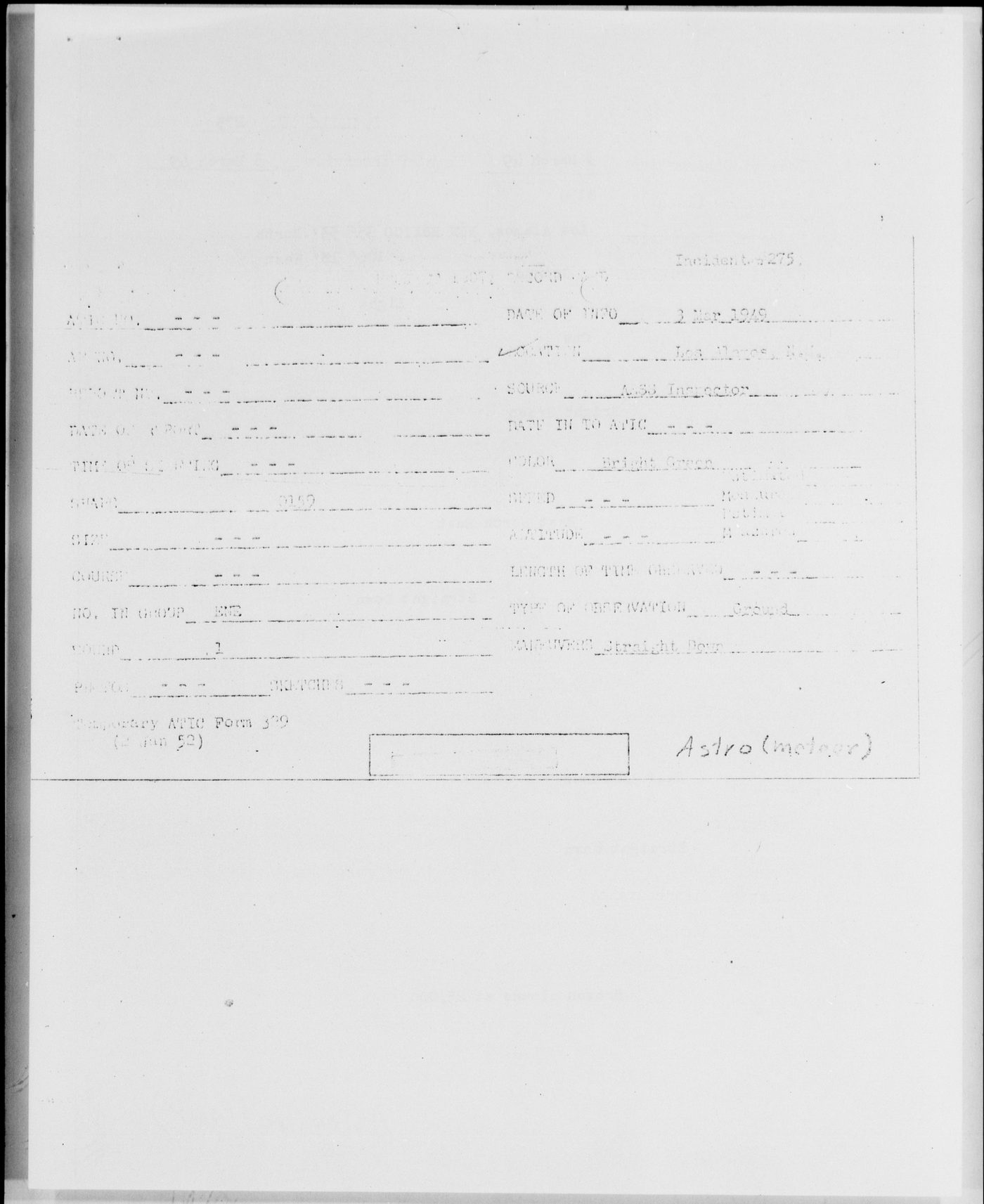
Los Alamos, N.M., March 1949 — Incident Number 275
Source: National Archives, NAID 28933421. View full document
That's not folklore. That's a pattern over a specific target, documented by the same office that hunted Soviet moles.
The NSC Memo That Shouldn't Exist
While the OSI was logging incidents and La Paz was ruling out meteors, someone thought this was important enough to put in front of James Lay.
Lay was the Executive Secretary of the National Security Council.
The memo is in the National Archives right now, sitting in Record Group 273 — the NSC's own registry files. Eight pages. The fact that it exists in that record group at all is the tell. RG 273 is not where you file routine Air Force housekeeping. The NSC registry logged things that required the council's formal awareness. Green fireballs over Los Alamos, apparently, qualified.
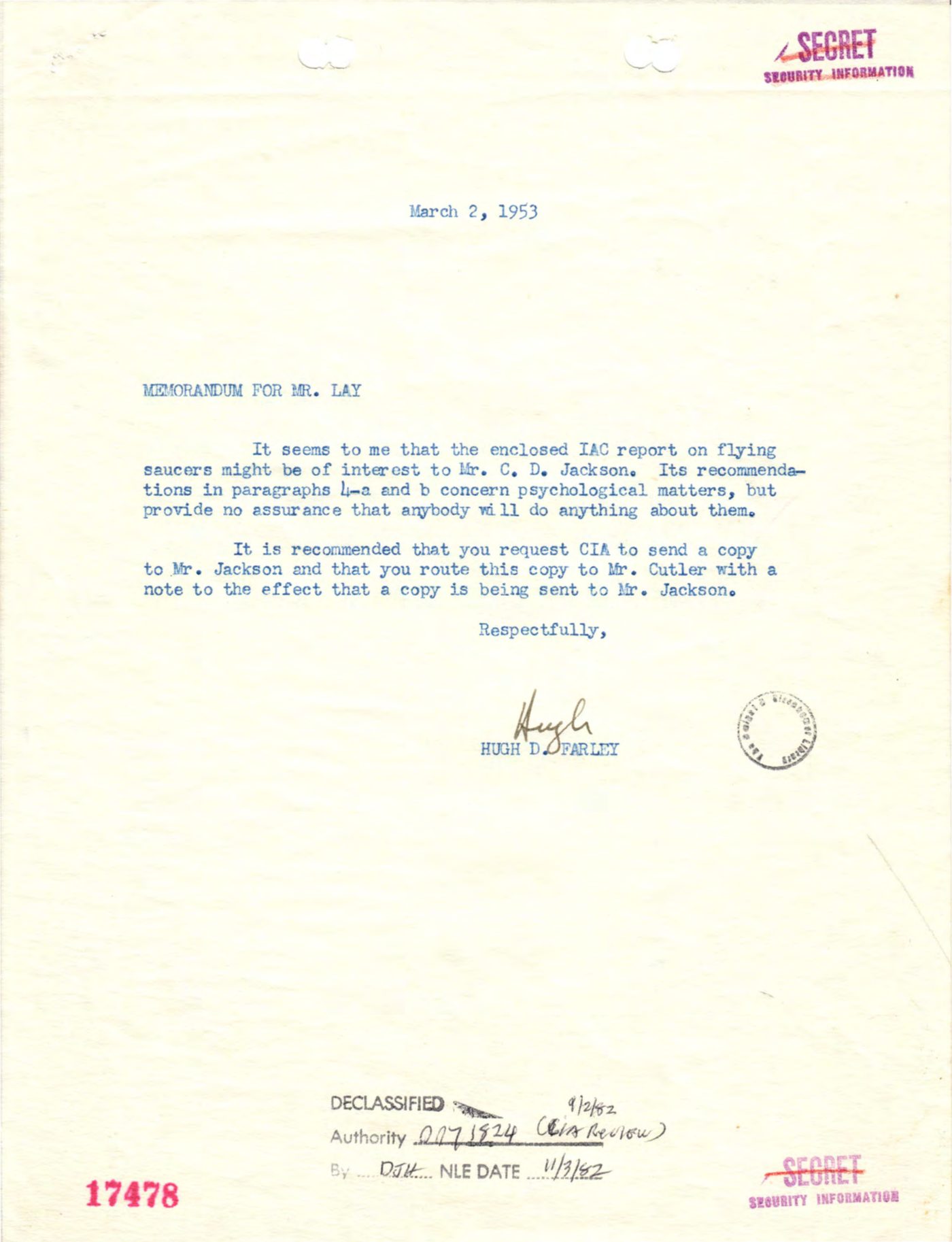
Memorandum for James Lay — NSC Registry Files, page 1
Source: National Archives, NAID 493470227. View full document
You don't memo the Executive Secretary of the National Security Council about something you've already decided is ordinary. That memo is institutional acknowledgment that the phenomenon was unresolved at the highest civilian national security level.
Then Project Twinkle ran for two years. Then the final report went into Blue Book's administrative files.
Something changed in between. The sightings didn't stop — the Blue Book case files show Los Alamos incidents continuing through December 1950, nearly a year into Twinkle's operational period. La Paz didn't recant. His non-meteor conclusion was never publicly challenged by anyone with equivalent credentials.
What changed was the context. The Korean War started in June 1950. The nuclear program was accelerating. The institutional appetite for a public record linking "unidentified objects" to "Los Alamos" had dropped to approximately zero.
The Structural Tell
This is the part that requires a little bureaucratic literacy, but it's worth it.
The OSI investigation files and the Blue Book administrative files are different series within the same record group. They're not interchangeable. The OSI series was where active, security-framed investigations lived. Blue Book was the Air Force's public-facing UFO program — the one designed, structurally, to produce mundane explanations and close cases.
Filing Twinkle's final report in Blue Book's administrative series wasn't neutral record-keeping. It was a classification decision. It said: this is a Blue Book matter. Which meant: this is a routine UFO matter. Which meant: whatever La Paz concluded, the institutional verdict is "unidentified, unimportant, filed."
No rebuttal required. The filing was the rebuttal.
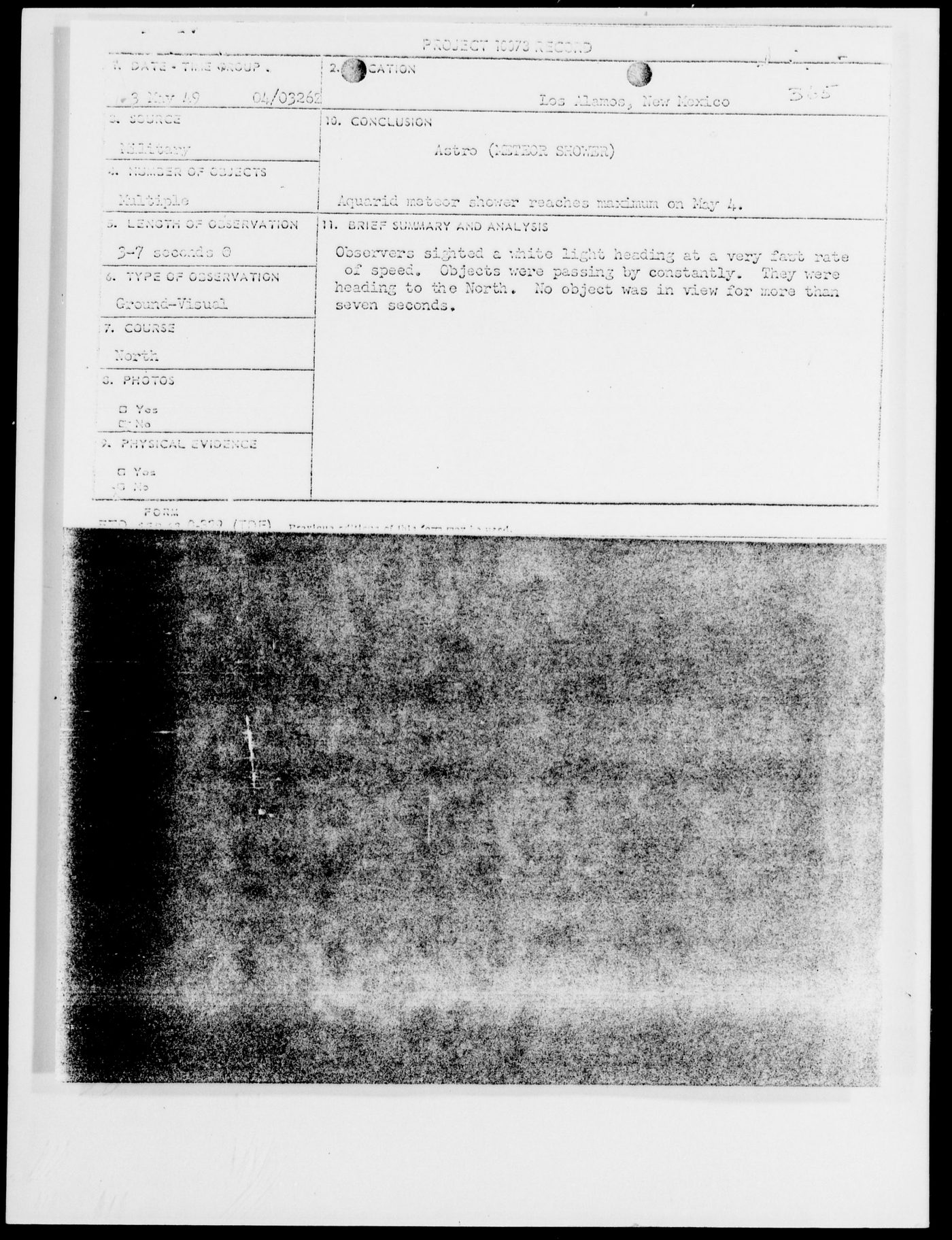
Los Alamos, New Mexico, May 1949 — Incident Number 365
Source: National Archives, NAID 28934586. View full document
The Question Nobody Asked
The Final Report of Project Twinkle is 29 pages. It's been sitting in an unrestricted folder in College Park, Maryland for decades. Anyone can pull it.
What the report can't tell you — what none of the 23 documents in this collection can tell you — is who made the call to file it where they filed it. Someone decided that a counterintelligence-framed investigation, producing a credible non-meteor finding from a credentialed scientist, working over active nuclear facilities, at a moment when the NSC's own Executive Secretary had been formally briefed — should be administratively retired into the UFO catch-all.
That person may have left a name somewhere in the bureaucratic chain. A routing slip. A memo. A signature on a transfer order.
Or they understood exactly what they were doing and kept it clean.
What to Watch
The Twinkle final report is unrestricted and accessible. So are the OSI chronological files. So is the NSC memo. The question isn't whether the government took the green fireballs seriously — the documents prove it did. The question is what mechanism was used to close a serious investigation without addressing its central finding, and whether that mechanism was deliberate policy or institutional inertia.
If any researcher is working through the Blue Book administrative series looking for routing documentation on the Twinkle filing decision, that's the thread worth pulling. The answer, if it exists, is probably not in the report itself. It's in whatever preceded it.
Stay curious.
Follow @boggleriley and subscribe at spacedew.com
Further Reading — National Archives Documents Referenced
- Final Report, Project TWINKLE, 27 Nov. 1951 — NAID 461457213
- Memorandum for James Lay, NSC Registry Files — NAID 493470227
- OSI Chronological Files, January 1949 — NAID 330781865
- OSI Chronological Files, March–April 1949 — NAID 330781540
- OSI Chronological Files, April–June 1949 — NAID 330781681
- Los Alamos, March 1949 — Incident 275 — NAID 28933421
- Los Alamos, March 1949 — Incident 276 — NAID 28933517
- Los Alamos, May 1949 — Incident 365 — NAID 28934586