Project Blue Book: The 701 Unknowns
The Air Force Said UFOs Were Just Weather Balloons. They Were Quietly Collecting Arrowheads and Salt Crystals from Crash Sites.
The U.S. Air Force told Congress in 1969 that Project Blue Book's 701 "unknown" cases were simply incidents lacking sufficient data for explanation, but newly accessible National Archives records reveal investigators systematically collected, catalogued, and analyzed physical artifacts from UFO sites using formal laboratory specimen numbers.
The contradiction is stark. Blue Book's final report dismissed the unknowns as paperwork problems. Meanwhile, the Air Force maintained what the archives call "Project Bluebook Artifacts" — a classified evidence collection with specimen numbers like 7-3745-422 and laboratory analysis protocols that contradict the program's public stance.
The Official Story vs. The Evidence Locker
Project Blue Book investigated 12,618 UFO reports from 1952 to 1969. The Air Force explained away most as aircraft, weather phenomena, or astronomical objects. But 701 cases remained "unidentified."
When Blue Book shut down, officials claimed these unknowns weren't mysterious — just incomplete. Dr. Edward Condon's final report stated the cases "contained insufficient information to permit evaluation." Case closed.
Except the Air Force kept an evidence locker.
The National Archives now holds five physical specimens that Blue Book collected and analyzed. Not reports about debris. Actual artifacts with laboratory specimen numbers, chain of custody documentation, and detailed analysis reports.
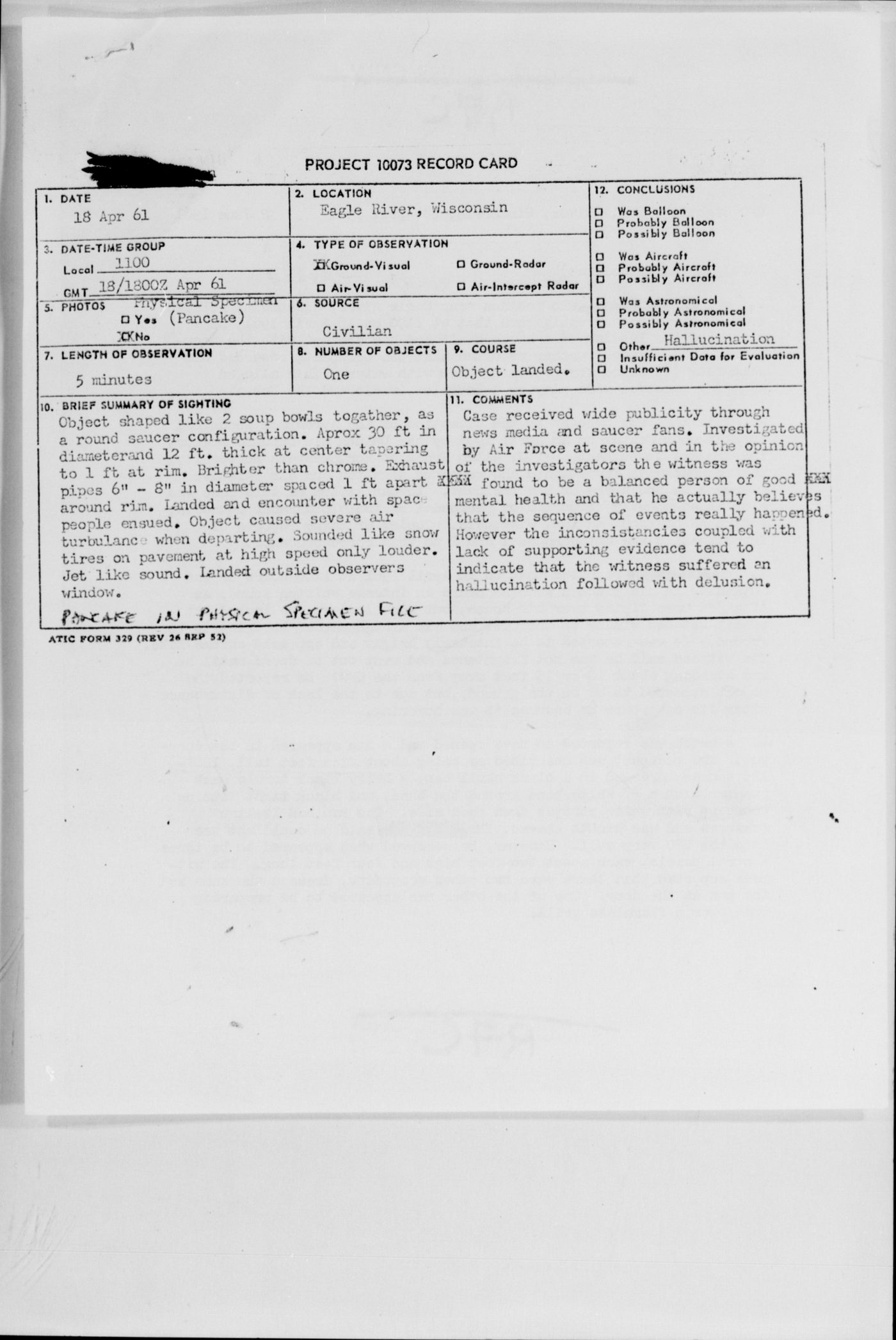
Air Force Physical Specimen Analysis
Source: National Archives, NAID 28992244. View full document
Physical Specimen 7-3745-422: An arrowhead recovered from Sacramento, California in September 1964. The documentation spans eight pages. An arrowhead.
Physical Specimen 7-3745-442: Salt crystals from Cleveland, Ohio, August 1963. Fourteen pages of analysis.
Physical Specimen 7-3745-451: Quartz pieces from Germany, October 1964. Collected by military personnel, shipped to Wright-Patterson Air Force Base, catalogued with the same precision as any criminal evidence.
The Infrastructure Nobody Mentioned
The artifact collection reveals something Blue Book's critics and defenders both missed. This wasn't a casual debunking operation or a serious scientific study. It was a bureaucratic machine.
The archives contain 169 administrative files for Blue Book alone. Not case files — administrative paperwork. The mundane stuff that keeps large organizations running. Personnel records. Budget documents. Equipment requisitions.
You don't need 169 administrative files to dismiss weather balloons.
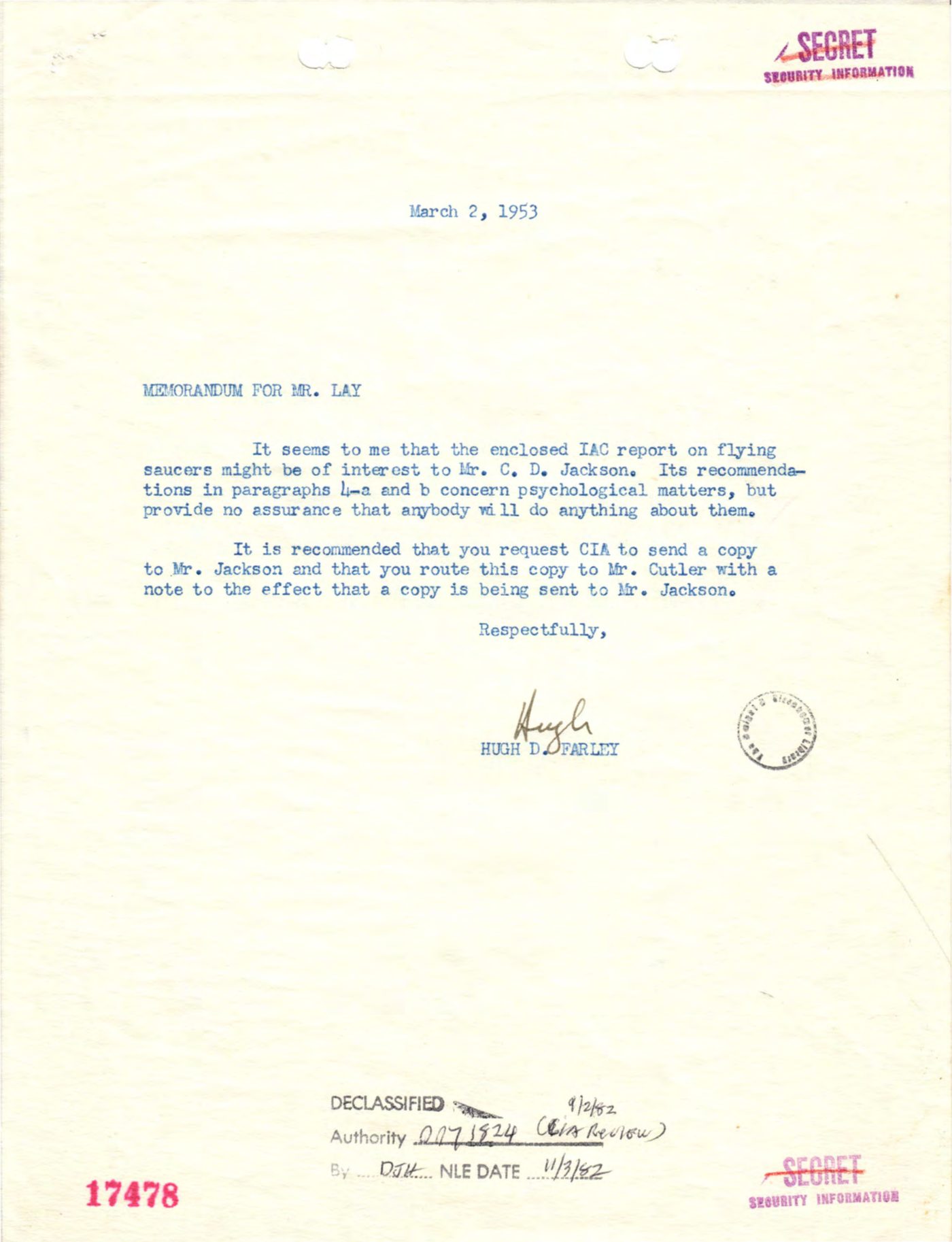
NSC Memorandum on UFOs
Source: National Archives, NAID 493470227. View full document
A 1950s memorandum to the National Security Council shows Blue Book cases reaching the highest levels of government. The NSC doesn't typically review public relations campaigns designed to calm civilian fears about aircraft misidentifications.
The 4602nd Air Intelligence Service Squadron — Blue Book's parent unit — generated thousands of pages of correspondence. The archives show investigators requesting laboratory analysis, coordinating with other agencies, filing reports that never saw public release.
The Missing Artifacts
Here's the problem with the official story. If Blue Book collected five physical specimens that warranted formal laboratory analysis, how many others were there?
The specimen numbers suggest a larger collection. 7-3745-422, 7-3745-442, 7-3745-451. Sequential numbers in a filing system that implies hundreds of other specimens. The archives show us five. Where are the rest?
The Eagle River, Wisconsin case from April 1961 generated 98 pages of documentation. A witness claimed to have received metallic pancakes from a UFO occupant. Blue Book investigators collected the pancakes, analyzed them, determined they were ordinary buckwheat pancakes, and filed 98 pages of reports.
Ninety-eight pages. For pancakes.
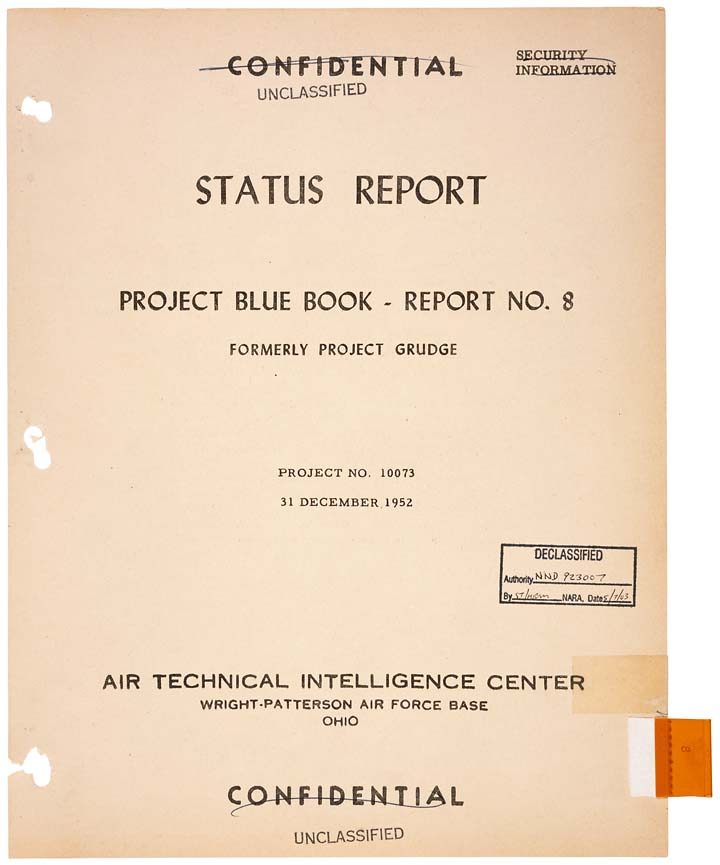
Blue Book Status Report
Source: National Archives, NAID 595507. View full document
Blue Book Status Report Number Eight shows the program's scope expanding, not contracting, through the 1960s. More personnel. More resources. More laboratory capabilities. The trajectory of an operation taking on greater responsibilities, not winding down toward predetermined conclusions.
What the Archives Actually Show
The documents don't prove UFOs are extraterrestrial. They prove the Air Force wasn't telling the truth about what Blue Book was doing.
The program wasn't just filing reports and dismissing sightings. Investigators were collecting physical evidence, conducting laboratory analysis, briefing the National Security Council, and maintaining a bureaucratic infrastructure that contradicts every public statement about Blue Book's limited scope.
The Eureka, Utah case from April 1962 fills 78 pages in the archives. Investigators collected metal fragments, photographed the site, interviewed witnesses, conducted spectrographic analysis of the debris. The final classification: "Insufficient Data."
Seventy-eight pages of investigation. Lab analysis. Site photography. Insufficient data.
The Real Question
The 701 unknown cases weren't mysteries because investigators lacked information. They were mysteries because investigators collected too much information that didn't fit conventional explanations.
The archives show Blue Book functioned as a collection operation disguised as a debunking program. Gather everything. Analyze everything. File everything. Tell the public nothing significant happened.
But somebody kept the evidence locker. Somebody maintained the specimen numbers. Somebody preserved the documentation that now sits in College Park, Maryland, waiting for researchers who know where to look.
The biggest UFO disclosure might not come from congressional hearings or Pentagon reports. It might come from a filing cabinet that's been sitting in the National Archives for fifty years, holding artifacts the Air Force collected while telling America there was nothing to collect.
Stay curious.
Follow @boggleriley and read more at spacedew.com