Area 51: The Declassified Truth
The Man Who Built the Cover Story Had Something to Say About the Myth
Richard Bissell — the CIA architect of the U-2 spy plane program, whose secret aircraft became the original explanation for UFO sightings over America — wrote a formal letter about Majestic 12, and the government decided you could read it.
It's sitting in an archive right now. Unrestricted. Two pages. Catalog number and everything.
Richard Bissell was not a UFO person. He was the CIA's Deputy Director for Plans in the late 1950s — the man who personally ran the U-2 program, who oversaw the A-12 OXCART development at Area 51, who built the infrastructure of American aerial espionage from the ground up. When civilians reported strange lights moving silently at impossible altitudes over the American Southwest, the official explanation — eventually — was Bissell's planes. He didn't create the UFO myth on purpose. He created the secret that required one.
Majestic 12 is the alleged covert committee, supposedly formed by Truman in 1947, tasked with managing the government's response to actual alien contact. The FBI investigated the MJ-12 documents in the 1980s and called them fake. The Air Force called them fake. Serious researchers largely moved on.
And yet. A letter from Richard Bissell, addressed to the subject of Majestic 12, is filed under Correspondence at the National Archives — unrestricted, accessible, waiting.
What the Archives Already Contain
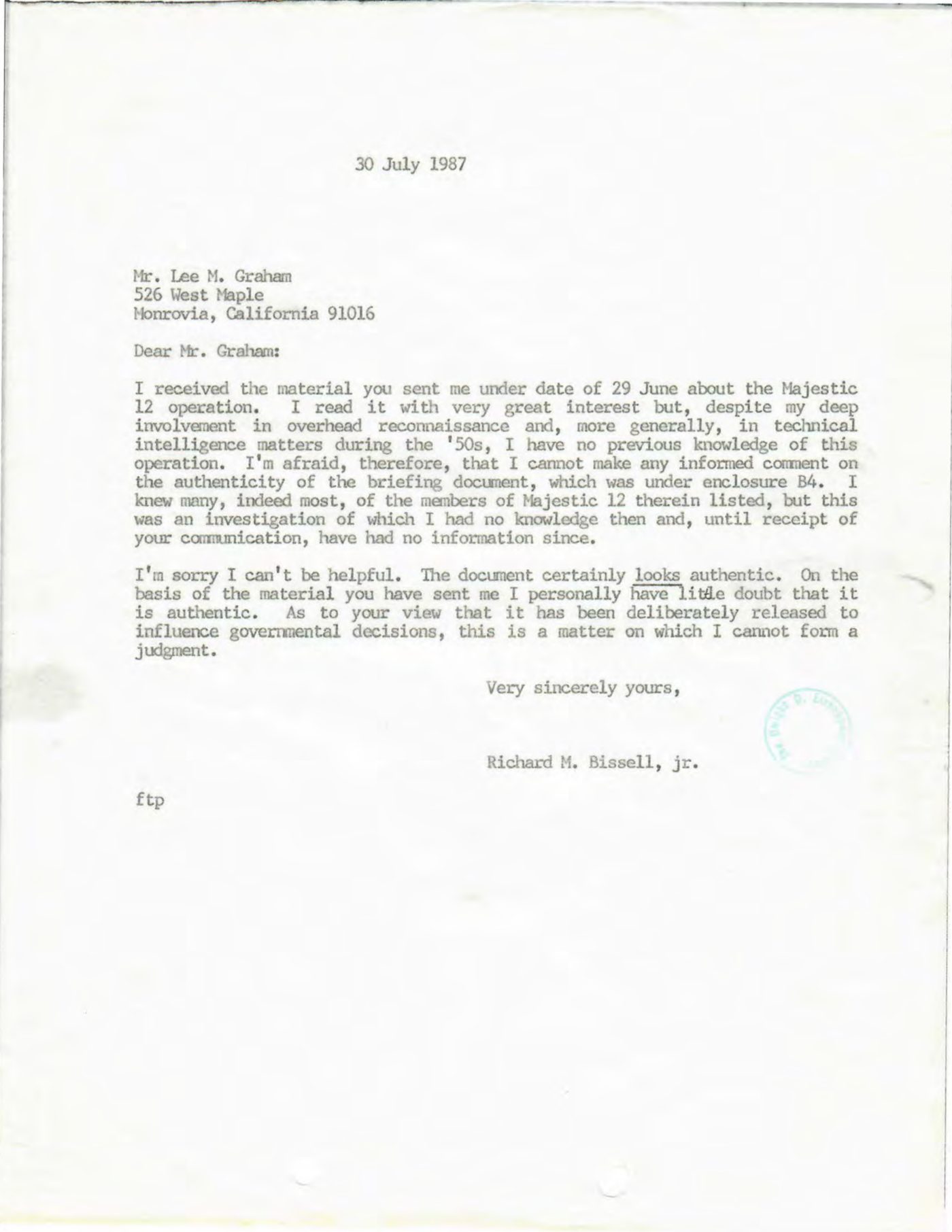
Letter from Richard M. Bissell regarding Majestic 12
Source: National Archives, NAID 493468585. View full document
The document's metadata tells you this much: it exists, it's two pages, it's unrestricted, and it's filed in Correspondence — not in the Roswell source files, not in a UFO-specific series, not buried in a restricted presidential record. Someone cataloged it under its actual subject. The title is not a researcher's annotation. It's the official description: Letter from Richard M. Bissell regarding Majestic 12.
That's the fact. The metadata doesn't tell you what Bissell said. It tells you he said something. Formal enough to file. Specific enough to title. Unrestricted enough to read.
Here's what makes that unusual. The government spent decades treating Majestic 12 as beneath official response — a fringe fabrication not worth dignifying. If that's true, Bissell's letter is an odd artifact. Senior CIA officers don't typically write formal correspondence about myths they consider worthless. They ignore them. Or they route them to someone whose job it is to ignore them.
The alternative is more interesting. Bissell ran the U-2 program precisely because it had to be invisible. The cover story — weather research, then later, reluctantly, spy planes — was his department. Managing what the public believed about things they saw in the sky was, functionally, part of his job description. A letter about Majestic 12 from that man isn't a curiosity. It's potentially a window into how deliberately the UFO mythology was shaped, by whom, and from what level of the organization.
The 1994 Convergence
While the Bissell letter sits in the Eisenhower-era Correspondence Files, a separate cluster of documents points to 1994 as a year when something was being actively coordinated.
Stanton Friedman — the nuclear physicist who spent decades as the most credible civilian voice arguing that the MJ-12 documents were genuine — was writing letters to Air Force Lieutenant James McAndrew in September of that year. Those letters are now archived in the Roswell Report Source Files at the National Archives, 108 pages of them, unrestricted. Friedman wasn't sending fan mail. McAndrew was the officer assigned to prepare the Air Force's official Roswell debunking report. The government wasn't ignoring the leading MJ-12 advocate. It was corresponding with him while writing the document designed to close the case.
That same month, a cable — not an email, a cable — was sent on November 22, 1994. It's the only cable in a series otherwise composed entirely of Clinton-era emails from 1996 onward. Cables in 1994 meant something different than email. They were operational. They moved between field and headquarters. They implied urgency, or at minimum, a communication channel distinct from routine administrative traffic.
The cable's contents are partly restricted. We don't know what it says. We know when it was sent, and we know it's the format outlier in its entire series — older by format, older by date, different by channel.
Friedman writing to the Air Force. The Air Force preparing its official report. A cable sent through a different channel on the same timeline. Richard Bissell's letter about Majestic 12 filed and left unrestricted.
These aren't proof of anything. They're a pattern. And patterns are worth pulling on.
The Buried Lede
The Air Force Roswell Report Source Files contain 192 pages of research material supporting what the government publicly described as a straightforward case — a weather balloon, Project Mogul, end of story. The outgoing correspondence files alone run to 145 pages. That's 145 pages of letters Air Force headquarters sent to people about a case they claim required no serious explanation.
You don't generate that volume debunking something you actually believe is nothing.
The Bissell letter is unrestricted because someone decided it should be. That decision is institutional. Files don't accidentally end up accessible — especially files that connect the CIA's chief of covert operations to a conspiracy theory the same government officially dismissed as fabricated. Either the letter is innocuous enough to release without concern, or releasing it serves a purpose.
Both possibilities are worth considering. The first means Bissell wrote a routine response to a crank letter and it got filed. The second means the CIA is comfortable with the public seeing exactly as much of this story as the CIA wants them to see.
Bissell died in February 1994. The same year as the cable. The same year as the Friedman-McAndrew correspondence. The same year the Air Force began assembling the document that would officially close Roswell.
His letter is already there. Two pages. Unrestricted. The question nobody has answered yet is what he said — and whether the answer changes anything about who built the story, and who kept building it after he was gone.
What to Watch
The Bissell letter can be read right now by anyone with a browser. The Roswell Source Files — all 192 pages of research behind the "it was just a balloon" conclusion — are equally open. What's missing is the connective tissue: a full content review of the Bissell letter against the timeline of MJ-12 document circulation in the 1980s, and a systematic cross-reference of the Air Force's outgoing Roswell correspondence against known researchers and journalists from that period. Someone in a university archive program or an investigative newsroom could do this in a week. It hasn't been done publicly. When it is, the story won't be about flying saucers. It'll be about who managed the narrative, from what level of government, and for how long.
That's a different story than the one we've been told. It might also be a better one.
Stay curious.
Follow @boggleriley · Read the full archive at spacedew.com
Further Reading
- Letter from Richard M. Bissell regarding Majestic 12 — National Archives, NAID 493468585
- Stanton Friedman to Lt. James McAndrew, September 1994 — NAID 40989192
- Report of Air Force Research Regarding the 'Roswell Incident' — NAID 40989297
- Air Force Outgoing Correspondence, Roswell Source Files — NAID 40989277
- Cable, November 22 1994 — NAID 297910672