Webb Releases Mid-Infrared View of Cat's Head Nebula
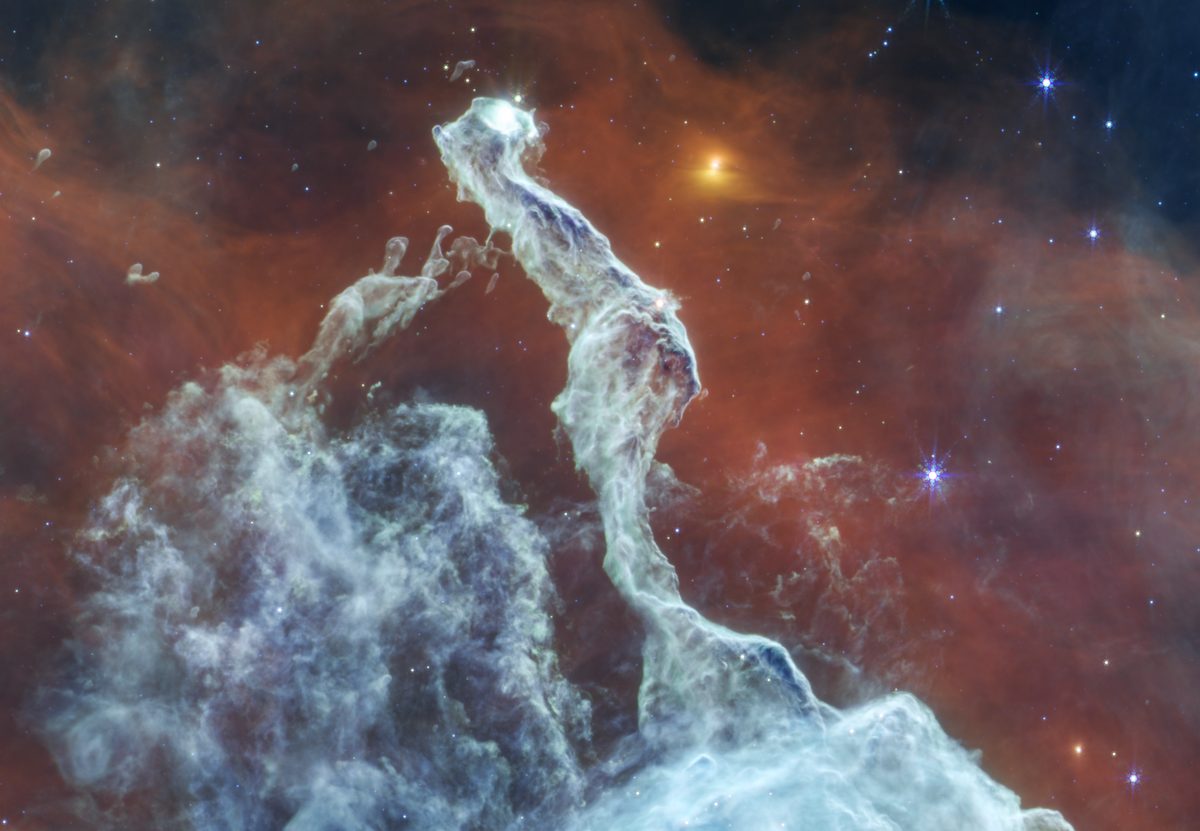
NASA's James Webb Space Telescope released a mid-infrared image of the Cat's Head Nebula on Oct. 29, 2026, NASA said, showing a dust pillar in the Carina Nebula, about 7,500 light-years from Earth.
NASA's release credits the image to NASA, ESA, CSA and STScI (the Space Telescope Science Institute), with image processing by Joseph DePasquale of STScI. NASA says the cat shape was likely carved over time by ultraviolet radiation and winds from massive stars in the Carina Nebula. That wearing-away leaves denser material in the pillar standing, "at least for now," NASA says.
In this view, NASA Science says, warm dust and carbon-based molecules lit by starlight trace fine structures inside the nebula. Delicate globules and strands to the left of the pillar stand out. To the right sits a bright yellow source that NASA Science calls likely an infant star wrapped in dust. A narrow filament appears to cross it, but NASA says the image alone cannot show whether the two are physically related.
The Cat's Head is a small patch of Carina that both Webb and NASA's Hubble Space Telescope looked at, according to NASA Science and the European Space Agency. ESA says Hubble's visible-light view shows a dark, opaque dust pillar, while Webb's infrared views show many more stars and hidden detail. ESA also says the nebula is temporary and will eventually disperse.
What nobody can say yet is what the bright yellow source is. NASA Science's wording is "likely," and the release gives no follow-up observation for it.
The release, ESA's page and NASA Science's side-by-side Hubble and Webb article are all public, so you can compare the three views yourself.
Stay curious.
Find more at spacedew.com and @boggleriley on X
Get the Morning Dew
The daily brief, live quotes and the newest File Zero story, every morning. Plus a Friday recap of the week. Nothing else, ever.