Webb Maps Rare Planetary Collision Systems for the First Time
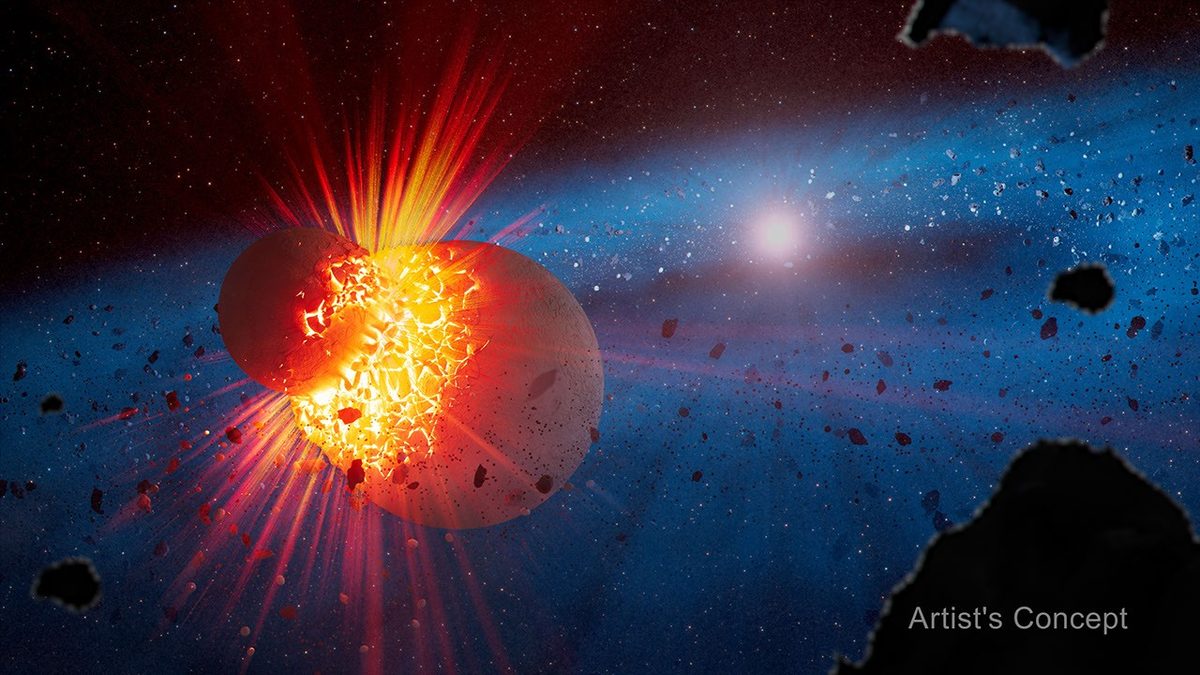
Astronomers led by Kate Su published findings Thursday in The Astrophysical Journal revealing Webb's first comprehensive study of 21 extreme debris disks, rare young star systems showing signs of planet-shattering collisions similar to the one scientists believe created Earth's Moon.
A team led by Kate Su of the Space Science Institute in Boulder, Colorado used NASA's James Webb Space Telescope to study a class of young stellar systems called extreme debris disks. These are regions around young stars packed with unusually large amounts of warm dust sitting close to the star, in roughly the same zone where rocky planets orbit in our solar system. The findings, published Thursday in The Astrophysical Journal, mark the first time researchers have assembled a sample large enough to draw firm conclusions about what these systems are and how they form.
What the Record Shows
NASA's science release describes extreme debris disks as a subclass first identified by the agency's retired Spitzer Space Telescope. Spitzer found them during its mission and flagged them as unusual: warmer, dustier, and more variable in brightness than the cold debris disks astronomers typically study, like those around the stars Vega and Fomalhaut.
Su's team pulled together 21 of these systems for the new study. Five came from Spitzer's archival data. Webb contributed 16, including 12 newly observed disks and follow-up observations on four that Spitzer had previously flagged, according to the NASA release.
"This is the first time we have gathered enough systems to truly understand this subclass that we call extreme debris disks," Su said in the release. "Before Webb, we had limited information. We knew that they are weird and very different from the typical cold debris disks that we know. Now that we have more data, we can pin down what these disks represent for planet formation and evolution."
The team confirmed three properties shared across the sample: dust grains smaller than those found in protoplanetary or classic debris disks, a high concentration of warm dust, and irregular swings in brightness. All three were revealed through mid-infrared spectra, a technique that spreads light into its component wavelengths to reveal the chemical fingerprints of the material emitting it, from Webb and Spitzer combined, the release says.
To go further, the team studied the mineral composition of each disk. They found the 21 systems split into two groups: silica-rich and silica-poor. Silica-rich material is what you find in volcanic glass like obsidian. Silica-poor material includes forsterite, a mineral that shows up as green sand on some Hawaiian beaches. The NASA release explains that which group a disk falls into tells scientists something about the violence of the collisions producing it.
About one-third of the sample is silica-rich, according to the release. Those disks appear to result from high-energy impacts between Mars-sized bodies, where enough heat is generated to vaporize a significant portion of the colliding rock. The remaining two-thirds are silica-poor, pointing to lower-energy events: grazing collisions between Moon-sized objects.
The age pattern is sharp. Silica-rich disks appear only around stars younger than 300 million years, the release says. Silica-poor disks show up across a much wider range of ages and tend to show greater swings in brightness. The team proposes that the brightness variability in silica-poor disks is driven by fresh debris evolving quickly through orbital changes and follow-on impacts.
Agnes Kospal of Konkoly Observatory in Budapest, Hungary, a coauthor of the study, described what Webb made possible. "To just see their mid-infrared emission and beautiful spectral features with Webb, which allowed us to identify their compositions, was the most exciting thing for me," she said in the release. "We have no other way to study these planetary embryos directly because they are too small."
Why It Matters
The connection to our own solar system is the reason this work draws attention beyond the specialty journals.
Scientists theorize that roughly 100 million years after the Sun formed, a Mars-sized body called Theia struck the early Earth, vaporizing enormous amounts of rock and sending material into orbit that eventually coalesced into the Moon, according to the NASA release. That scenario would have produced exactly the kind of silica-rich extreme debris disk the team studied. The age range of silica-rich disks in the sample, stars younger than 300 million years, fits that timeline, the release notes.
The silica-poor, older disks carry a different implication. If their irregular brightness reflects orbital instability, that pattern would be broadly consistent with what scientists call the Late Heavy Bombardment hypothesis, a proposed period in our solar system's early history when the gas giant planets migrated inward and outward, gravitationally scrambling the orbits of smaller bodies and triggering a wave of collisions. The release describes this as a possible second extreme debris disk phase our own solar system may have passed through.
"How rocky planets formed and giant planets evolved are part of the broader story of the solar system's formation. It's all one story," Su said in the release. "Our work on extreme debris disks helps us bring together the big picture of what we currently understand."
The rarity of these systems is itself a finding worth noting. Scientists estimate that only about 1 percent of young stars show observable signs of this phase, according to the NASA release, even though theoretical models predict many more should exist. A sample of 21 is enough to establish patterns, but it is still a small number.
What Comes Next
The team has a clear gap to fill. Coauthor Attila Moor of Konkoly Observatory noted in the release that the hypothesis predicts no silica-rich systems among older extreme debris disks, but only three disks in the current sample fall in the relevant age range to test that prediction. "It'll be nice to observe more of these systems to confirm our hypothesis," Moor said.
What the full Webb observing schedule for this program looks like, and when additional results might be published, is not in the record.
The study is published in The Astrophysical Journal. NASA's full release is at science.nasa.gov/missions/webb.
Stay curious. Find more at spacedew.com and @boggleriley on X
Get the Morning Dew
The daily brief, live quotes and the newest File Zero story, every morning. Plus a Friday recap of the week. Nothing else, ever.