Webb Finds the Home of the Most Distant Fast Radio Burst, a Small Dwarf Galaxy
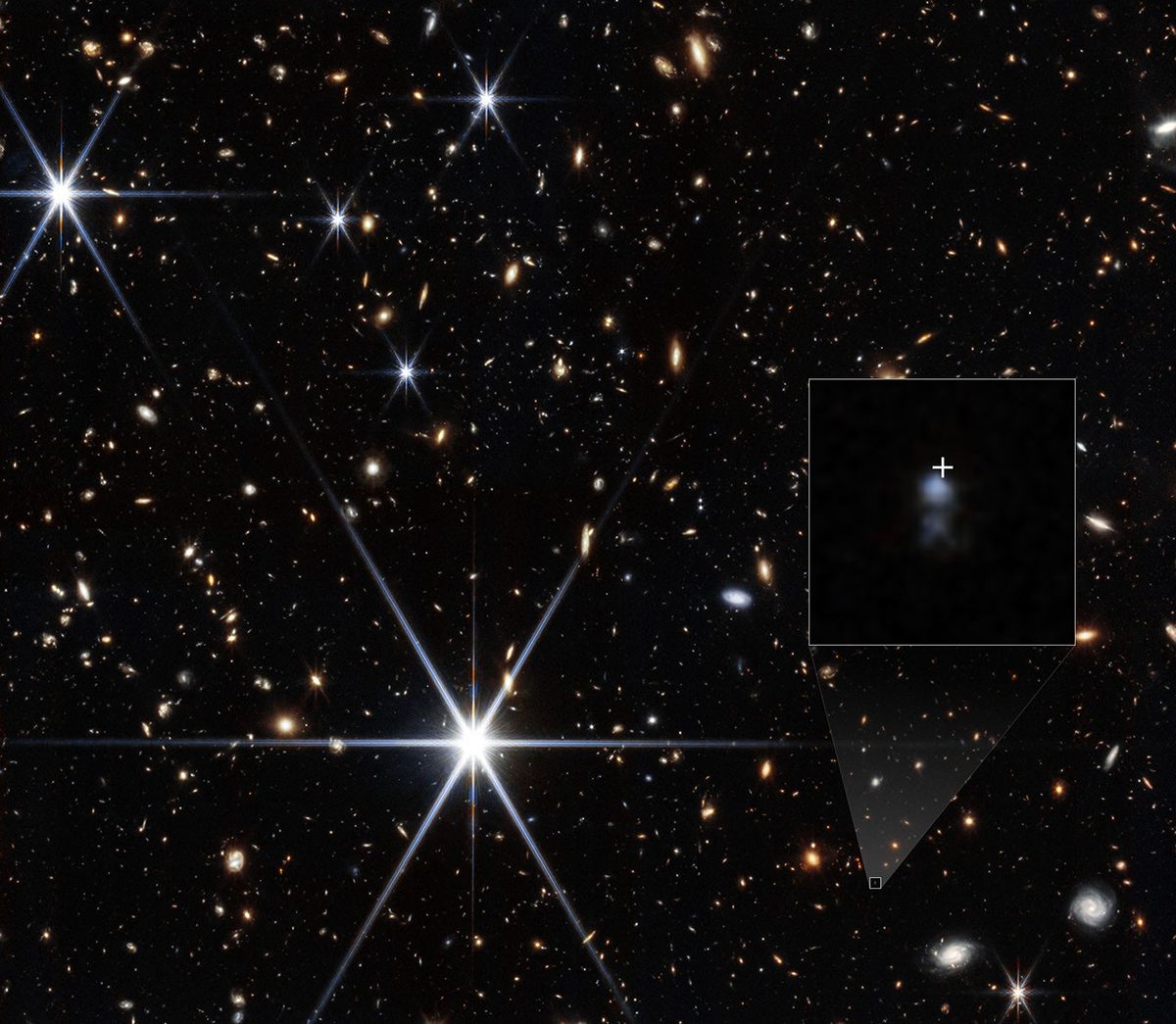
Astronomers led by Manisha Caleb of the University of Sydney used NASA's James Webb Space Telescope to find the host galaxy of the most distant fast radio burst seen so far, NASA said Thursday, October 8, 2026, in a study published in the journal Science.
The burst is FRB 20240304B. NASA says Webb's spectrograph measured the host galaxy's redshift at 2.148, which corresponds to a time just 3 billion years after the big bang. Redshift is how much the expansion of the universe has stretched a galaxy's light; a bigger number means a farther, older object.
The release does not give a clock time for the study's publication, so Thursday's date is the firmest timing in the record.
What NASA says
Fast radio bursts are millisecond-long flashes of radio emission from the distant universe, NASA says. They were first discovered in 2007. Their origin is still uncertain, in part because most are seen once and never again.
The MeerTRAP team detected this one with the MeerKAT radio telescope on March 4, 2024, according to NASA. The radio data suggested the burst was extremely distant. Confirming that meant finding its host galaxy.
That was the hard part. NASA says the team knew the burst's position very precisely, yet the world's largest ground-based telescopes could not see any galaxy at that spot. So the team turned to Webb. Its Near-Infrared Camera found a galaxy in the right place, and its Near-Infrared Spectrograph measured the redshift.
NASA says the vast majority of fast radio bursts detected so far occurred billions of years later in cosmic history.
A small galaxy, not a big one
The host was a surprise. NASA says most galaxies that host fast radio bursts are massive star-forming galaxies, but this one was 1,000 times less massive than the team expected.
"We thought it would be a big, nicely formed galaxy with lots of stars, and instead it was a little dwarf galaxy, although it was actively forming stars," Caleb said in NASA's release.
Ben Stappers of the University of Manchester, a co-author, said the host "sticks out in the whole galaxy sample that we have."
The galaxy existed at what NASA calls cosmic noon, a period when star formation in the universe was at its peak. NASA says the galaxy's rate of star formation suggests most of its stars may have formed within just 30 million years.
What it means for the cause
NASA lays out two leading ideas for what makes these bursts. One is the merger of two neutron stars (the dense leftovers of exploded stars). NASA says that process, with the stars spiraling closer until they collide, is expected to take billions of years, so such bursts should turn up in older galaxies with more evolved stars.
The other idea is a single, young, highly magnetic neutron star called a magnetar, producing a burst through a mechanism like starquakes. NASA says that could happen soon after a massive star explodes, so bursts would be expected in younger galaxies like this one.
"Our work suggests that it's very unlikely that this FRB was produced by a merger," Caleb said.
That is a narrowing, not a final answer. Caleb also said the field lacks conclusive proof of what generates the bursts. Coverage of the study adds that the researchers did not identify an individual magnetar in the distant galaxy, and that one event does not show every burst shares the same origin.
Context: the burst as a flashlight
The burst also told the team about the space between it and Earth. J. Xavier Prochaska of the University of California, Santa Cruz, a co-author, described a burst as "almost like a cosmic flashlight" that carries an imprint of everything it passes through.
NASA says the team found the imprint of two structures on the signal. One is a previously unknown galaxy cluster at a redshift of 0.3, which NASA puts at about 3.5 billion light-years from Earth. The other is the nearby Virgo Cluster, which NASA places about 54 million light-years away.
A separate NASA release shows how far this field has come in one respect. It describes a 2022 burst from a magnetar inside our own galaxy, SGR 1935+2154, studied by NASA's NICER and NuSTAR X-ray telescopes. The study authors there said they still need more data to solve the mystery. That burst was close enough to watch the source. The new one is far too distant for that, which is why the host galaxy matters.
One more detail from the Paris Observatory, which took part in the data analysis: its account puts the redshift at a lookback time of more than 10.7 billion years. That is a different way of counting the same distance, measuring how long the light traveled rather than how old the universe was when the burst happened.
What is next
The team expects more. NASA says they estimate MeerKAT may be able to detect and localize several fast radio bursts per year at a redshift greater than 1.0, meaning they occurred more than halfway back to the start of the universe. NASA adds that as other new radio telescope facilities and instruments come online, that pace may grow.
Webb will be essential for studying those distant host galaxies, according to NASA. No dates for further observations are given in the release.
Stay curious.
Find more at spacedew.com and @boggleriley on X
Get the Morning Dew
The daily brief, live quotes and the newest File Zero story, every morning. Plus a Friday recap of the week. Nothing else, ever.