Voyager 1 Passes One Light-Day From Earth, but Its Science Data Has Gone Quiet
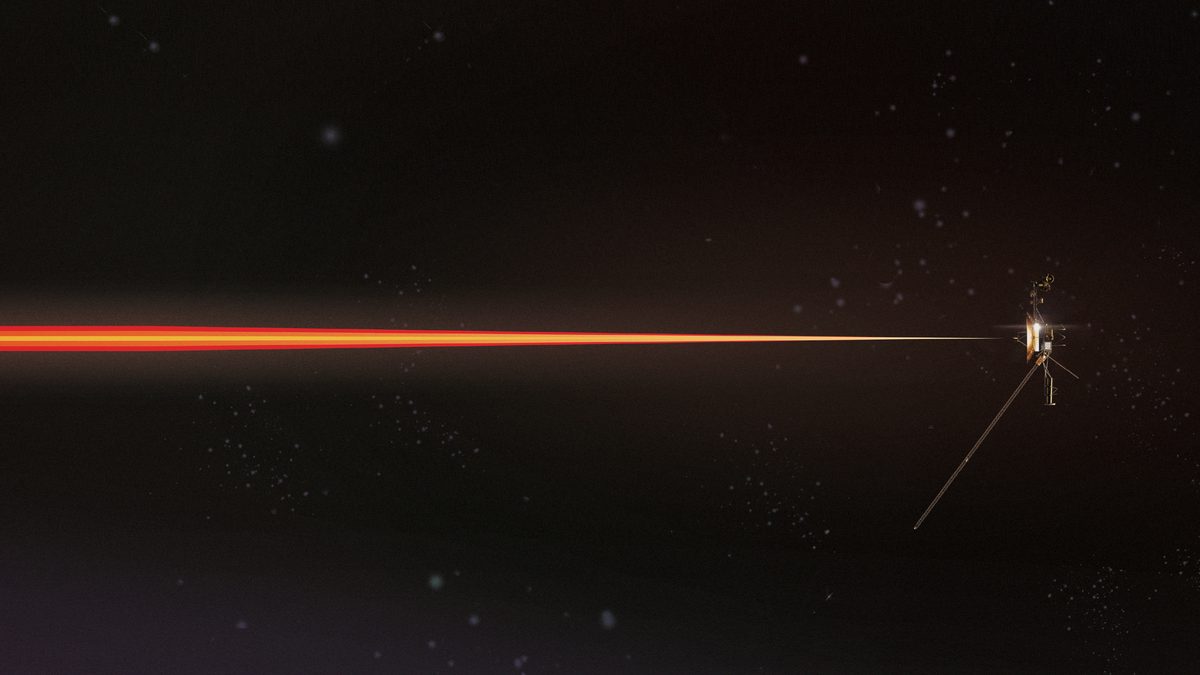
NASA's Voyager 1 reached one light-day from Earth at 2:16 a.m. PST (5:16 a.m. EST) on Nov. 18, 2026, in interstellar space, NASA said, after more than 49 years of travel.
A light-day is the distance light travels in 24 hours. NASA's release puts it at about 16.1 billion miles (25.9 billion kilometers). Voyager team members at NASA's Jet Propulsion Laboratory (JPL) in Southern California heard from the probe 24 hours later, NASA said. That is how long its radio signal, moving at the speed of light, took to reach Earth. The news came early Thursday.
There is a catch, and NASA states it plainly. The team has not received science and engineering data from Voyager 1 since Nov. 14, according to the release. The spacecraft is still sending a carrier signal, which is the steady radio tone that normally carries that data. Mission engineers used the carrier signal and trajectory calculations to confirm the milestone. NASA says they continue to analyze the issue. The release does not say what caused it or when data might return.
What NASA says
NASA gives a few ways to picture the distance. Light travels about 186,000 miles (299,000 kilometers) a second in a vacuum, per the release. A ray of sunlight takes about 1.3 seconds to reach the Moon and about four hours to reach Neptune. It needs another 20 hours to reach Voyager 1. For comparison, NASA says a light-year is 5.88 trillion miles (9.46 trillion kilometers).
Suzanne Dodd, the Voyager project manager at JPL, described what that does to daily work. "We listen to Voyager 1 every day and send commands to the spacecraft weekly. It just takes a little longer to communicate than it used to," she said. Signals now take 24 hours to reach the spacecraft and 24 hours to come back.
Joe Westlake, director of NASA's Heliophysics Division, said the mission would be remarkable for the Grand Tour of the outer planets alone. He added that it went on to become central to NASA's fleet of missions studying the Sun. Dave Gallagher, the JPL director, credited the teams who built and fly the spacecraft today.
Linda Spilker, the Voyager project scientist at JPL, pointed to one finding. "One big surprise is the extent to which our Sun continues to affect interstellar space, all the way out to Voyager 1," she said. She asked where the Sun's influence ends and pristine interstellar space begins, and said Voyager may last long enough to answer.
Context
Voyager 1 and its twin, Voyager 2, launched in 1977, NASA says, to take advantage of a rare planetary alignment. They were only the third and fourth spacecraft to visit Jupiter and Saturn, and the first to return high-resolution imagery of them. Voyager 2 went on to Neptune and Uranus.
NASA says Voyager 1 traveled at about 38,000 mph (61,155 kph) and in 2012 became the first spacecraft to leave the heliosphere, the bubble of particles and magnetic fields made by the Sun. Voyager 2 crossed the boundary in 2018. Both carry a Golden Record, a gold-plated copper phonograph of images and sounds from Earth.
Keeping them alive is a power problem. Each probe runs on a radioisotope thermal generator, essentially a nuclear battery that turns heat from decaying plutonium into electricity. NASA says both probes lose about 4 watts of power a year. Earlier this year, engineers turned off three devices on Voyager 1 and swapped in three lower-power ones. NASA calls the move "not without risk." The release says the change should give enough power to keep the current science instruments running until at least the 50th launch anniversaries next summer.
One detail in the release is easy to miss. The two probes have trouble beyond power: NASA lists clogged thrusters and a malfunctioning computer among the aging-hardware problems engineers have worked around.
Some outlets covering the milestone describe Voyager 1 as still returning science data. NASA's own release says data stopped arriving on Nov. 14, so this account follows NASA.
What is next
The next dated marker in NASA's release is the 50th launch anniversary of the Voyagers, which NASA places next summer. The agency expects the energy-saving work to keep the current science instruments running until at least then. That is an expectation, not a guarantee, and it assumes the data problem is resolved.
Whether Voyager 1 resumes sending science and engineering data is not known yet. NASA says engineers are still analyzing the issue. For now, the team can still hear the spacecraft, and Dodd says the commands keep going out weekly.
For more, NASA points readers to its Voyager mission page at https://science.nasa.gov/mission/voyager/.
Stay curious.
Find more at spacedew.com and @boggleriley on X
Get SpaceDew by email
Free. Tick what you want, and nothing else is sent.