Vietnam signs the Artemis Accords, becoming the 78th nation to join
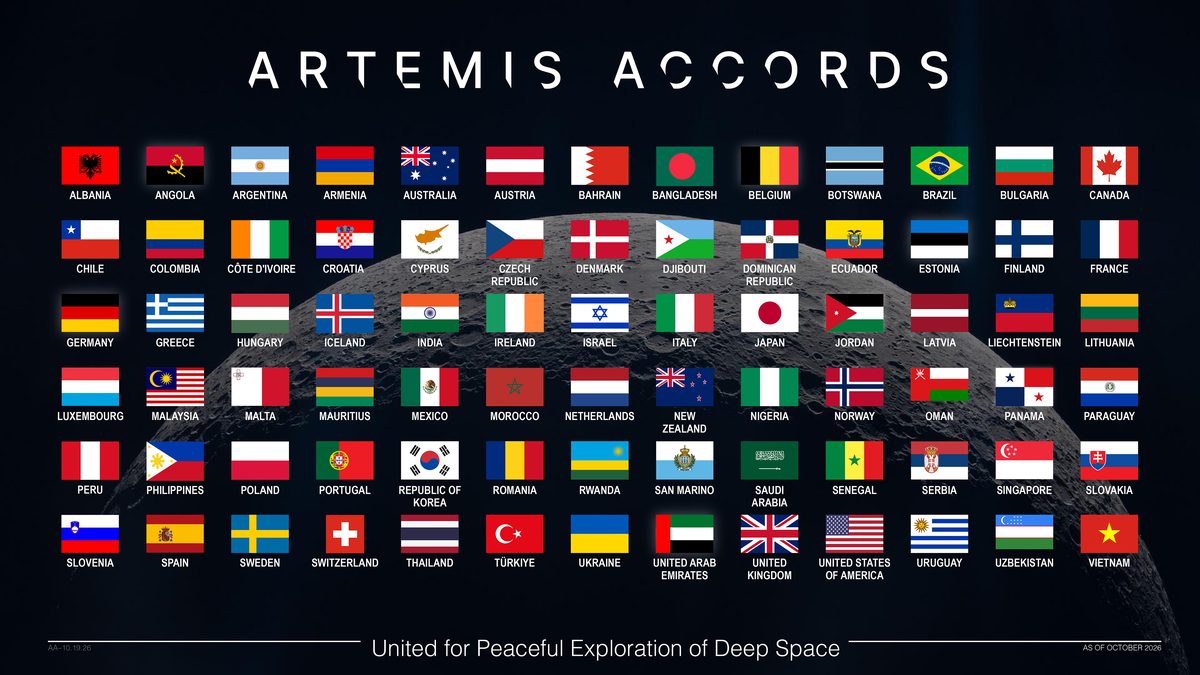
Vietnam's Minister of Science and Technology, Vũ Hải Quân, signed the Artemis Accords for his country during Vietnam International Digital Week in Ha Long, making Vietnam the 78th signatory, NASA said in a release.
What NASA says happened
The Artemis Accords are a set of shared principles for exploring the Moon, Mars and beyond. NASA's release says Vietnam is "joining a growing coalition of like-minded nations committed to the peaceful, transparent, and responsible exploration of space."
Quân signed on behalf of the country at the digital week event in Ha Long. NASA says Jennifer Wicks, the U.S. Ambassador to Vietnam, also took part in the signing event.
NASA Deputy Administrator Matt Anderson did not attend in person. He spoke in recorded remarks for the ceremony. "Vietnam is joining at an important point in the development of its own space program," he said. He pointed to work NASA and the Vietnam National Space Center have done together on "satellite innovation, land-use research, and radar-based Earth observation." Then he added a line that says where things stand: "We've aligned on the principles. The opportunities are in front of us, and now we can build on that foundation together."
The NASA release does not give the day or the hour of the signing. SpaceDew will not guess at either.
What signing means
NASA's release lists five commitments. Signers agree to explore peacefully and openly. They agree to help people in need. They agree to share scientific data so that, in NASA's words, "all of humanity can learn from" it. They agree to keep their activities from interfering with those of others. And they agree to preserve historically significant sites and artifacts by developing best practices.
These are principles, not a treaty with a list of penalties. NASA describes them as "practical principles aimed at enhancing the safety and coordination between nations as they explore the Moon, Mars, and beyond."
The Vietnam connection
NASA frames the signing as an extension of the U.S.-Vietnam Comprehensive Strategic Partnership, which it says is "built on more than 30 years of cooperation." According to NASA, that partnership spans defense, economic, law enforcement, war legacy and technological cooperation. Space is now added to that list.
The release also gives some concrete space work already underway. Earlier this year, NASA says, it partnered with Vietnam's Vietnamese-German University to support the agency's Soil Moisture Active Passive mission. That mission measures the water in surface soil around the world.
Here is the detail worth noticing. The university link is a ground-level, practical project, not a rocket or a launch. It is the sort of work that builds trust before any signature goes on paper.
NASA also says Vietnam has inaugurated its National Space Center in Hanoi. The country is developing its own satellite capabilities through a program called LOTUSat, which NASA says focuses on Earth observation, weather monitoring and disaster response. The release does not say how many satellites are planned or when any would launch, so there is no schedule to report.
Where the count stands
The Accords began in 2020. NASA says the agency and the State Department joined with seven other founding nations to set them up, responding to growing interest in lunar activity by both governments and private companies.
The pace since then has been steady. A NASA release from May 2024 says Slovakia became the 42nd nation to sign, at a ceremony hosted by then NASA Administrator Bill Nelson at agency headquarters in Washington. That same release says Peru signed earlier the same day as the 41st.
Vietnam's signing follows another one close by. A NASA release dated October 20, 2026, says Uzbekistan became the 77th signatory at a ceremony in Samarkand on a Monday. Vietnam is the next number up.
By NASA's own counts, that is 36 more signers than at the time of the Slovakia release in May 2024. Those figures come from the two NASA releases, and the arithmetic is simple subtraction.
The 2024 release also says the Accords are grounded in the Outer Space Treaty and other agreements, including the Registration Convention and the Rescue and Return Agreement. It adds that signers have met in person at a workshop to work on carrying out the principles. That workshop, held in May 2024, is the kind of follow-through the signing is meant to lead to.
What is not known yet
The record does not say what specific steps Vietnam will take after signing. NASA's release talks about opportunities and a foundation to build on. It names no new joint mission, no funding and no timeline.
What is next
NASA says more countries are expected to sign "in the months and years ahead." That is a statement of expectation, not a schedule, and the release names no country and no date.
For Vietnam, the next step is the work the principles are meant to guide. NASA's own list of existing efforts includes the soil moisture partnership, the National Space Center in Hanoi and the LOTUSat program. Those are where any follow-up would show up first.
The full NASA release is on nasa.gov, under the Office of International and Interagency Relations pages. More about the Accords is at https://www.nasa.gov/artemis-accords.
Stay curious.
Find more at spacedew.com and @boggleriley on X
Get the Morning Dew
The daily brief, live quotes and the newest File Zero story, every morning. Plus a Friday recap of the week. Nothing else, ever.