Update: NASA Says Artemis II Heat Shield Held Up, With Far Less Damage Than Artemis I
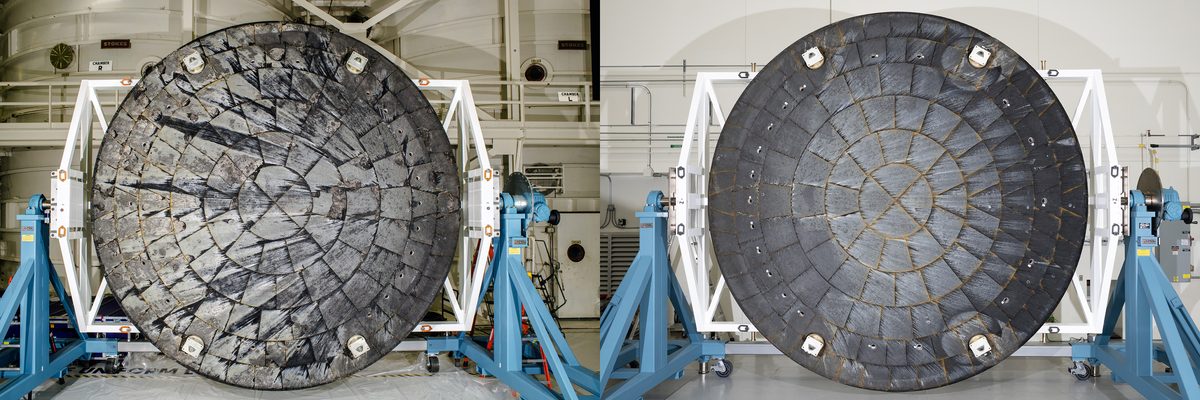
NASA said in a post-flight analysis on nasa.gov that the Orion heat shield protected four astronauts as expected during their return from the Moon, with splashdown in the Pacific off San Diego. Our earlier story on the crew's Congressional Space Medal of Honor covered the ceremony. This one is about the hardware that got them home.
What NASA found
The heat shield is the thick, charred-looking disk on the bottom of the capsule. It takes the worst of the heat when Orion hits the atmosphere on the way home. NASA says additional engineering analysis confirmed the first data, which already showed the shield did its job.
The numbers are big. NASA says Orion reached a top speed of 39 times the speed of sound. Outside temperatures went above 4,000 degrees Fahrenheit at the peak. Inside, NASA says, the cabin stayed in the mid-70s Fahrenheit during the trip back from the Moon.
The comparison with Artemis I is the heart of the release. That was the uncrewed test flight, and its heat shield lost more material than engineers expected. NASA says engineers found only nine spots of char loss on the Artemis II heat shield dish, compared to 103 on Artemis I. NASA says the shorter allowable downrange distance cut cracking and char loss by a factor of ten.
Why it went better
NASA says the fix was in the flight path, not the shield itself. After its analysis of the Artemis I findings, informed by arc jet testing at NASA's Ames Research Center in California (a test that blasts material samples with superheated gas), the agency changed Orion's reentry trajectory. It shortened the maximum downrange distance the spacecraft could fly between entering the atmosphere and splashing down.
The reasoning, per NASA, is that a shorter path limits how long the shield spends in the temperature range where the Artemis I problem occurred. NASA says pre-flight analysis showed this, and the flight bore it out.
Orion also landed close to where planners aimed. NASA says it entered within 192 feet of its targeted entry point and splashed down 0.59 miles from the predicted landing site.
The inspections so far
NASA says divers took images of the heat shield just after splashdown, and crews did further checks on the recovery ship. Both found it performed as expected, with a significant drop in cracks and char loss compared to Artemis I.
The shield then went to NASA's Kennedy Space Center in Florida, where thermal protection experts began more examination. NASA says it is built from 186 unique blocks of an ablative material called Avcoat. Ablative means it is meant to burn away slowly and carry heat off with it. The shield was then moved to NASA's Marshall Space Flight Center in Huntsville, Alabama. Sample extraction and internal x-ray scans began there in August, NASA says.
One detail from the release is easy to miss. NASA says features such as the seams between the Avcoat blocks, and the Avcoat around the bolts where the compression pad separates, behaved consistently from Artemis I to Artemis II. In plain terms, the basic design repeated its performance on a second flight.
The backshell also checked out. That is the cover on the sloped sides of the crew module, which NASA says is made up of 1,300 ceramic tiles. NASA says visual inspection showed expected performance, and the features that seal windows, vents, thrusters and the side hatch met expectations. It reports no signs of overheating.
What is not known yet
The work is not finished. NASA says the team made laser scans of the heat shield surface and is comparing them to pre-flight measurements to work out how much material wore away. Those results will then be checked against the analysis predictions. NASA does not give that result in this release. Sample extraction at Marshall, followed by material tests and thermal analysis, continues.
What is next
The release turns to Artemis III. NASA says the heat shield design was upgraded after the Artemis I investigation to give the Avcoat blocks more uniform and consistent permeability. Technicians attached the Artemis III crew module heat shield at Kennedy in early July, NASA says. The crew and service modules were joined at the end of July. NASA says the spacecraft has since been powered up for the first time, so engineers could check that all connection lines between the two modules work as planned.
Artemis III is planned for next year, in low Earth orbit, NASA says. The crew is NASA astronauts Randy Bresnik, Frank Rubio and Andre Douglas, plus Luca Parmitano of the European Space Agency. NASA says they will rendezvous with human lander test articles from Blue Origin and SpaceX to demonstrate systems needed for future landings, which NASA says begin with Artemis IV in 2028.
On the rocket side, NASASpaceFlight reported on October 14 that both solid rocket boosters of the Artemis III Space Launch System are fully stacked and all four RS-25 engines are installed, as teams prepare for a pad tanking test. NASA has also announced a briefing at 2 p.m. EDT on Friday, October 23, at Kennedy, to update its plans for returning astronauts to the Moon's surface by 2028.
Stay curious.
Find more at spacedew.com and @boggleriley on X
Get the Morning Dew
The daily brief, live quotes and the newest File Zero story, every morning. Plus a Friday recap of the week. Nothing else, ever.