Two Stars in Andromeda Merged Into One, and Webb Helped Prove It
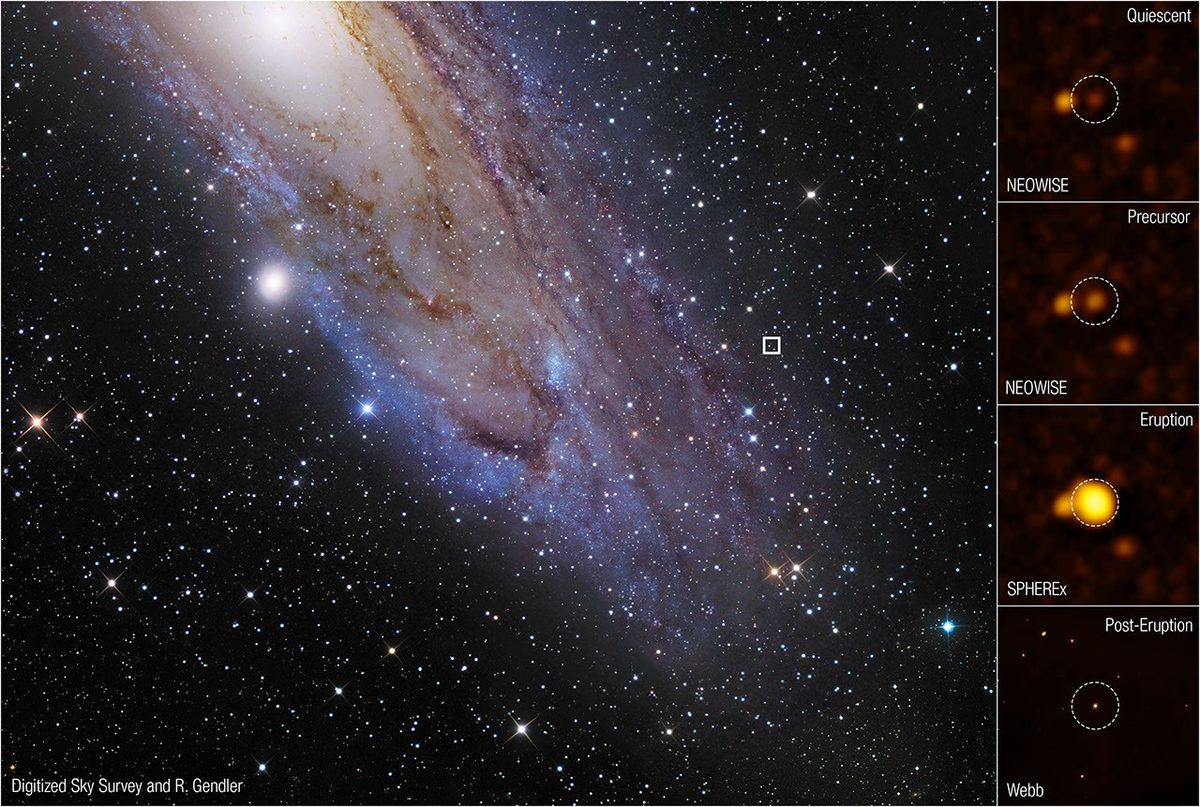
NASA said on Wednesday, November 18, 2026, that researchers used its James Webb Space Telescope data to show a star merged with a giant companion at the edge of the Andromeda galaxy, in a study published in Nature.
The timestamp on the release is not given, so no clock time appears here. The date comes from NASA's release on science.nasa.gov, which says the Nature paper was published Wednesday.
What NASA says happened
The release describes a first of its kind. A star slightly less massive than the Sun spiraled into a puffy supergiant star and merged with it. The team nicknamed the newly single star Bao. Its formal name is AT 2025abao.
NASA says the discovery was funded by NASA and then bolstered by quick Webb observations, which were cross-checked against data from other telescopes in space and on the ground.
Viraj Karambelkar, first author of the paper and a NASA Hubble Fellow at Columbia University in New York, said mergers are very hard to watch live because they are hard to predict. His team noticed something odd in 2023 and kept watching. "Then, in 2025, it erupted!" he said. Webb observed Bao 47 days after the eruption peaked, which NASA calls the earliest follow-up of an event like this.
The pair had circled each other for millennia, NASA says. Once the smaller star touched the surface of the giant, the two united after only seven orbits, about seven years. NASA notes that other known mergers of two smaller stars took thousands of orbits.
How the team pieced it together
According to the release, the team's model of the system, matched to Webb's mid-infrared data, showed the dust the bigger star had shed over centuries. From that, the team concluded the primary star was seven times as massive as the Sun, 350 times the radius and 18,000 times brighter. They nicknamed it "Big Bao."
The model also gave the first mass estimate for the smaller companion, "Little Bao": about 0.7 times the Sun's mass, with a slightly smaller radius, and fainter. Early results suggested it might have enough leftover energy to escape. Further analysis showed it was dragged into Big Bao's core. Kishalay De, an assistant professor at Columbia, called the encounter "almost like a bomb exploding inside a living star."
This kind of event is called common envelope evolution. The gas between the stars at that stage shares an outer layer, hence the name. In some systems both stars survive, NASA says. Here, Webb's data showed they merged.
The timeline
NASA's release lists the steps:
- February 2023: The team spots an unusual variable star in data from NASA's retired NEOWISE mission, a space survey that looked in infrared light. Before 2018, the release says, the object had a steady brightness.
- September 2024: The Wide-field Infrared Transient Explorer shows Bao brightening and spewing dust.
- July 2025: NASA's SPHEREx, during a routine survey, sees Bao fade quickly in visible light and brighten in infrared.
- October 17, 2025: The Zwicky Transient Facility detects the eruption.
- November 2025: Fast observations come from NASA's retired Neil Gehrels Swift Observatory and from the Gemini North telescope in Hawaii.
- December 24, 2025: Webb observes Bao, in a just-in-time program called Director's Discretionary Time.
Here is a detail worth noting. The team's first paper on the system came out right before the 2025 eruption, according to NASA. They were already writing about Bao before it blew.
Coverage of the work also reported that the Webb observation took three hours, and that other instruments joined in, including the Himalayan Chandra Telescope in India and Spain's Gran Telescopio CANARIAS in the Canary Islands.
Why it matters
The release says the team watched the merger in real time. In other cases, astronomers work backward from events that may have happened hundreds or even millions of years ago. Watching it live let the team measure how efficient common envelope evolution is, NASA says.
NASA also says that where both stars survive such a stage, the pairs can later turn into neutron stars and black holes, explode as supernovae, send out gravitational waves (ripples in space-time) and create millisecond pulsars.
One thing is not known yet. NASA says only future observations will show how the new star's "heft" settles.
What is next
NASA says its recently launched Nancy Grace Roman Space Telescope is about to conduct large, publicly available surveys. Its Galactic Bulge Time-Domain Survey will turn up a large number of new transient events (objects that brighten or fade over time) that could benefit from similar analysis. "There's going to be a large influx of similar discoveries just ahead," Karambelkar said.
The work was funded in part by a grant from NASA's Astrophysics Data Analysis Program, according to the release. The full account is on NASA Science at science.nasa.gov/missions/webb/nasa-data-clinches-first-of-its-kind-stellar-merger/.
Stay curious.
Find more at spacedew.com and @boggleriley on X
Get SpaceDew by email
Free. Tick what you want, and nothing else is sent.