The Kecksburg Incident
The Government Kept a File on Every UFO Except the One That Landed
FILE ZERO | Investigative
The U.S. Air Force logged thousands of UFO sightings in Project Blue Book between 1952 and 1969, but when something came down near Kecksburg, Pennsylvania, in December 1965, no file was ever opened.
That absence is the story.
Not the acorn-shaped object witnesses described. Not the military cordon around the woods. Not the flatbed truck that reportedly left before dawn. Those details have been argued over for sixty years. The thing worth sitting with is simpler: the government maintained a formal, bureaucratic system for capturing anomalous aerial events, and Kecksburg never entered it. The most witnessed, most militarily-responded-to incident of 1965 produced no Blue Book case number. None that has ever surfaced in any archive, including the National Archives, where the full sanitized series lives today.
That is not a gap in the record. That is a decision someone made.
What Blue Book Actually Was
Project Blue Book was the Air Force's public-facing UFO investigation program, running from 1952 until its closure in 1969. It was, in bureaucratic terms, a capture mechanism: a system designed to receive reports of anomalous aerial phenomena, assign them case numbers, investigate them, and classify them. Balloon. Aircraft. Astronomical. Unknown.
The word "public-facing" is doing real work in that sentence. Blue Book was the thing the Air Force showed you. The question the Kecksburg record raises is what ran alongside it.
The full sanitized case file series sits in Record Group 341, Records of Headquarters U.S. Air Force (Air Staff). Two entries from that series are directly relevant here, not because they mention Kecksburg, but because of where they fall in the timeline and what their existence implies about the system's reach.
The Indianapolis Entry
Eight months before Kecksburg, the Air Force opened a Blue Book case file for a sighting northwest of Indianapolis, Indiana. That file, now accessible and unrestricted at the National Archives, is the geographically closest Blue Book entry in this record group to western Pennsylvania in the period immediately preceding December 1965.
Nine scanned images in the catalog. The contents of those images are not in front of us, and we will not speculate about what they say. What the metadata tells us is enough: Blue Book was active in the American Midwest in April 1965. The system was running. Reports were being received, logged, and filed.
Eight months later, something came down in Kecksburg. The system produced nothing.
If you are looking for the moment the routing changed, the Indianapolis entry is the last confirmed use of the official mechanism in the region before it did.
The Misawa Entry
The second document is older and stranger in its implications. A Blue Book case file from Misawa, Japan, dated July 1960. Five scanned images, unrestricted, sitting in the same record group and the same administrative series as every other Blue Book case.
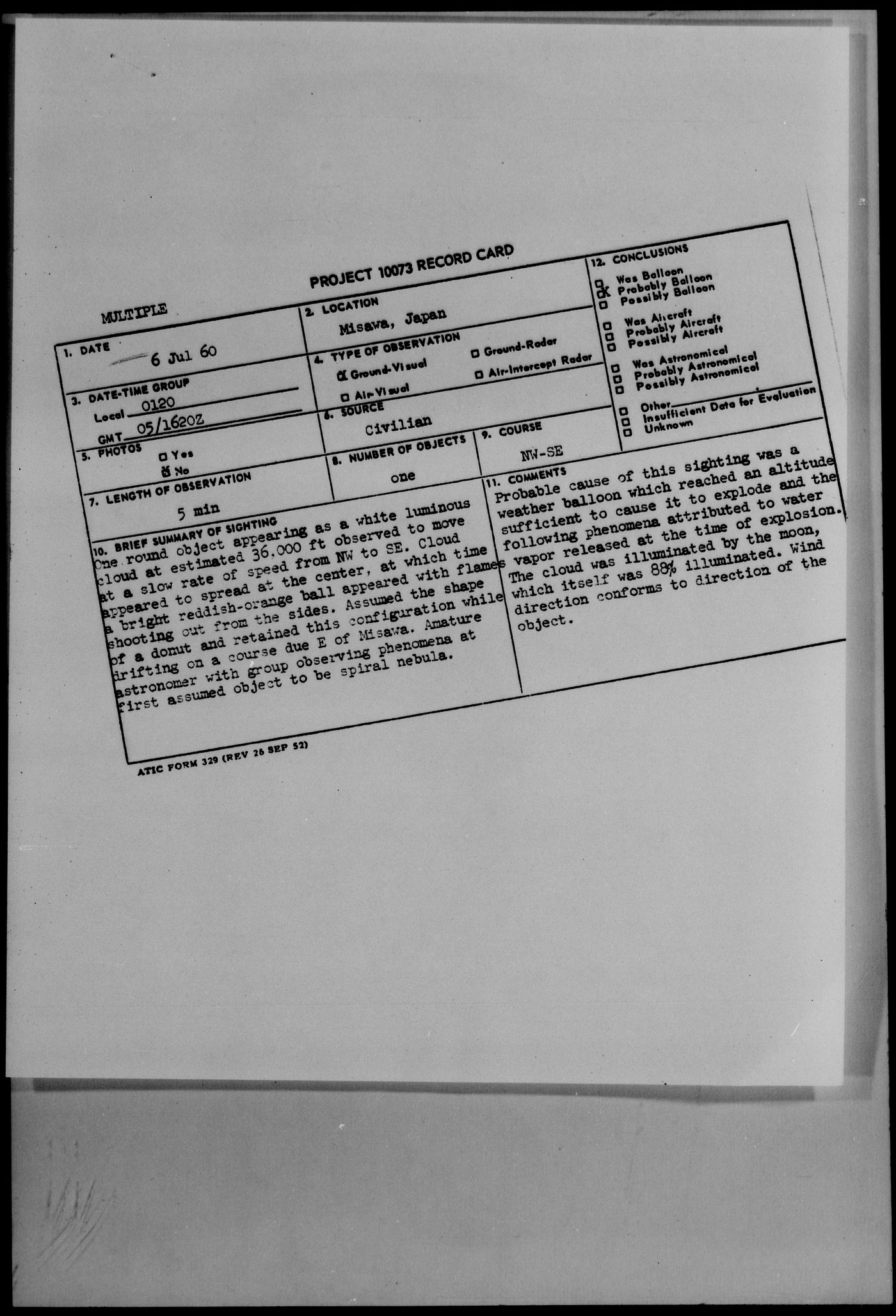
Project Blue Book Case File, Misawa, Japan, July 1960
Source: National Archives, NAID 28987665. View full document
Misawa Air Base in 1960 was not a routine posting. It was one of the primary signals intelligence and foreign technology collection nodes in the Pacific, operated jointly by the Air Force and the National Security Agency. The base's mission, in plain terms, was to watch for things the Soviets were doing in the air and figure out how they worked.
A Blue Book file originating at Misawa, inside RG 341, places foreign technology recovery and UFO reporting inside the same administrative series five years before Kecksburg. That is not a smoking gun. It is a bureaucratic fingerprint. It tells you that the people running Blue Book understood the category of "object of unknown origin" well enough to file reports from a foreign technology collection base under the same series as civilian sightings over Indiana.
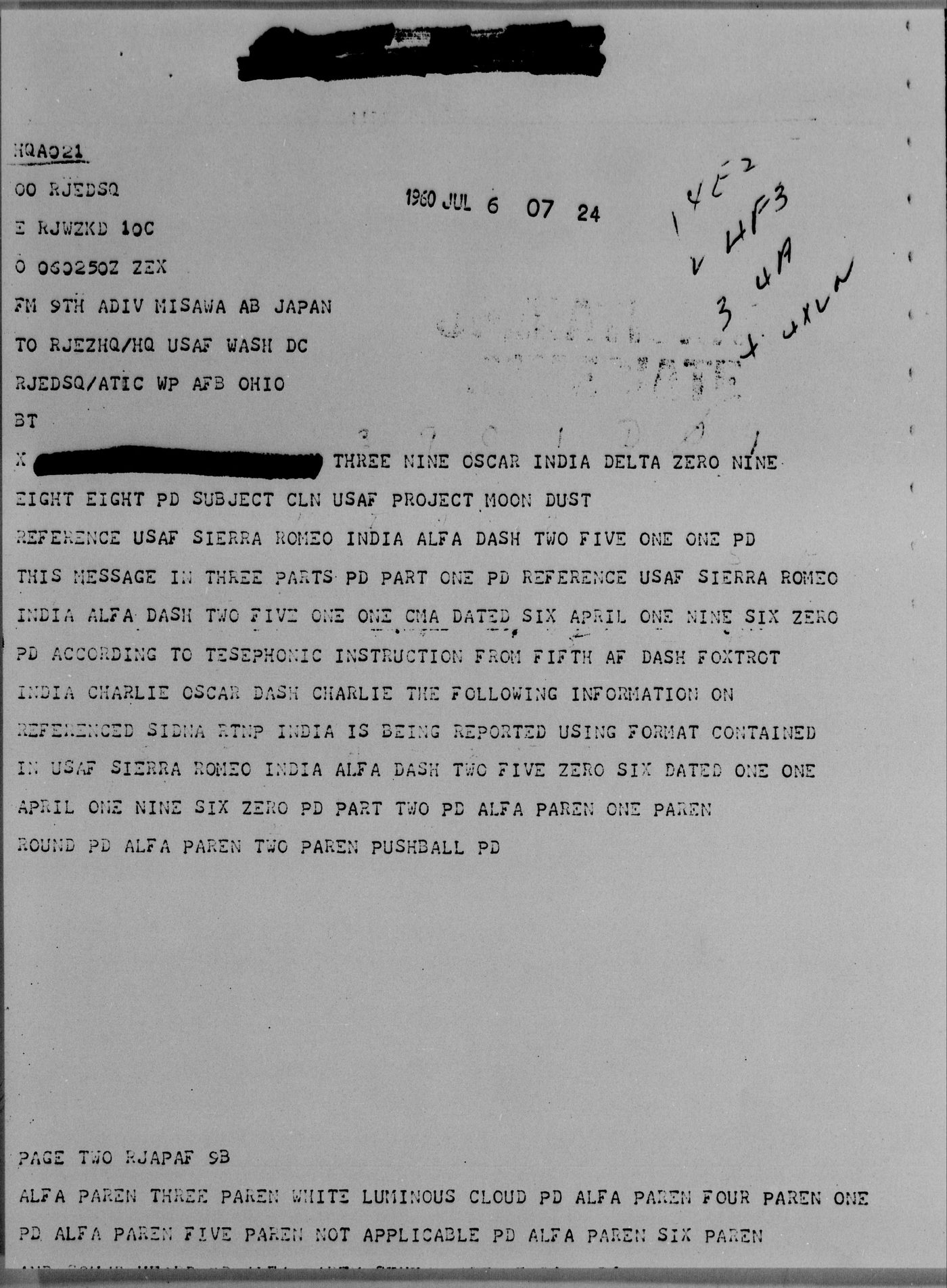
Project Blue Book Case File, Misawa, Japan, July 1960
Source: National Archives, NAID 28987665. View full document
The Third Document
There is a third piece of this that does not come from the two National Archives files above, but is confirmed in the public record and belongs in any honest account of how this system worked.
In the 1990s, researchers obtained a 1967 State Department cable through FOIA requests. The cable explicitly names Project Moon Dust as the U.S. government's recovery program for "objects of unknown origin" and instructs field offices to report sightings through channels separate from Blue Book. Moon Dust was real. It was not a rumor or a researcher's inference. The State Department put it in writing.
Read that cable alongside the Indianapolis gap and the Misawa filing, and a picture forms. Blue Book was the public record. Moon Dust and its companion program, Project Blue Fly, handled physical recovery through a parallel channel. The two systems were not in competition. They were designed to handle different phases of the same problem: Blue Book took the reports, Moon Dust took the hardware.
Kecksburg involved hardware. Or at least, witnesses and local law enforcement said it did. The military response that night, corroborated by multiple independent accounts, was consistent with a recovery operation, not an investigation.
Which channel would you route that through?
The Buried Lede
Here is the detail that tends to get lost in sixty years of Kecksburg coverage.
Blue Book was closed in 1969, four years after Kecksburg, following the Condon Report's conclusion that UFO investigations offered no scientific value. The Air Force used that report to shut the program down and, with it, the public's primary window into the official record.
If a Kecksburg file existed inside Blue Book, closing the program would have been one way to ensure it stayed buried without anyone having to actively suppress it. The file simply becomes part of a closed program's archive, sanitized and released decades later with everything else.
No file means no such problem. It also means no case number, no investigator's name, no chain of custody, no official conclusion. The absence is cleaner than a redaction.
That is not a finding. It is a question the record raises and does not answer. But it is the right question, and it is one the existing documents, taken together, make harder to dismiss.
What to Watch
The Kecksburg case has been in active FOIA litigation before. In 2007, NASA agreed to search its records following a lawsuit by researcher Leslie Kean. The agency produced some documents and claimed others were lost. That search was never exhaustive, and the Moon Dust channel was not its focus.
The Indianapolis Blue Book file and the Misawa entry are both unrestricted and accessible today. Anyone can request the full scanned images through the National Archives catalog. The State Department Moon Dust cable is in the public record. None of this requires a new FOIA request. The material is already there.
The open question is whether anyone with subpoena authority ever asks, specifically, which program received the Kecksburg report, who authorized the routing, and where that file went. Congress has shown recent appetite for exactly this kind of structural question about legacy UAP programs. Whether that appetite extends to a sixty-year-old case in western Pennsylvania is worth watching.
The government kept a public file on every unexplained object in American skies. Except the one that actually landed.
That is either a coincidence or a policy. The archives are not yet saying which.
Stay curious.
Find more at spacedew.com and @boggleriley on X
Get the Morning Dew
The daily brief, live quotes and the newest File Zero story, every morning. Plus a Friday recap of the week. Nothing else, ever.