Nitinol and the Memory Metal Question
The Contractor Who Counted UFOs Was Also Filing Patents for the Government
Battelle Memorial Institute, the firm the Air Force hired to statistically analyze Project Blue Book reports in the early 1950s, appears in the Patent and Trademark Office's own index of government licensees, raising a question the public record has never formally answered: what were they inventing, and for whom?
Start with what Battelle is supposed to be in this story. A contractor. An outside analyst. The organization the Air Force brought in to run the numbers on thousands of UFO sightings and produce Special Report 14, the 1955 study that concluded most sightings were explainable and the remainder were simply lacking in data. Battelle was the neutral third party. The scientists with clipboards. The people who made the whole program look rigorous.
That framing holds up until you pull a record group that has no obvious business being in this conversation.
The Patent Index Nobody Checked
The National Archives holds an index to patent assignments by government licensees, filed under Record Group 241, the records of the Patent and Trademark Office. One entry in that index covers Battelle Memorial Institute. The catalog record, NAID 256488001, is unrestricted and contains 778 scanned images. It is not a classified file. It is not a leaked document. It is sitting in the open stacks, alphabetically, between entries for other government licensees, and it confirms something the standard Blue Book narrative does not account for: Battelle was not just analyzing data for the federal government. It was generating patentable intellectual property under government license.
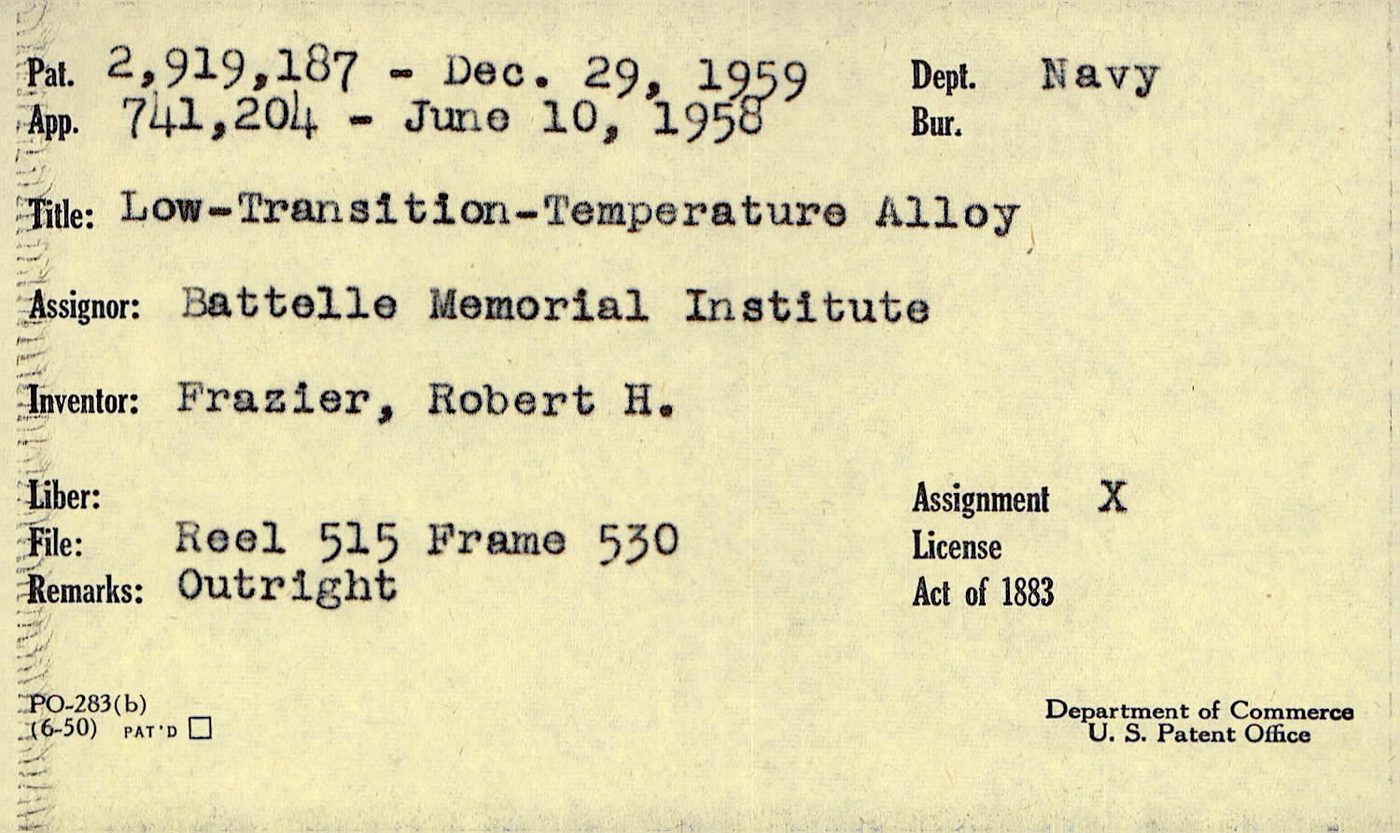
Battelle Memorial Institute entry, Index to Patent Assignments by Government Licensees, RG 241
Source: National Archives, NAID 256488001. View full document
That is a different kind of relationship. Analysts produce reports. Licensees produce inventions. The catalog entry does not say what those inventions were. That is the point. The index confirms the relationship exists. The contents of the patents themselves are a separate question, and it is one that does not appear to have been formally asked in any public examination of Battelle's government work during this period.
Two Roles, One Contractor
Here is where it gets specific. Project Blue Book was administered through the Air Force's Foreign Technology Division, known as FTD. That division's mandate was not limited to Soviet aircraft recognition. FTD was the Air Force's primary office for reverse-engineering foreign materials and technology, anything that came into U.S. possession that needed to be understood before it could be countered or replicated.
A document in the Blue Book Administrative Files, NAID 461458827, places FTD explicitly in the Blue Book chain of command. The record is titled "Foreign Technology Division: Soviet Effort to Contact Extraterrestrial Life," dated February 3, 1967. What the document says is a matter for the document itself, which is accessible and unrestricted. What the catalog confirms is that FTD was generating Blue Book administrative paperwork as late as 1967, well after Special Report 14 was published, and that the division's scope included tracking foreign programs related to phenomena beyond conventional aircraft.
Battelle served that division. The same contractor that produced the statistical analysis of UFO sightings also worked within an office whose core function was processing unknown foreign materials. Whether those two functions ever touched the same project is not something the catalog can tell you. But the dual role is documented, not inferred.
How Serious Was This, Really?
The standard answer is: not very. Blue Book was a public relations exercise. The Air Force needed a place to route civilian sightings, and Blue Book was that place. The program was underfunded, understaffed, and eventually shut down in 1969 after the Condon Report gave the Air Force the institutional cover it needed to walk away.
That narrative has a document problem.
The National Security Council's registry files contain a memorandum addressed to James Lay, the NSC's executive secretary under Eisenhower. NAID 493470227. The memo comes with an attached report on unidentified flying objects. Eight scanned images, unrestricted, sitting in Record Group 273 at the Eisenhower Presidential Library.
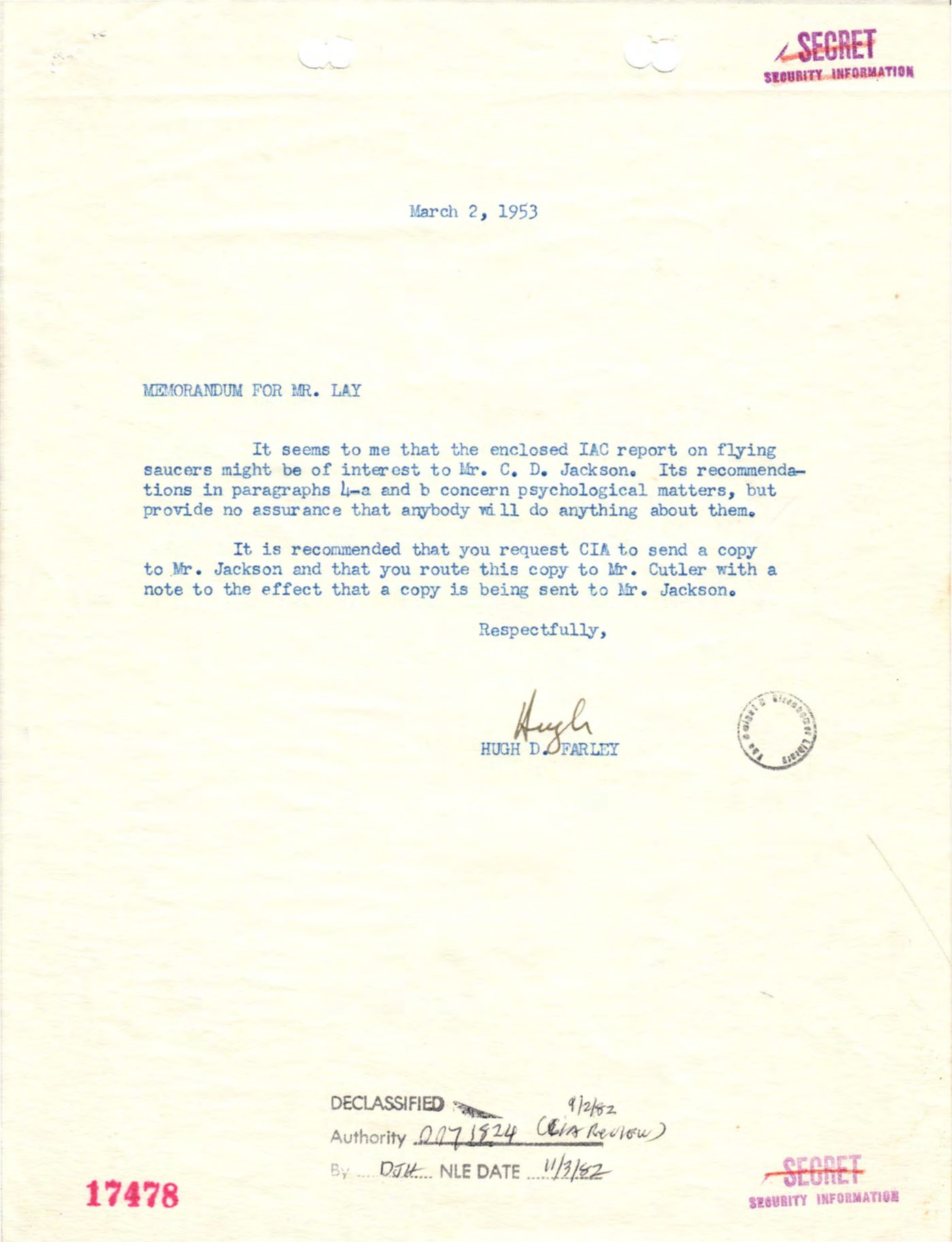
Memorandum for James Lay with attached report on unidentified flying objects, RG 273
Source: National Archives, NAID 493470227. View full document
James Lay was not a mid-level bureaucrat. He was the man who managed paper flow for the National Security Council. Routing a UFO report to his desk means someone decided this subject required NSC-level documentation. That is not the paper trail of a program anyone considered trivial. What the memo argues, or recommends, or reports, the catalog does not say. But its existence in that record group is its own kind of answer to the question of how seriously the Eisenhower administration took the subject.
The Buried Lede
The Project Blue Book entry in the Air Staff records, NAID 542184, is unrestricted. It is named. It is findable. It has zero associated files in the catalog.
A named project with no attached files is either an incomplete processing job or a placeholder for records that live somewhere else. Both explanations are mundane. Neither one is satisfying when the project in question is the Air Force's official UFO investigation program. The catalog entry anchors the timeline. What it does not do is show you the work.
That gap matters for one specific reason. Battelle's Special Report 14 was the analytical product of Blue Book's most intensive investigative period. If the Air Staff records for Blue Book are thin, and the Patent and Trademark Office records for Battelle are substantial, the question of where the full record of that relationship actually lives is not rhetorical. It is a research question with a real answer somewhere in the stacks.
What to Watch For
The patents are the thread worth pulling. Battelle's government licensee entry covers a specific window. The early 1960s overlap with two things: the tail end of Blue Book's serious analytical phase, and the first documented synthesis of Nitinol at the Naval Ordnance Laboratory in 1962, a shape-memory alloy whose origin story has attracted its own share of scrutiny. Battelle's work on exotic metallurgy for the government is documented independently of Blue Book. Whether any patent from that window involved material properties, specifically superelastic or thermally responsive metal behavior, and which agency held the license, is a question the public record has not answered. A FOIA request to the Patent and Trademark Office, targeted at Battelle assignments from 1955 to 1965, would be a reasonable next step. Someone should file one.
Stay curious.
Find more at spacedew.com and @boggleriley on X
Get the Morning Dew
The daily brief, live quotes and the newest File Zero story, every morning. Plus a Friday recap of the week. Nothing else, ever.