NASA Plans Artemis III as a 2027 Earth-Orbit Rehearsal With Two Moon Lander Test Vehicles
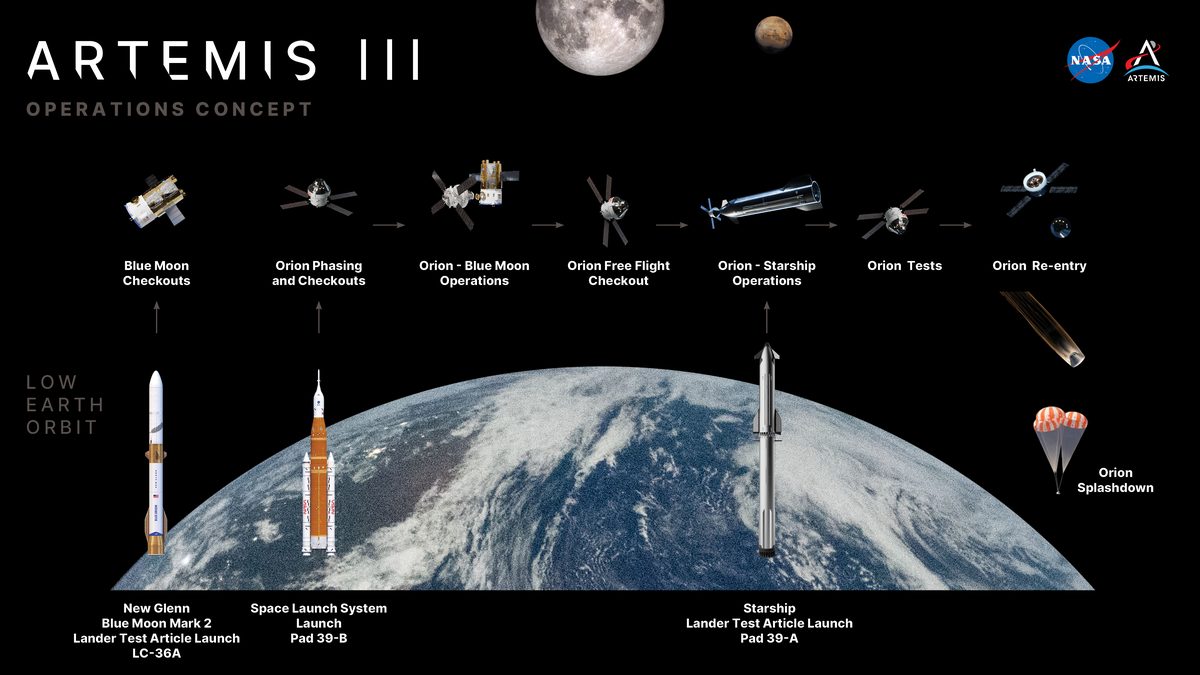
NASA says Artemis III will launch in 2027 and send four astronauts into low Earth orbit aboard Orion to practice docking with test versions of two commercial Moon landers, according to the agency's mission release.
What NASA says
The crew is NASA astronauts Randy Bresnik, Frank Rubio and Andre Douglas, plus Luca Parmitano of ESA (the European Space Agency). NASA's release says they will fly a planned 14-day mission and work with test versions, which NASA calls test articles, of landers built by Blue Origin and SpaceX.
The goal is practice. Crews and flight controllers will rehearse the rendezvous, docking, living and working procedures they will need when astronauts begin landing near the Moon's South Pole in 2028, NASA says. The release calls the mission "designed to reduce risk, validate hardware, and gain operational experience" before a crewed landing attempt.
"We're launching three spacecraft on three different rockets and testing how they operate together, something NASA has never attempted," said Jeremy Parsons, NASA's Artemis program manager, in the release.
Three launches, in order
Blue Origin goes first. NASA's release says the company will launch a test version of its Blue Moon Mark 2 lander into a circular orbit about 273 miles (237 nautical miles) up. The lander can stay there up to 30 days, which gives NASA room to adjust the schedule.
NASA then plans to launch Orion on its SLS (Space Launch System) rocket from Kennedy Space Center in Florida, only days after the Blue Moon launch and after confirming the lander is healthy. Orion starts in an oval orbit of 18 by 1,122 miles. Its service module then moves it to a circular orbit at about 345 miles (300 nautical miles) so it can settle thermally before the chase begins.
Inside Blue Moon
Once Orion docks, the astronauts spend about two days on evaluations aboard the Blue Moon test article, NASA says. The crew opens the hatch and goes inside to check the cabin, the controls and the life-support systems. Teams will verify the lander can hold the right air and pressure.
A companion NASA account from July adds a detail. Up to two astronauts, wearing orange Orion crew survival suits, will enter the lander. Blue Moon will also carry an instrumented mass simulator in the shape of a lunar surface spacesuit. It will send back live readings of conditions in the cabin, much like the "Moonikin" dummy that flew on Orion during Artemis I.
Then Starship
After Orion undocks from Blue Moon, SpaceX launches a Starship Version 3 test article from Florida, NASA's release says. It flies later in the mission because Starship is designed for a much shorter time on orbit than Blue Origin's lander. It will fly at 206 nautical miles and carry an added docking system on its nose.
The Starship test is expected to last up to two hours, and the crew will not go inside. NASA and SpaceX plan to look at how the two vehicles handle as one docked spacecraft, including communications, software and the forces of docking and undocking.
The two dockings are different on purpose. Orion connects to a port beside Blue Moon's crew cabin, then later lines up its own forward docking system with the one on Starship's nose. NASA says testing both in one flight lets it compare two operating approaches.
The rest of the flight
When the Starship test ends, Orion and its crew have up to five more days in orbit, according to the release. NASA plans to use them for more tests of the Orion crew survival suits, docking sensors, noise and heat measurements, and studies of how the crew performs.
The list also includes a cellular biology experiment and a proof-of-concept study on how astronauts could carry out health checks when they cannot talk directly with mission control. Researchers will use the flight to test ideas for bringing lunar samples back to Earth and moving them into storage. Plant seeds ride along too, NASA says. The release says planners built flexibility into the timeline in case objectives need more time.
Context
Artemis II flew a crew around the Moon and splashed down on April 10, according to NASA's account of the astronauts' later transition to emeritus status. Artemis III is the next crewed flight, and it stays near home.
Coverage of an October 23 news conference at Kennedy Space Center reported that NASA officials called the hardware on track for a tanking rehearsal at the end of this year. That is a practice run of loading propellant while a shortened SLS stack sits on the pad. The same coverage reported that a New Glenn rocket exploded during a static fire test at Cape Canaveral on May 28, damaging Blue Origin's launch pad, and that Blue Origin has chosen to rebuild it. That coverage also quoted NASA Administrator Jared Isaacman saying New Glenn was always the plan for the Blue Moon test article.
What is next
Artemis III is planned for 2027, and NASA's release gives the year, not a day. Before the mission begins, NASA says, it will review both lander test articles to confirm they are ready and safe for a crewed Orion to approach. The reviews will check performance requirements and hazard controls. Crewed landings near the Moon's South Pole are planned for 2028, NASA says.
Stay curious.
Find more at spacedew.com and @boggleriley on X
Get the Morning Dew
The daily brief, live quotes and the newest File Zero story, every morning. Plus a Friday recap of the week. Nothing else, ever.