NASA Mars Simulation Crew Exits Habitat
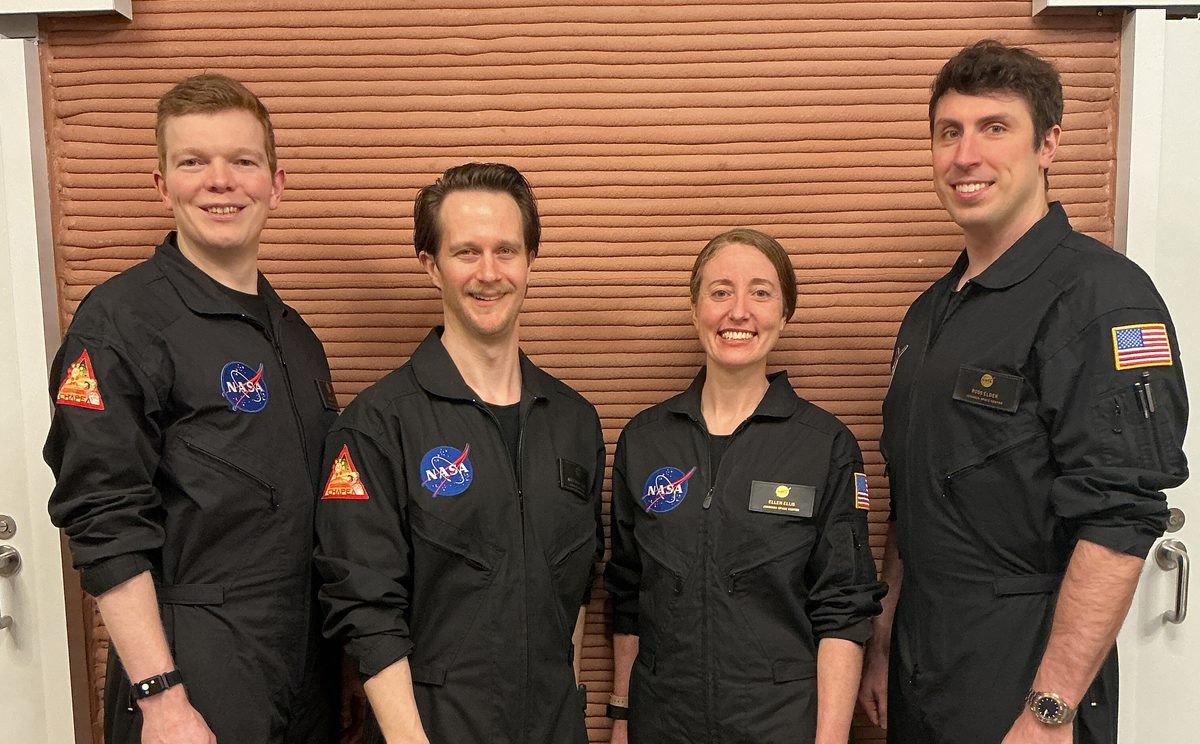
Four crew members, including commander Ross Elder, will leave NASA's simulated Mars habitat at Johnson Space Center in Houston on Saturday, Oct. 31, ending a year of isolation meant to prepare for Mars, NASA said.
The release does not give a clock time for the exit. It says only that the crew will leave the habitat that day to conclude the mission.
What NASA says
The crew is on the second Crew Health and Performance Exploration Analog mission, called CHAPEA. NASA's release says the four have spent the past 365 days living and working in a confined habitat at Johnson Space Center, operating as though they were on Mars.
That meant growing crops, managing limited resources, dealing with communication delays, and doing suited extravehicular activities (spacewalks) on a simulated Martian surface, according to the release.
The crew is Ross Elder, mission commander; Ellen Ellis, medical officer; Matthew Montgomery, science officer; and James Spicer, flight engineer. NASA says they entered their 1,700 square foot, 3D-printed habitat on Oct. 19, 2025.
Here is the detail that caught my eye. This is a one-year mark, not the finish line. NASA describes the full mission as 378 days, so the crew has more time inside than the headline number suggests.
Their families have been reachable only by email, with a Mars-like communication delay, NASA says. After the exit, the crew gets a chance to reconnect with them.
What the data is for
Grace Douglas, the CHAPEA principal investigator, said in the release: "We are extremely proud of the crew for their commitment and achievements over the last year on such a fast-paced, highly demanding mission."
NASA says science teams prepared to process the health and performance data collected on the crew. The agency says that data can help it balance priorities and develop ways to counter spaceflight risks on future long Mars missions.
The release gives examples. Data could show how limited food and exercise systems will affect NASA's ability to meet mission goals, including spacewalks on the surface of Mars. Some of it could also help NASA build decision-making support systems for crews facing communication delays that NASA says can last up to 45 minutes each way.
Michael Stenger, chief scientist for NASA's Human Research Program, said the mission has been valuable in starting to show how to understand requirements for year-long missions, including medical and psychological care across communication delays. He said NASA will be able to carry the knowledge over "to Moon Base and beyond." The release does not say what Moon Base refers to beyond that phrase.
Context
NASA's Human Research Program studies how spaceflight affects human bodies and behavior, according to the release. It does that work in laboratories, ground-based analogs like this habitat, commercial missions, the International Space Station and Artemis missions.
CHAPEA is one of those ground-based analogs. A crew on the ground cannot feel weightlessness or radiation, so this kind of test is about the other things a Mars trip would involve: confinement, limited supplies, long delays in talking to home, and the work of staying productive anyway.
NASA's release does not include results from the crew. The data is still to be processed, and no findings have been announced.
What is next
The crew exits the habitat on Saturday, Oct. 31, NASA says. The agency will stream the CHAPEA Mission 2 egress ceremony live on YouTube; the link is at the bottom of NASA's release at nasa.gov, in the story titled for the one-year mark.
After that, the crew begins two weeks of post-mission evaluations and debriefs with NASA scientists, according to NASA. Those sessions are meant to show what it takes for crews to adapt to daily routines and demands on long missions. What the data shows is not known yet.
Four people have spent a year doing the job of a Mars crew, and they are not done until the door opens on Oct. 31.
Stay curious.
Find more at spacedew.com and @boggleriley on X
Get the Morning Dew
The daily brief, live quotes and the newest File Zero story, every morning. Plus a Friday recap of the week. Nothing else, ever.