Dwarf galaxies hold only a small share of the oxygen their stars make
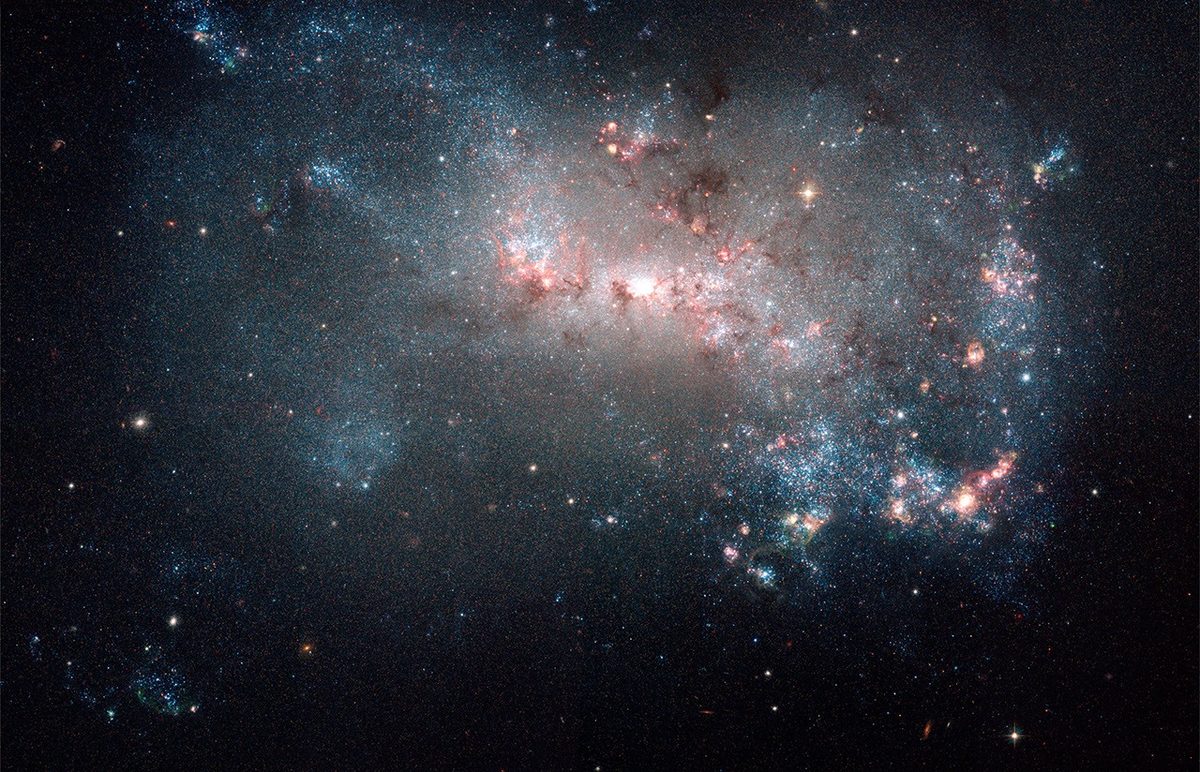
NASA said Monday that Hubble data on 37 nearby dwarf galaxies show the galaxies keep only a small fraction of the oxygen their stars produce, according to a paper in The Astrophysical Journal.
The paper comes from the Galaxies Losing Oxygen via Winds project, called GLOW. NASA's release says the project is funded by NASA and the National Science Foundation. Kristen Wingfield McQuinn is the principal investigator. Grace Telford, an assistant professor in the Department of Physics and Astronomy at the University of Utah, is a co-investigator.
The team looked at 37 dwarf galaxies. NASA describes these as small galaxies that hold a few thousand to hundreds of millions of stars. Simulations predict that much more oxygen should be sitting in galaxies like these. The data say it is not.
Oxygen is made inside stars, so it had to start out inside the galaxies. Telford put the logic this way in NASA's release: "We know that the oxygen had to be inside of the galaxies at some point in the past, so the oxygen must have been ejected."
Pushing it out takes energy. Telford said that energy comes from massive stars and supernova explosions, which drive material out of the host galaxies and into the space between galaxies.
NASA's release says the study found that galactic winds from supernovae are apparently more effective at removing oxygen from low-mass galaxies than current models predict. A galactic wind is a stream of gas blown out of a galaxy, here by exploding stars.
Why oxygen
Of all the elements, why chase this one? McQuinn said the reasons are practical. NASA's release describes oxygen as the most abundant element after hydrogen and helium. It is relatively easy to detect and measure, and how stars make it is well understood.
That makes it a good marker for a wider set of heavy elements. "Being able to trace how much oxygen gets made, and then how much is distributed inside and outside of galaxies, helps us understand galaxy evolution," McQuinn said in the release. She added that it also shows where and how much galaxies enrich the intergalactic medium, which is the space between galaxies.
How they did it
The team used archival optical images from Hubble, meaning pictures already in the telescope's records. These let them pick out stellar populations and work out star-formation histories and compositions. They added data from NASA's retired Spitzer Space Telescope and from two ground-based radio observatories, the Very Large Array and the Australian Telescope Compact Array.
The galaxies were chosen with care, according to NASA. Their masses fall in the range where simulations and theory say a growing share of oxygen gets blown out by supernovae. All 37 are also close enough for Hubble to see individual stars. NASA says that is not true for the vast majority of known dwarf galaxies, which are too far away for this kind of study.
Context
Astronomers already suspected that galaxies throw out a large share of their oxygen and other heavy elements. The open question was where it ends up. NASA's release points to a 2014 study of Milky Way-like, star-forming galaxies. It found those galaxies lost a large fraction of their oxygen, and some of it sits in the thin halo of gas around them called the circumgalactic medium.
GLOW pushes that kind of accounting down to low-mass galaxies across a wide range of masses and environments. One thing remains unsettled. Earlier teams have measured oxygen in the circumgalactic medium of dwarf galaxies, but NASA says it is still unclear whether most of the missing oxygen is there or has left the galaxy's surroundings entirely.
One detail from the release: McQuinn is also mission head of the Science Operations Center for NASA's newly launched Nancy Grace Roman Space Telescope, at the Space Telescope Science Institute in Baltimore. She is an associate professor at Rutgers University as well.
What is next
Both researchers have follow-up work, according to NASA. McQuinn has an approved program to use the Roman telescope to find even fainter, lower-mass galaxies across a wide swath of sky. If she finds them, she hopes to use Hubble and the James Webb Space Telescope for deeper looks at their stars, so she can reconstruct how those galaxies formed stars over cosmic time.
Telford plans to use Hubble to zoom in on individual massive stars, the ones that make oxygen and send it out of their galaxies. She is using some of the nearby GLOW targets for very detailed observations of how those stars differ in small galaxies. NASA's release gives no dates for either program.
Stay curious.
Find more at spacedew.com and @boggleriley on X
Get the Morning Dew
The daily brief, live quotes and the newest File Zero story, every morning. Plus a Friday recap of the week. Nothing else, ever.