Dragon Cargo Ship Lifts Off for Space Station With Last Pair of New Solar Arrays
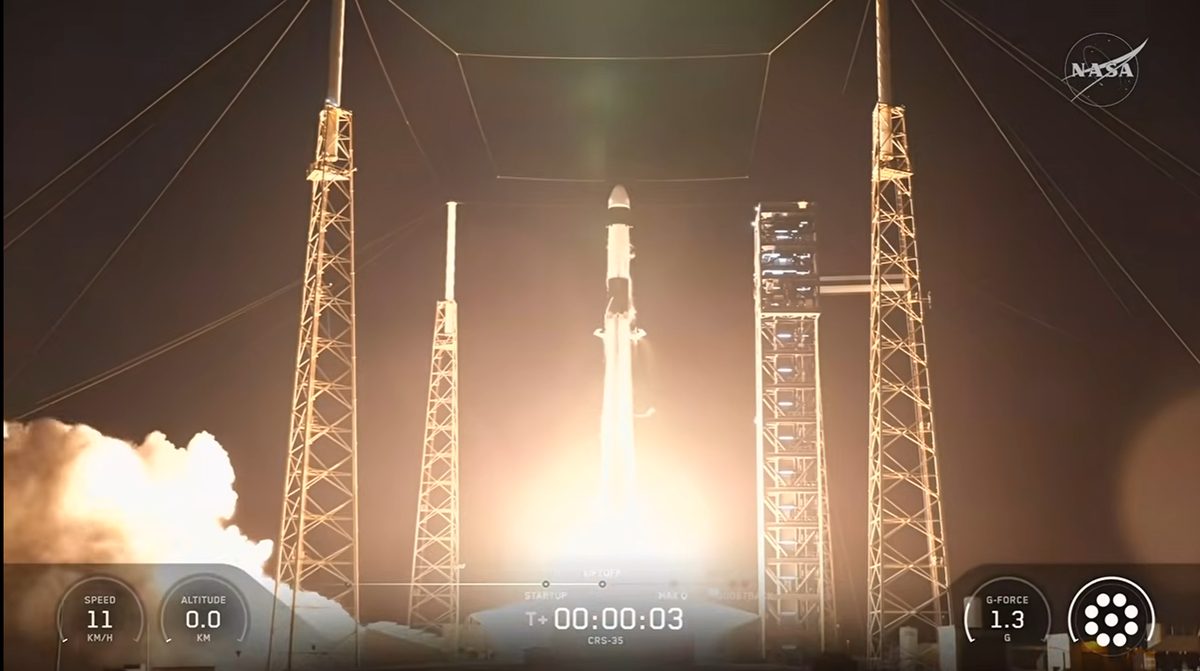
SpaceX's Falcon 9 rocket lifted off at 6:33 a.m. EDT (1033 UTC) Tuesday, Oct. 13, from Space Launch Complex 40 at Cape Canaveral Space Force Station in Florida, NASA said, sending supplies and the last two new solar arrays to the International Space Station.
What NASA says
NASA's release calls this the SpaceX 35th commercial resupply mission. The Dragon spacecraft is carrying more than 6,300 pounds of supplies and hardware, according to NASA. Spaceflight Now, which watched the launch, gives the same liftoff time and says the rocket left the pad under the glow of sunrise.
The headline cargo is the final pair of International Space Station Roll-Out Solar Arrays. NASA says they will complete the station's power system upgrade, which adds electricity for research and operations, and for the station's safe, controlled deorbit (the planned end of the station's life, when it is brought down on purpose). Astronauts will install the arrays during spacewalks that NASA says are planned for later this fall. No dates for those spacewalks are in NASA's release.
Dragon is also carrying new experiments. NASA lists:
- hardware to manufacture artificial retinas in microgravity, which the agency says could help restore vision for patients on Earth
- 3D heart tissue models for large-scale drug testing
- materials to study how a new type of glass forms in microgravity
- brain organoids (small lab-grown clusters of brain cells) that NASA says could point to treatment targets for Alzheimer's, Parkinson's and multiple sclerosis
Spaceflight Now adds that the Dragon carries equipment for more than 40 different scientific studies.
How the launch went
Spaceflight Now reports that the first stage booster, tail number B1096, landed at Landing Zone 40, next to the pad, fewer than 7.5 minutes after liftoff. The outlet says it was the booster's eighth trip to space and back. About two minutes after that, the cargo Dragon, tail number C211, separated from the upper stage to begin a two-day trip to the station.
Here is the detail worth a second look. Spaceflight Now says onboard cameras showed two Roll-Out Solar Array wings tucked inside Dragon's unpressurized trunk, the open cargo section behind the capsule. The outlet says Redwire Space built them, that they are the fourth and final pair bound for the station, and that each can provide more than 20 kW of power for more than 10 years.
The two timing reports differ slightly. NASA and Spaceflight Now both give 6:33 a.m. EDT. Space.com reported 6:35 a.m. EDT. This article uses the NASA time.
Where the arrays came from
Gaurang Patel, NASA's operations integration manager for its Low Earth Orbit Program, spoke on NASA's post-launch broadcast, as quoted by Spaceflight Now. He said the technology was first shown in 2017, when ROSA launched on CRS-11. "Once we were able to prove that technology, we were trying to understand how we could leverage this for the ISS and apply that," he said.
He also said the station's older arrays were not built for standard upgrades. Teams had to design modification kits to mount the new arrays safely, he said, because the interfaces were non-standard.
Spaceflight Now adds that a version of ROSA will help power NASA's Space Reactor 1 Freedom when it launches in 2028. That date comes from the outlet; NASA's release does not mention it.
On the glass experiment, Dr. Liz Warren, NASA's deputy chief scientist in its ISS Office, spoke at a prelaunch press conference. She said most ordinary glass forms from silica, the main component of sand, while unconventional glass is made from heavier elements. Such glasses could have refractive indices higher than diamond, greater resistance to breaking, and even the ability to contract rather than expand when heated, she said. She added that it could potentially be used in lunar rovers and lunar habitats.
What is next
Dragon is scheduled to dock on its own at 11 a.m. EDT Thursday, Oct. 15, at the space-facing port of the station's Harmony module, NASA says. NASA will stream rendezvous and docking coverage starting at 9:15 a.m. EDT at nasa.gov/live. Spaceflight Now says NASA astronaut Anil Menon and Canadian Space Agency astronaut Joshua Kutryk will monitor the arrival.
Docking is scheduled, not done. Until it happens, the arrays are still on their way.
NASA says Dragon is scheduled to stay until mid-November. It will then leave with time-critical research and cargo and splash down off the coast of California. Spaceflight Now puts the stay at about a month.
The rocket did its job, and the booster came home. The next step is Thursday morning.
Stay curious.
Find more at spacedew.com and @boggleriley on X
Get the Morning Dew
The daily brief, live quotes and the newest File Zero story, every morning. Plus a Friday recap of the week. Nothing else, ever.