Curiosity Drills Its 48th Rock Target on Mars, Hunting for Mineral Clues to Ancient Water
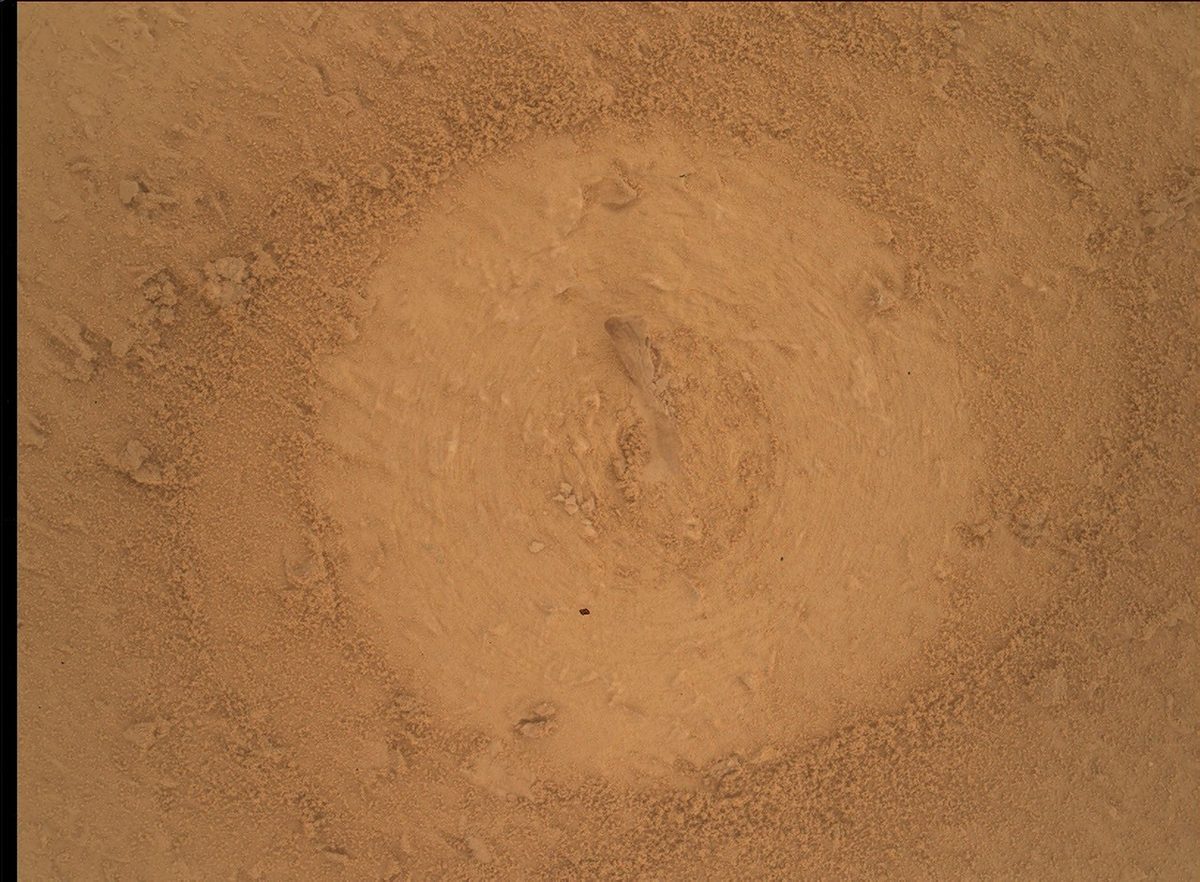
Lucy Thompson, senior research scientist at the University of New Brunswick, led planning for Curiosity's 48th drill operation in Gale crater's Cache Creek quad on September 25, 2026, seeking mineral evidence of Mars' ancient water chemistry, according to a NASA science blog post she wrote that day.
The target rock is called "Basque Lakes," and the drill went in successfully, Thompson wrote on the NASA Science website. The sample is now being analyzed by CheMin, the rover's X-ray diffraction instrument, which identifies minerals by the way they scatter X-rays. Results from that analysis were expected over the weekend following the September 25 planning date, Thompson said.
Before drilling, the team ran a careful pre-drill sequence. Thompson, serving as APXS uplink lead and strategic planner for the week, wrote that the rover placed its APXS instrument, which measures elemental chemistry through alpha particle and X-ray bombardment, directly on the Basque Lakes target. The MAHLI camera, a hand-lens imager, was positioned to within 1 centimeter of the rock surface to examine its texture in fine detail, according to Thompson's account. ChemCam then fired its laser at the same target to further characterize its composition. Engineers also ran a pre-load test to confirm the rock was stable enough to drill. All of those results fed the go or no-go decision on drilling, Thompson wrote.
Even with the power demands that drilling places on an aging rover, the team squeezed in additional science. Mastcam photographed the surrounding terrain to give context to the new drill site. ChemCam analyzed a nearby bedrock target called "Peace River" and turned its imaging and passive spectroscopy on the fresh drill hole and the material scattered around it. The team also pointed ChemCam's remote imager at a deposit of jumbled blocks at the base of a nearby butte called "Cordillera," which Thompson described as interesting-looking. Navcam and Mastcam continued their routine monitoring of atmospheric and environmental conditions inside Gale crater.
The Cache Creek quad takes its name from a region of British Columbia, Canada. Thompson wrote that the Canadian area contains oceanic crust, marine sediments, volcanic rocks, and glacial deposits, and is home to lakes with unusual chemistry that researchers think may be analogous to lakes that once existed on Mars. The quad name also carries a historical note: the area sits at the southern end of the 1860s Gold Rush Trail, where prospectors pushed into that part of British Columbia looking for riches. Thompson drew the parallel lightly, writing that while the team may not literally strike gold, they are eagerly waiting to see what minerals the sample holds.
Curiosity has now traveled 38 kilometers, or about 24.6 miles, and climbed more than 1 kilometer, roughly 0.6 miles, in elevation since landing, Thompson wrote. The rover entered the Cache Creek quad recently, having long since climbed above the named quads that were mapped out before the mission landed. The quad naming system, Thompson explained, assigns names from small towns associated with significant geological features, and targets within each quad get unofficial names tied to the same theme.
The Basque Lakes drill sample is not finished giving up its data. Thompson wrote that material will be delivered next to SAM, the Sample Analysis at Mars instrument, which heats samples and analyzes the gases they release to reveal more about a rock's chemical history. That analysis is planned for the week following the September 25 planning date, according to Thompson's post.
After SAM finishes its work, Curiosity will likely remain at the Basque Lakes site for roughly another week before the team dumps the sample and drives on, Thompson wrote. The destination after that is the continued exploration of Mount Sharp and Gale crater. What the mineral results will show is not yet known.
Stay curious. Find more at spacedew.com and @boggleriley on X
Get the Morning Dew
The daily brief, live quotes and the newest File Zero story, every morning. Plus a Friday recap of the week. Nothing else, ever.